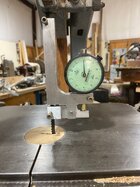
• December 2025 Turning Challenge: Single Tree! (click here for details)
  • Congratulations to Bob Henrickson, People's Choice in the November 2025 Turning Challenge (click here for details)
  • Congratulations to Steven Gordon for "Dropped Ice Cream Cone" being selected as Turning of the Week for December 8, 2025 (click here for details)
  • Welcome new registering member. Your username must be your real First and Last name (for example: John Doe). "Screen names" and "handles" are not allowed and your registration will be deleted if you don't use your real name. Also, do not use all caps nor all lower case.

Bandsaw Blade Tension

Joined
Apr 30, 2008
Messages
368
Likes
102
Location
Southern Utah
Just curious, how do you like to gauge the tension on your bandsaw blades? Do you go by feel, use the indicators on the machine, or a special tension gauge. Also who releases the tension when finished, or are you like me and leave the blade always in tension?
 
Mark Duginski's book, Bandsaw Handbook.

Louis Iturra, Iturra Design, based in Florida.

Louis is old-fashioned in that he has no internet presence at all. But his bandsaw knowledge is second to none. Call him and pay the $8 bucks or so for his annual "catalog". Quotation marks because that catalog is half bandsaw products, half advanced education, and worth every penny. His specialty has always been geared toward the USA-Delta 14" bandsaws, and Jet clones. Some of his products are on my two Delta saws, including blade tensioning bits. And with Iturra's knowledge and his aftermarket tensioning springs, I'm a lot more confident that I'm getting blade tension where it should be.

I take the tension off my blades when not in use. (And I clean the dust and sap goo off the tires each time, too.) Tension up or down does not take even 10 seconds of time, no big whoop. Even less with a quick release system on some saws. Believe it or not, both of my saws (1980s-90s vintages) still wear the original tires, which are in fine shape, and I want to think that keeping the tension off has helped them survive.
 
I got my first bandsaw 30+ years ago. A friend said to go to a local blade shop. They fixed me up with what I needed for what I was doing, and have had no problems. I asked about tension, and they told me the scales on the bandsaws were junk. Adjust it as tight as you can. Mine has a 1/2 inch blade and I set the tension to the 1 inch blade scale. I have a Laguna 16 HD, and I run a 1 1/4 inch blade with the tension set to a 1 1/2 inch blade. No problems with either, at least not yet. Neither saw has a tension release, so I leave them under full tension. No lumps in the wheels at all.

robo hippy
 
Sorry Steve, I meant a link to the recent forum discussion on a similar topic.
 
Just curious, how do you like to gauge the tension on your bandsaw blades? Do you go by feel, use the indicators on the machine, or a special tension gauge. Also who releases the tension when finished, or are you like me and leave the blade always in tension?

Oops, wrote this much earlier today and forgot to click "Post Reply"...

I wrote about tension recently.

I use a commercial bandsaw blade tension gauge. It guarantees the proper tension. A bit pricey these days. These are extremely easy to use, no math needed.
As I mention in the message above, it's easy to make your own tension gauge but does need a bit of easy Young's Modulus math to get the numbers.
The commercial gauge dials are calibrated to eliminate the need for the calculation.

At one time I had 5 bandsaws so having the gauge was handy, especially when changing to a different type/size/thickness of blade.
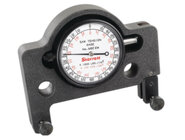
tension_gauge_Starrett.jpg

I usually use it once for a particular size/type of blade and make a mark on the highly inaccurate indicator marks on most bandsaws. Also, the stock tension springs are often too weak.
Some other methods are iffy, things like the flutter or finger deflection rely on experience and are best done AFTER setting the tension properly with a gauge.

Some points:
  • The tension too high can break blades and damage the bandsaw in several ways.
  • Tension too low can result in poor and unsafe cuts. I've seen a low-tension blade actually bow and come out of the side of a tall cut during trimming a thick blank. Imagine what that could do to the hand if supporting the wood in that spot! As shown in my bandsaw video, I cut a LOT of thick wood on my bandsaws.
  • If the saw has never been properly tensioned, doing so may reveal some adjustments needed, in particular if the wheels need to me made coplanar.
Having the tension right is so important I think turning clubs should buy a tension gauge and loan it to users. They are incredibly simple technology. I've taken my gauge to friend's shops and checked/adjusted their tension.

I leave the blade tensioned unless I plan on using the bandsaw in the next few days. I know some who NEVER detension. That can be harder on the saw and the tires but maybe not too hard.

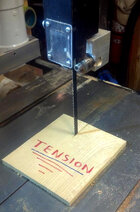
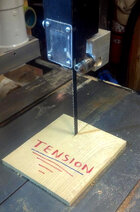
When I release the tension, I put this on the bandsaw table so I can't forget to retension before use. I stole this idea from someone years sgo.
tension.jpg

I think the bandsaw is the 3rd most useful thing in the turning shop after the lathe and and sharpening station.

JKJ

 
I'd put the bandsaw in the top one or two most useful electric machines in a woodshop in general. I don't miss my old table saw at all, esp. in my small shop.
 
I use an unscientific method but it works for me. I run the blade guide all the way up. I loosenbthe blade untilnit wobbles. Then I tighten the blade until it runs perfectly true. Many years ago I built one of the homemade tension jigs. I got pretty close to those readings using my no vibration test so that's what I use now.
 
I use an unscientific method but it works for me. I run the blade guide all the way up. I loosenbthe blade untilnit wobbles. Then I tighten the blade until it runs perfectly true. Many years ago I built one of the homemade tension jigs. I got pretty close to those readings using my no vibration test so that's what I use now.

I read of a method that essentially amounts to the same thing you are doing. Leave 6" of blade exposed in the throat. Loosen the blade until it flutters. Tighten it until the flutter stops.
 
I just received some new Timberwolf blades. They recommend the flutter technique. I bandsaw a little almost every day. Cutting bowl blanks, or pen blanks, maybe greenwood. I would be interested to know how many detension their saw at the end of the day. I have a Laguna 14/12. Also from experts how important is it.
 
I just received some new Timberwolf blades. They recommend the flutter technique. I bandsaw a little almost every day. Cutting bowl blanks, or pen blanks, maybe greenwood. I would be interested to know how many detension their saw at the end of the day. I have a Laguna 14/12. Also from experts how important is it.
I have an 18” Laguna BS. It has a quick detensioning lever that makes it very easy. I detension if I won’t be using the BS any more that day, it’s an easy 2second procedure. I’ve also gotten in the habit of always looking for this detensioning lever to be down (tensioned) before starting the saw.
 
Been using bandsaws both professionally and personally for 40+ years, never has the blade been de-tensioned. To tension it, I go by feel. Tighten the blade and with a sideways press, there is a certain amount of deflection that should be there. I recognize this does not help someone who is relatively new to a saw. I will say, that the Snodgrass video is a shortcut to getting good results with a saw, with a minimum of effort.

My main saw is a 1940's 16" walker turner, but I also have a 1960's Delta. Don't bother with a delta or clone with riser blocks. Get a saw designed for a 12" cut, you'll come out ahead in the long term, the Delta is a great 6" saw, and I'm not sure I'd ever want to be without one one, but it is not a 12" saw. BTDT.
 
I’ve also gotten in the habit of always looking for this detensioning lever to be down (tensioned) before starting the saw.
I stole this idea years ago from someone years ago, made one and place it on the bandsaw table if I detension the blade. No way to forget! This plywood reminder hangs on the wall next to the bandsaw. I use my bandsaw often so I rarely detension.
(I posted this pic before but it's so useful I think it's worth repeating.)
1765581887652.jpeg

Don't bother with a delta or clone with riser blocks. Get a saw designed for a 12" cut,

I agree, after using a Delta with a riser for years I finally bought an 18" Rikon with 12-1/4" cutting height. The Rikon is a better saw but the Delta did the job. If I had no extra cash in my pocket I might consider a used Delta if it was in good condition. I cut a LOT of green wood into turning blanks to dry with the delta. I did take the time to align the wheels and make them co-planar, add a stronger tension spring, and changed the guides. The Deltas also had a weak tension bracket which I replaced with a stronger one.

The Delta was a little under-powered but the cut was excellent. One day a friend brought over a 12 ft long 8/4 x 12" Doug Fir board and wanted it resawn into four thin pieces. Yikes. I made a tall fence, put on a new blade, and fed the board while he supported the cut end. To this day I have no idea how we ever pulled that off - the cut was so good the four 12'x12"x1/2" boards needed only a very light pass through the planer.

I learned from Mark Duginski's bandsaw book as well as the one Lonnie Bird wrote.

The only thing I have to say about the flutter and finger deflection tensioning methods is borrow a tension gauge and use it to calibrate your finger and flutter sense. A couple of decades ago I bought a Starrett tension gauge, fortunately when the price was 1/3 what it is now. Our turning club recently got a Lenox gauge to loan to members.

JKJ
 
Last edited:
Back
Top