• The forum upgrades have been completed. These were moderate security fixes from our software vendor and it looks like everything is working well. If you see any problems please post in the Forum Technical Support forum or email us at forum_moderator (at) aawforum.org. Thank you
  • Congratulations to Bernie Hyrtzak, People's Choice in the January 2026 Turning Challenge (click here for details)
  • Congratulations to Matt Carvalho for "Red Mallee Folded Form" being selected as Turning of the Week for February 9, 2026 (click here for details)
  • AAW Symposium demonstrators announced - If the 2026 AAW International Woodturning Symposium is not on your calendar, now is the time to register. And there are discounts available if you sign up early, by Feb. 28. Early Bird pricing gives you the best rate for our 40th Anniversary Symposium in Raleigh, North Carolina, June 4–7, 2026. (There are discounts for AAW chapter members too) For more information vist the discussion thread here or the AAW registration page
  • Welcome new registering member. Your username must be your real First and Last name (for example: John Doe). "Screen names" and "handles" are not allowed and your registration will be deleted if you don't use your real name. Also, do not use all caps nor all lower case.

Barley twist

Joined
Oct 21, 2011
Messages
132
Likes
200
Location
Leicester, UK
Hi all

Thought you guys might like to see this picture of a job I've just finished. This is a replacement stretcher (although I'm not sure what for exactly - it's too long for a chair!) and is the most technically challenging twist I have ever done. Made in Beech and hand cut with Microplanes and a little help from my little Proxxon angle grinder with a wood cutting disc. Shown with the original twist and some tools to make it look a bit arty ;-)
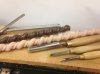
twist.jpg

Comments welcome

Richard
 
I've never made a twist, but I'd be interested in exactly why it was so challenging. What is it about the large and small bines that makes it specially tricky? Or is it the twin start thread? (Any twist at all looks hard to me!)
 
One challenge is maintaining uniform shape the whole distance. Since it is carved that adds the need to pay close attention to details. If a little bit too much wood is removed after doing most of the carving that can mean either going back to remove more material on the part that was already carved or in some situations it might mean starting over.
 
Thanks for all of your comments guys.

Terry, this twist is more difficult because on a standard twist you are only working with 2 diameters: The top of the twist (bine) and the bottom of the valley, like on this more standard single twist:

DSCF0340.JPG

On this twist there is a second smaller twist running in the valley, which means extra care has to be taken when forming the main twist, so the smaller twist isn't damaged or cut away when it shouldn't be; then when cutting the smaller twist, care has to be taken not to deform the larger twist. All good fun though!

The customer has since told me this is a stretcher for a foot stool, which is being sent away for upholstry, he's going to try and get me some pictures of the finished thing.

Richard
 
Richard I saw this thread a while back but sometimes it's hard to reply from my phone. You do outstanding work. I've never tried a twist with that secondary mini bead in the bottom. That took some concentration and careful work to produce. Great job. Love your article by the way. Having sold work but never had to make a living at it's fun to get your point of view and to see how you work.
 
Thanks all for your comments and kind words. John, I'm pleased you enjoy my articles, thank you.

I always check in to the forum but don't post much, although always happy to comment if I can help. I thought this job was suitably different and interesting to warrent a post here though!

Cheers

Richard
 
Back
Top