• Congratulations to Bernie Hyrtzak, People's Choice in the January 2026 Turning Challenge (click here for details)
  • Congratulations to David Croxton for "Geri's Basket Illusion" being selected as Turning of the Week for February 2, 2026 (click here for details)
  • AAW Symposium demonstrators announced - If the 2026 AAW International Woodturning Symposium is not on your calendar, now is the time to register. And there are discounts available if you sign up early, by Feb. 28. Early Bird pricing gives you the best rate for our 40th Anniversary Symposium in Raleigh, North Carolina, June 4–7, 2026. (There are discounts for AAW chapter members too) For more information vist the discussion thread here or the AAW registration page
  • Welcome new registering member. Your username must be your real First and Last name (for example: John Doe). "Screen names" and "handles" are not allowed and your registration will be deleted if you don't use your real name. Also, do not use all caps nor all lower case.

Deep Epoxy and wood pours

Jim McLain

Artist
Joined
Apr 7, 2011
Messages
294
Likes
2,200
Location
Socorro, New Mexico
Website
www.lucadecor.com
I am considering doing some 6 inch wide by 10-12 inch epoxy pours. My question is other than pvc pipe what types of form material are you using? Thought about concrete sonotube but don’t think it would hold up. Any insight would be greatly appreciated.
 
I am considering doing some 6 inch wide by 10-12 inch epoxy pours. My question is other than pvc pipe what types of form material are you using? Thought about concrete sonotube but don’t think it would hold up. Any insight would be greatly appreciated.
Whatever you use, wax it or use some other release agent. I think sonotube would be fine but do a small test to be sure

What resin are you planning to use?
 
I am considering doing some 6 inch wide by 10-12 inch epoxy pours. My question is other than pvc pipe what types of form material are you using? Thought about concrete sonotube but don’t think it would hold up. Any insight would be greatly appreciated.
I've been using plastic paint containers - 1qt. Although this is smaller than what you want...the epoxy doesn't stick, they might have larger ones.
Maybe use tyvek tape on the inside of the sonotube....the epoxy doesn't stick to it....
 
Whatever you use, wax it or use some other release agent. I think sonotube would be fine but do a small test to be sure

What resin are you planning to use?

I use both epoxy and urethane. With urethane the sonotube should be fine because of how fast it sets up. I used a 48 hour set epoxy, so I’m concerned the sonotube might start to get wet before it sets.
 
I've been using plastic paint containers - 1qt. Although this is smaller than what you want...the epoxy doesn't stick, they might have larger ones.
Maybe use tyvek tape on the inside of the sonotube....the epoxy doesn't stick to it....

Thanks. I did see someone that used two paint buckets glued together to make a taller forms. The plastic sheet recommended in the other thread seems like a good option.
 
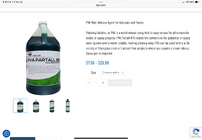
Poly vinyl alcohol (PVA) is used to coat forms that fiberglass is molded on. The epoxy won’t stick to it. If you had a container the right size but something resin would stick to, it might be useful.
 
Poly vinyl alcohol (PVA)
Umm do you mean perhaps Polyvinyl Acetate ? I'd think alcohol would be a bit too volatile? If it is what you mean by PVA, in other words - your basic elmer's white glue (the kind we used to smear on our hands in school and let it dry and peel off the "skin") or wood glue.. never heard of Poly Vinyl Alcohol.... but then I'm no chemist...
 
Not a glue. If you’ve ever done work with fiberglass forms, it’s very useful. I’ve carved foam into an air duct for an airplane, covered it with aluminum tape, and then cover it with PVA. CURED RESIN WILL NOT STICK TO IT. Which means if you have a mold that you want to use, a coating will provide a film that will be the mold release. It’s water soluble which makes for easy clean up. Think of it as liquid Syran Wrap, which by the way resin won’t stick to. It can be brushed on or sprayed. Usually a couple of coats is best.

Acetate tape (aka packing tape) is also something that resin won’t stick to. As added insurance of a release, a quick wipe of wax on top of the tape guarantees a release.

 

Attachments

  • IMG_2723.png
    IMG_2723.png
    604.7 KB · Views: 27
Not a glue. If you’ve ever done work with fiberglass forms, it’s very useful. I’ve carved foam into an air duct for an airplane, covered it with aluminum tape, and then cover it with PVA. CURED RESIN WILL NOT STICK TO IT. Which means if you have a mold that you want to use, a coating will provide a film that will be the mold release. It’s water soluble which makes for easy clean up. Think of it as liquid Syran Wrap, which by the way resin won’t stick to. It can be brushed on or sprayed. Usually a couple of coats is best.

Acetate tape (aka packing tape) is also something that resin won’t stick to. As added insurance of a release, a quick wipe of wax on top of the tape guarantees a release.

I wonder if that is green soap.
 
Not a glue. If you’ve ever done work with fiberglass forms, it’s very useful. I’ve carved foam into an air duct for an airplane, covered it with aluminum tape, and then cover it with PVA. CURED RESIN WILL NOT STICK TO IT. Which means if you have a mold that you want to use, a coating will provide a film that will be the mold release. It’s water soluble which makes for easy clean up. Think of it as liquid Syran Wrap, which by the way resin won’t stick to. It can be brushed on or sprayed. Usually a couple of coats is best.

Acetate tape (aka packing tape) is also something that resin won’t stick to. As added insurance of a release, a quick wipe of wax on top of the tape guarantees a release.

I built molds and tooling for custom yachts for 19 years so I know exactly what you're talking about with pva.😉
 
If I was going to use a sonotube I'd coat the inside with melted wax. That would keep the resin from soaking in or thru. I have used gallons of PVA in my previous life but it only works on a hard surface not a porous one. If you sealed the inside of the sonotube with multiple coats of lacquer or perhaps shellac then the PVA would be helpful. I'd still just melt some paraffin and seal it with that.
The biggest problem with epoxy pours is having a container as small as possible for the job at hand. Otherwise you are just filling the void with expensive resin only to turn it away. Keep in mind that if you are doing a deep pour it would be best to put it in a pressure pot with no more than 65lbs pressure.
 
Back
Top