• The forum upgrades have been completed. These were moderate security fixes from our software vendor and it looks like everything is working well. If you see any problems please post in the Forum Technical Support forum or email us at forum_moderator (at) aawforum.org. Thank you
  • Congratulations to Bernie Hyrtzak, People's Choice in the January 2026 Turning Challenge (click here for details)
  • Congratulations to David Croxton for "Geri's Basket Illusion" being selected as Turning of the Week for February 2, 2026 (click here for details)
  • AAW Symposium demonstrators announced - If the 2026 AAW International Woodturning Symposium is not on your calendar, now is the time to register. And there are discounts available if you sign up early, by Feb. 28. Early Bird pricing gives you the best rate for our 40th Anniversary Symposium in Raleigh, North Carolina, June 4–7, 2026. (There are discounts for AAW chapter members too) For more information vist the discussion thread here or the AAW registration page
  • Welcome new registering member. Your username must be your real First and Last name (for example: John Doe). "Screen names" and "handles" are not allowed and your registration will be deleted if you don't use your real name. Also, do not use all caps nor all lower case.

Don Pencil Jam Chuck

I have one and have used it a couple of times.
I have turned a couple of cones with different tapers.
A bit more DIY than a kirsten kone, but the same result in the end.

mark
 
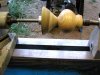
It's a handy tool to have around for those hard to hold forms. The holding friction is between the tailstock and end of the jam. The cone is used to center the piece with only minimal pressure, (DAMHIKT).
 

Attachments

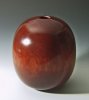
  • Sweet-Gum-HF-web.jpg
    Sweet-Gum-HF-web.jpg
    143.8 KB · Views: 44
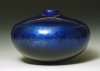
  • Pot-1-web.jpg
    Pot-1-web.jpg
    150.6 KB · Views: 38
  • Cosmos.jpg
    Cosmos.jpg
    266.5 KB · Views: 38
Just took a look at this jam chuck on the DP site......and, it's a little confusing as to how it works.

Anyone care to explain it for us dummies?

thanks

ooc
 

Attachments

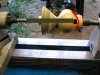
  • SMALL_HOLLOW_FORM.jpg
    SMALL_HOLLOW_FORM.jpg
    22.8 KB · Views: 115
Odie,

Assuming this is like other reverse chucks I have seen,

It looks like a hollow from turned with a faceplate and a wooden cone of similar color.
Gives the illusion of a wide lipped vase shaped opening on the top of the hollow form hollow form.

The rod sticking out of the head stock has a morse taper on one end and a soft pad or cup on the other end.
The hollow form is put over the rod with the soft pad resting on the center of the bottom
The tailstock is brought up and when tightened it centers. The Pressure from the tailstock goes through solid wood to the pad on the end of the rod.
Pressure can't break the hollow form.

On the left is a wooden cone with a hole in the center the diameter of the shaft. The cone is slid into the opening of the hollow form and a locking collar on rod holds it in place. The cone is just to keep the hollow form from vibrating there is no pressure on the opening.

On the right is the faceplate tenon that needs to be tune way to finish the bottom.

Hope that is somewhat clear.

Al
 
Last edited:
odie

here is a crude picture

the red is meant to be the wall thickness.
black is the pad and gray the shaft of the rod indside the form

my little pictures don't line up quite right.
 

Attachments

  • diag.jpg
    diag.jpg
    34 KB · Views: 113
Odie,

Assuming this is like other reverse chucks I have seen,

It looks like a hollow from turned with a faceplate and a wooden cone of similar color.
Gives the illusion of a wide lipped vase shaped opening on the top of the hollow form hollow form.

The rod sticking out of the head stock has a morse taper on one end and a soft pad or cup on the other end.
The hollow form is put over the rod with the soft pad resting on the center of the bottom
The tailstock is brought up and when tightened it centers. The Pressure from the tailstock goes through solid wood to the pad on the end of the rod.
Pressure can't break the hollow form.

On the left is a wooden cone with a hole in the center the diameter of the shaft. The cone is slid into the opening of the hollow form and a locking collar on rod holds it in place. The cone is just to keep the hollow form from vibrating there is no pressure on the opening.

On the right is the faceplate tenon that needs to be tune way to finish the bottom.

Hope that is somewhat clear.

Al

OK, thanks Al..........I think that clears it up for me. Makes sense to me now. What confused me is I had been thinking the "cone" used to stabilize the lip of the hollow form opening was part of the turning.....threw me off there! :o

Also appreciate your effort to make up a visual reference.......:cool2:

ooc
 
Back
Top