• December 2025 Turning Challenge: Single Tree! (click here for details)
  • Congratulations to Bob Henrickson, People's Choice in the November 2025 Turning Challenge (click here for details)
  • Congratulations to Dave Roberts for "Low Rider" being selected as Turning of the Week for December 1, 2025 (click here for details)
  • Welcome new registering member. Your username must be your real First and Last name (for example: John Doe). "Screen names" and "handles" are not allowed and your registration will be deleted if you don't use your real name. Also, do not use all caps nor all lower case.

Former Users of Odie's Oil

Joined
May 25, 2021
Messages
103
Likes
295
Location
Glendale, AZ
Any former users want to share what you switched to?
I like Odie's. The smell, ease of use and of course the finished finish. It is just getting a bit expensive, and I wonder if there is anything else close to it.
*I do not want more work to do with a finish :)
 
I've never used Odie's Oil, but it sounds good:

About this item​

  • We all want our finished woodworking projects to look their absolute best when finished. The hard part shouldn’t be the application process, nor should it be the choosing what to apply to your project. Introducing Odies Oil, the food safe, solvent free, non-toxic wood finish and wood stabilizer. Odies Oil is easy to us and it waterproofs and leaves a wonderful lustrous sheen in one coat. It is also the perfect finish for leather, concrete, plastic, vinyl and metal.
  • Odie's Oil is great for all species of wood, exotic and domestic. Formulated to work on even the oiliest of woods. Your surface with Odies Oil applied will actually get better with age, becoming more durable and more beautiful as time goes on. It contains natural UV inhibitors-sunscreen for your wood!
  • Odie's Oil is a proprietary blend of oils and waxes, born out of inspiration, hard work and a driving need to solve problems specific to the woodworker. The culmination of 30+ years of research, development and field testings in the most extreme environments produced a revolutionary product that out-performs and out-covers the competition.
  • If you’re a wood turner and want to bring out the best in your projects, give Odie's Oil a try. You can use it as a friction polish! Works on most any turning project you can imagine from pens, bottle stoppers, vessels, bowls and a whole bunch more! Odie's Oil does not contain driers or toxic chemicals and is food safe. It’s safe for everybody: families, kids, and pets! Super easy to use it requires no sanding or stripping in between coats or for retouching! Wipe on, Wait a while, Buff off!
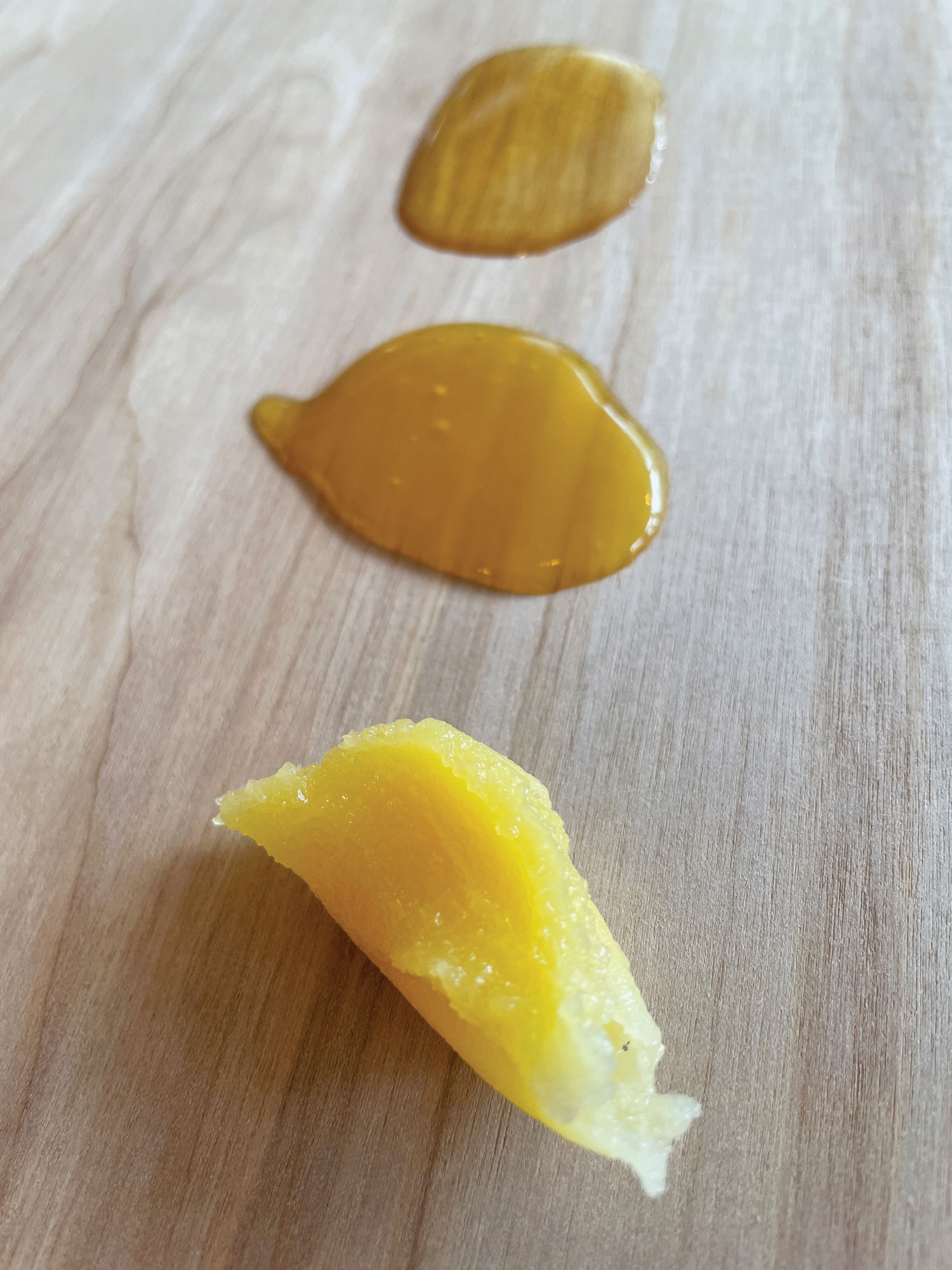
  • A little Odie’s goes a long way! No solvents" means there is almost nothing to evaporate, so what you put on the wood, stays in the wood. Odie's Oil covers many, many times the area of other wood finishes. Up to 20 times the coverage as conventional finishes. Coverage will vary depending on wood density and porosity. Coverage is approx. 189 sq. Feet per 9 oz jar (based on American Cherry). This finish has a unique honey-like consistency and a pleasant aroma. It really goes a long, long way.
 
I’ve seen it on sale here in the UK but it’s very expensive so I’ve never tried it. A cheaper alternative might be interesting as long as it’s available over here.
Maybe there are some home brew recipes on YouTube? I know for sure that home brew abrasive waxes on YouTube are just as good as the commercial ones because I’ve made them myself.
 
I’ve used Odie’s on a variety of things, including turnings and flat work. It’s not cheap, but a little really does go a long way. The one thing I’ve noticed, as is true of many hard oil finishes, is that it tends to introduce a touch of yellow to the wood. I’ve done quite a bit of segmented turning with aspen, and it does cause it to yellow a bit though it certainly provides a depth to the wood.

If maintaining the original color is the goal, then I’ve been using a water based wipe on poly as it’s been the best solution I’ve found to date.
 
If I'm understanding correctly, Odie's Oil is applied like a friction polish and combines the oil with the waxing/polishing stage.

Doing these two steps individually, as I do with the Danish Oil application, and then followed by the Beall buffing stage works extremely well for me. I don't see how Odie's Oil can be better......easier certainly, but how can it possibly be better?

Among woodturners, there seems to be a big gap between what is easier, as opposed to what will have the better outcome.

=o=
 
I think you have it exactly right, Odie - it’s faster but not necessarily better. Also, I think the depth a DO adds to at least certain woods is superior to that from Odies. For example, I do some koa segmented turnings and I find the DO is better at developing the depth and luster on koa than the Odies. When I use DO, I also use the Beal buffing (though generally not all 3 steps) and on koa it is my preferred approach.
 
There are plenty of recipes online for making your own hard wax (and soft wax) finishes if you want to try it. It's nothing too special, unlike what the pricetags want you to think. Tried & True Original (linseed oil and beeswax) would be considered a soft wax finish. I use it. Christopher Schwarz/Lost Art Press freely publishes the recipe and process of making their soft wax finish. Hard wax finishes contain carnuba wax, the hardest natural wax with a 180 degree melting temp. Soft wax finishes are typically beeswax, or maybe paraffin.
----------------
1- Oils penetrate and cure within the grain, and enhance the appearance of the wood colors. After several coats they can't penetrate any more and cure on the surface.

2- Resins stay on the surface and create a plastic film, a protective wear layer on the wood surface. (Oil or water formulas are the carriers for the resin.)

3- Waxes stay on the surface, but only in the micro scratches which will otherwise scatter reflected light. It makes the surface look, and probably feel smoother. It is not a long-lasting finish, it wears away and needs periodic re-application. It can be used on any kind of film finish.

This 3-step process is arguably the best way to finish wood. Or, pick 2 steps. Or a single step. No right, no wrong.

But I'll contend that even though mixing the components together into one product may work just fine, the all-in-one blend of oil, resin (or not), and wax may compromise the strengths of using the 3 components as separate steps of a process. Again, there is no right way, no wrong way, just different ways that have strengths and compromises. Pick your poison. Something that is new, something that is different, is not necessarily something superior to that which is time tested.
 
Soft wax, buy the finished product from them...
https://lostartpress.com/products/soft-wax-soft-wax-kits (includes a short video of the product and use).

Or make it from their recipe-

Or, raise the temperature (carefully, a double boiler is your friend) to 185 degrees and melt carnuba rather than (or in some proportion along with) beeswax and make your own hard wax oil. A mayo consistency, more or less, should be the mix to go for.
 
Doing these two steps individually, as I do with the Danish Oil application, and then followed by the Beall buffing stage works extremely well for me. I don't see how Odie's Oil can be better......easier certainly, but how can it possibly be better?
Thin finishes with a resin, like poly or danish oil, have an advantage over the hardwax oils, particularly for spalted or other “weaker” woods. They penetrate deeper into the fibers and any cracks etc (if flooded on and kept wet for ~30 min) and cure with added structural integrity of the wood.

For good solid wood it isn’t a concern, but I turn a lot of spalted and other somewhat questionable wood (tends to have more character).

I turn a lot of natural edge items, and getting these thick hardwax oils onto negative surfaces woulld be time consuming and I’m not sure how they would look.
 
2- Resins stay on the surface and create a plastic film, a protective wear layer on the wood surface. (Oil or water formulas are the carriers for the resin.)
Resins do not just stay on the surface. Thinned poly or spar or epoxy penetrate just like oils. It is a function of viscosity and open time of the finish. Danish oil has a resin component. The resins can be almost completely wiped off the surface. Most all my projects are finished this way.
 
I'm confused over the repeated claim that a little goes a long way. I recently completed a fairly small table (20" x 40") and used Odie's just to see. Smelled great and relatively easy application but I ended up using half a jar on just top and bottom. I'd put a small 'glop' of the material on the wood and it would barely spread to the size of a playing card. Is this material supposed to have an undercoat of something or what else am I missing. The piece came out fantastic so I have no complaints there but 'a little dab' will definitely not do ya or at least in my use. Thoughts?
 
I'm confused over the repeated claim that a little goes a long way.

I have tended to use it on dense hardwoods for the most part (though Aspen is anything but dense and took more). For example, I used some on cocobolo and koa, and it took very little with each. If the wood has more open pores, like oak, it will suck it up and you have to use more. Ultimately, I like it for ease of use but it can get expensive if you’re using it on more open woods.
 
Given the ingredients I’ve often wondered why it’s so expensive?

View attachment 80246

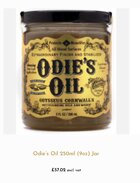
That’s just over £228 a Litre or $307!
$56 for that 1 cup 1 oz jar. To rich for my blood. $150-190/qt, depending on the version. https://odiesoil.com/finishes/
It must be the essential oils making it smell pretty that drives the cost because tung oil and carnuba wax won't get it there. Make your own, see my post above.
 
Jim, I am a former Odie's oil user, in the sense that I added Odie's Oil to my arsenal and then stopped using it because it wasn't any better than other finishing approaches I use at a lower cost (though I don't find the cost of finishes to be a determining factor).

So, for a less costly but similar finish (one-step, hard wax oil finish) I would go with Osmo Polyx (which, BTW, prevailed in the recent Fine Woodworking hard wax oil review, though it was considered to be less protective than Odie's).

If the solvent-free feature of Odie's is important, I would suggest Tried and True Original, which, like Osmo, is about 1/2 the cost of Odies. It is, however, a bit of an effort to apply and buff and so takes longer to get to a final finish. It is a soft-ish finish, but with a nice gentle glow.

But, as others have said, if you don't mind the two-step of "finish-then-wax", you could get similar or better results without much extra effort (and at a much lower cost than Odie's or any of the hard wax oils) with an oil or Danish Oil followed by wax/buff, adjusting the buffing to get the level of sheen you want. I use polymerized tung oil and microcrystalline wax (e.g. Renaissance) for this approach. Doctor's has a few walnut oil / microcrystalline wax products in this category.

 
There’s a really good (IMHO) video on hard wax finishes. Odie’s is one of the brands compared. The video also gives 2 recipes for the home brew enthusiast. One food safe finish and one more durable finish.

View: https://www.youtube.com/watch?v=9xSJpkU-hsg
Great video, thanks for posting. I may have to find a hot plate at a thrift store. And a candy thermometer from the grocery store.
 
I like friction polish finished with wax. Since I don’t have any hard wax finish, Im wondering how it would do if applied like friction polish?
 
I like friction polish finished with wax. Since I don’t have any hard wax finish, Im wondering how it would do if applied like friction polish?
Hi Webb, with anything oil-base, wiped on and off at the lathe, effective product application and penetration comes with letting the product sit wet on the surface as it penetrates into the wood, then wiping the surface "dry" at the time the manufacturer recommends. Unless applying many coats to obtain a built-up surface, these oil finishes (incl. hard wax) will not produce a friction polished surface like you'd get with products such as shellac or lacquer that stay on the surface of the wood and don't really absorb into the fibers more than the very top surface of fibers where its more mechanical attachment vs. absorbing into the wood fibers. So, I think they are two different things working in two different ways. I think the video you linked above does a good job of demonstrating that.
 
Jim, I am a former Odie's oil user, in the sense that I added Odie's Oil to my arsenal and then stopped using it because it wasn't any better than other finishing approaches I use at a lower cost (though I don't find the cost of finishes to be a determining factor).

So, for a less costly but similar finish (one-step, hard wax oil finish) I would go with Osmo Polyx (which, BTW, prevailed in the recent Fine Woodworking hard wax oil review, though it was considered to be less protective than Odie's).

If the solvent-free feature of Odie's is important, I would suggest Tried and True Original, which, like Osmo, is about 1/2 the cost of Odies. It is, however, a bit of an effort to apply and buff and so takes longer to get to a final finish. It is a soft-ish finish, but with a nice gentle glow.

But, as others have said, if you don't mind the two-step of "finish-then-wax", you could get similar or better results without much extra effort (and at a much lower cost than Odie's or any of the hard wax oils) with an oil or Danish Oil followed by wax/buff, adjusting the buffing to get the level of sheen you want. I use polymerized tung oil and microcrystalline wax (e.g. Renaissance) for this approach. Doctor's has a few walnut oil / microcrystalline wax products in this category.
Thanks for the info Gord. Other than the smell, I have liked Odie's for the water-resistant finish and ease of use. Rub it in, wait a little bit then buff away. I will look into Osmo Polyx.
 
Back
Top