• The forum upgrades have been completed. These were moderate security fixes from our software vendor and it looks like everything is working well. If you see any problems please post in the Forum Technical Support forum or email us at forum_moderator (at) aawforum.org. Thank you
  • February 2026 Turning Challenge: Cookie Jar! (click here for details)
  • Congratulations to Chad Eames for "Red Tines" being selected as Turning of the Week for February 23, 2026 (click here for details)
  • AAW Symposium demonstrators announced - If the 2026 AAW International Woodturning Symposium is not on your calendar, now is the time to register. And there are discounts available if you sign up early, by Feb. 28. Early Bird pricing gives you the best rate for our 40th Anniversary Symposium in Raleigh, North Carolina, June 4–7, 2026. (There are discounts for AAW chapter members too) For more information vist the discussion thread here or the AAW registration page
  • Welcome new registering member. Your username must be your real First and Last name (for example: John Doe). "Screen names" and "handles" are not allowed and your registration will be deleted if you don't use your real name. Also, do not use all caps nor all lower case.

Greg Haggard

Joined
Nov 29, 2025
Messages
22
Likes
13
Location
Wilbraham, MA
Hi all. I started turning about a year ago at Artisans Asylum, then migrated to Lowell Makes where they have some amazing Rikon lathes. I recently moved to Wilbraham, MA and am looking at ways to plug in in my new neighborhood.

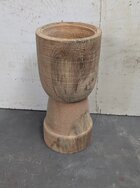
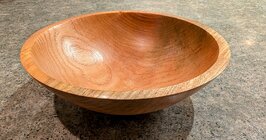
Being a drummer most of my life, I have a long-term goal of turning full size djembe drums out of local hardwoods (I am a cheap barstid, and plan to "rescue" wood from downed trees etc), most likely maple. Meanwhile, bowls have been an excellent training ground, and what the heck, I know where my holiday gifts are coming from!

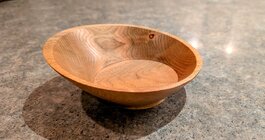
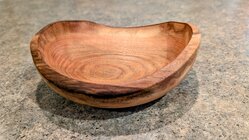
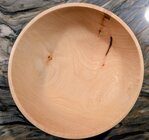
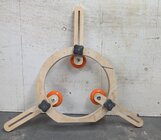
Over the past year, I turned several bowls from apple wood that has been aging about 7 years in a pile originally designated for the fire pit. It is really beautiful wood, and hard as a beast! Tried to end grain cut a miniature drum from one larger piece, but gave up after burning up a 2" Forstner bit and sweating over it for hours. It is now on a shelf, the ultimate lesson in humility. The steady rest was intended to support the drum, but I came to realize before I even finished it that anything short of steel didn't have a chance.

I look forward to interactions with folks on this board, and will be attending the Western MA Woodturners club meets as often as possible. Suggestions of other ways to connect are always welcome!
 

Attachments

  • Apple Bowl 08-16-25 (1).jpg
    Apple Bowl 08-16-25 (1).jpg
    414.4 KB · Views: 9
  • Apple drum.jpg
    Apple drum.jpg
    297.7 KB · Views: 8
  • apple flat bottom angled top 08-16_25 (1).jpg
    apple flat bottom angled top 08-16_25 (1).jpg
    330.3 KB · Views: 9
  • Apple Live Edge (1).jpg
    Apple Live Edge (1).jpg
    389.5 KB · Views: 9
More photos
 

Attachments

  • Maple green wood top.jpg
    Maple green wood top.jpg
    427.2 KB · Views: 9
  • Steady Rest.jpg
    Steady Rest.jpg
    534.2 KB · Views: 9
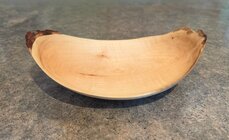
  • Maple live edge fist attempt .jpeg
    Maple live edge fist attempt .jpeg
    340.3 KB · Views: 9
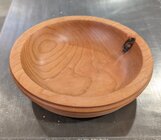
  • Cherry first turn.jpg
    Cherry first turn.jpg
    377.3 KB · Views: 7
Nice work - looks like you're having fun!

Hello Greg! Hey, have you made any drumsticks? Just for fun I made a set from Dogwood with Ebony tips. I'm no drummer so I have no idea how they would actually respond!

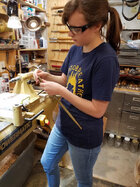
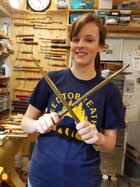
A good friend (who I've known since she was 6 years old!) is a fantastic drummer and when we started turning lessons the first real project she wanted to do was make a pair of sticks. As I always start students with the skew on spindles, she had zero problems, made one pair and wants to try another sometimes with a different wood. Good fun!

1764711601593.jpeg 1764711769433.jpeg

JKJ
 
Cool! How did you bond the tips to the stick? That seems like it would be the most challenging, although it seems glues today are stronger than the wood itself.

At one point, I was considering building a drum from layered slices cut from a ShopBot. Someday I might still try it, although I wonder if the glue between layers doesn't kill any resonance. Could be an interesting way to create some contouring that would be difficult to do on a solid piece of wood. My carving skills are even more limited than turning!
 
Cool! How did you bond the tips to the stick? That seems like it would be the most challenging, although it seems glues today are stronger than the wood itself.

At one point, I was considering building a drum from layered slices cut from a ShopBot. Someday I might still try it, although I wonder if the glue between layers doesn't kill any resonance. Could be an interesting way to create some contouring that would be difficult to do on a solid piece of wood. My carving skills are even more limited than turning!

The friend made hers from single pieces of wood, no bonding needed. When I took her home she wanted to test them right away - her mother and I were impressed!

I used slow-curing epoxy for those I made with glued tips. I wondered if a more flexible glue would be better. But as mine are for show rather than use it probably doesn't matter - unless I give them to a drummer. They they will find out!

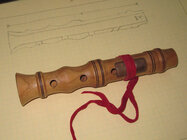
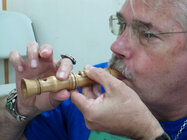
I like making things related to music. I've made numerous conductor's batons and some small flutes. Haven't tried to make a drum, although I have some handmade bongos, some single hand drums, and a djembe. Made a custom piano tuner's "hammer" with a B&W Ebony handle for a friend.

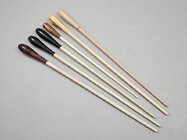
These conductor's batons are popular - handles of Cocobolo, Ebony, Kingwood, Olive; shafts of holly or basswood. It's a trick to get the balance right.
The one at the top in the photo below is one piece - dogwood.

Perhaps an interesting story of how I got into making these. A girl that was in my kindergarten class years before was graduating from college and she asked if I could make one she could give to her fiancé. I said sure (although I never made one before.) When she asked how much it would cost I told her what I tell everyone: $60. "But, if you come to the shop, help pick out the wood and sketch the design, and maybe help with sanding or finishing or something, it's free!" They always pick that. It lets them see the process - most have never seen a lathe before. Who knows, maybe someday they might be interested in woodturning, but even if not, at least they have an idea of how it's done!

Before I made one I my research revealed a bit of the conductor's world. Many are extremely picky, er, specific about the details: materials, size, handle style, balance, colors. I found one guy who made batons for famous conductors all over the world - they would pay for him to travel and touch up a baton or make a repair or replacement, sometimes in a frantic emergency. Most teachers and conductors just buy inexpensive commercial batons.
1764718306090.jpeg

I have drawings showing how I make these if anyone is interested.
I've taught the method to friends. The thin spindle is the hardest part if new to that.
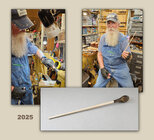
1764722132621.jpeg
(This gentleman grows his beard out all year so he can play Santa at malls!)

The specs for this were from a Native American flute maker. Cherry.
1764718381784.jpeg 1764718452698.jpeg

JKJ
 
Back
Top