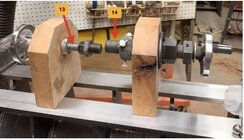
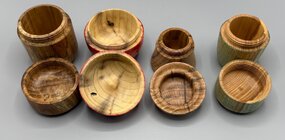
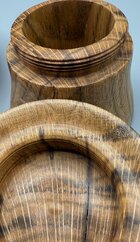
I posted a while back on how to make a threading jig. Taking the ideas from the post, searching the web, and input form a club member I was finally able to make one with somewhat repeatable results. The biggest challenge is eliminating runout. Dealing with off the shelf components and several mods I am somewhere between 0.005” and 0.009” runout consistently. I don’t think I can get it down any further and getting to this point was not without a lot of modifications. This jig is nowhere in the same class as one of the Baxter, Hope or ChefsWear jigs. It is big and bulky, but does work ok at a reduced price. I size the threads the same as the Alan Batty video using hand thread tools.
Description
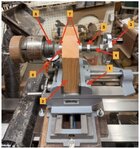
1. Sliding vice from HF cost was $69 (with $20 coupon) The vice is mounted on a piece of walnut and I used a piece of corian between the way to maintain position.
2. Base wood block. This was drilled when installed in the sliding vice to maintain center.
3. Cast hand wheel, $14 from Amazon,
4. 3/4” 10 tpi all thread $5
5. Jam nut used to stop the advance into the part.
6. 1 1/4” aluminum bar I threaded. I tried the 3/4” rod couplings, but way too much slop in those threads. Left over material from another project and I already had the tap.
7. I added 3 set screws on each end of the aluminum bar to take up any backlash in the threads. There is a leather plug in the bottom of the set screws.
8. One Way 3/4” to 1 1/4” adapter.
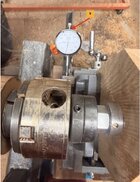
9. Indicator. This is a must have. Way too much backlash in the HF threads and the scale for the vise is way too coarse. Also I do not cut when reversing the part. I back off the cutter reverse the wood and then bring the cutter back to cutting using the indicator.
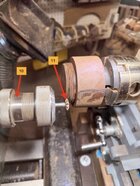
10. BMwood collet system $89 Amazon. I didnt have one, but can use it for other things in addition to this.
11. 3/4" Diameter, 3/16" Wide 60° Double Angle Cutter, HSS, Amazon $40
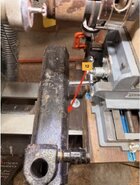
12. I use the banjo as a stop so I can slide the jig back to check the male threads against the female threads and return to the same place (using the indicator) if addition cutting depth is needed.
Description
1. Sliding vice from HF cost was $69 (with $20 coupon) The vice is mounted on a piece of walnut and I used a piece of corian between the way to maintain position.
2. Base wood block. This was drilled when installed in the sliding vice to maintain center.
3. Cast hand wheel, $14 from Amazon,
4. 3/4” 10 tpi all thread $5
5. Jam nut used to stop the advance into the part.
6. 1 1/4” aluminum bar I threaded. I tried the 3/4” rod couplings, but way too much slop in those threads. Left over material from another project and I already had the tap.
7. I added 3 set screws on each end of the aluminum bar to take up any backlash in the threads. There is a leather plug in the bottom of the set screws.
8. One Way 3/4” to 1 1/4” adapter.
9. Indicator. This is a must have. Way too much backlash in the HF threads and the scale for the vise is way too coarse. Also I do not cut when reversing the part. I back off the cutter reverse the wood and then bring the cutter back to cutting using the indicator.
10. BMwood collet system $89 Amazon. I didnt have one, but can use it for other things in addition to this.
11. 3/4" Diameter, 3/16" Wide 60° Double Angle Cutter, HSS, Amazon $40
12. I use the banjo as a stop so I can slide the jig back to check the male threads against the female threads and return to the same place (using the indicator) if addition cutting depth is needed.