• December 2025 Turning Challenge: Single Tree! (click here for details)
  • Congratulations to Bob Henrickson, People's Choice in the November 2025 Turning Challenge (click here for details)
  • Congratulations to Guillaume Fontaine for "Old Tea Pot" being selected as Turning of the Week for December 15, 2025 (click here for details)
  • Welcome new registering member. Your username must be your real First and Last name (for example: John Doe). "Screen names" and "handles" are not allowed and your registration will be deleted if you don't use your real name. Also, do not use all caps nor all lower case.

How often do you buy wood to turn?

Joined
Nov 14, 2023
Messages
170
Likes
222
Location
Los Angeles, CA
I’m a turner who almost exclusively uses found wood. AKA other people’s firewood. I have occasionally purchased wood over the last 30 years from estate sales or auctions with the intention of using it for flat work (boxes/cutting boards etc). And I've recently come to the realization that I probably have more wood than I’ll ever use in my lifetime.

With that in mind, I got to wondering -
How often do you buy wood blanks?
What percentage of your projects depend on a purchased blank? (As opposed to a blank you milled yourself)

And what considerations are most important when buying turning wood blanks?
Species?
Character?
Price?
Size?
Kiln Drying/Moisture content?

 
Don't usually buy wood except a few exotic species rarely. I would suggest to buy from a reputable dealer or (at much lower price) from a local sawmill.

After people learn that you turn wood they will call you when they find wood . Hence the need for a chainsaw. Like you I have more flat wood and turning wood than I will probably use in my lifetime now but that does not stop me from accepting more.
 
I was only a couple of months into turning when I realized that I wasn't going to be able to afford it if I bought wood. There is no real local sawmills that have hardwood. Our native wood here in alberta seems to consist of poplar, poplar, some more poplar and spruce/pine. I get access to green ash, elm, and box elder when tree removals happen. I've bought one blank in the last 3 years, a Osage orange bowl blank. There it sits covered in wax waiting for me to figure out what I'm going to do with it. I could probably turn for the next 10 years and not collect another piece of wood.
Price for me is the most important factor, and I get a lot of enjoyment from processing my own wood.
 
I almost only buy wood for making pens, since you can get some stunning exotics for a reasonable price. For larger work, I am either using up offcuts from our cabinet shop (lucky me) or I'm using "firewood"
 
Being a segmenter, buying wood is common. Color (fastness) and contrast dictate the woods used. It never goes bad and I can use the smallest of pieces (often don’t). At some point the scrap (future segments) becomes unmanageable! As I continue to age, my mantra has become “Why bother”, lol!
 
I always buy my wood once a month, since most of my work involves small exotic pieces for the boxes I make. I do have a budget, so I can keep in range. Also all wood must be kiln dried or air dried. Of course the smaller the piece the less expensive it is, most of my pieces are $50 or less. Also I buy from a few select companies, about 3, because quality is extremely important. I have tried dozens of companies over the years and just keep coming back to these. Very rarely I find free wood, because where we live it is not really available or close by....
 
As a bowl maker, I do best with very fresh cut logs (as the tree is felled), so look for tree cutters, but only in the winter. I’ll spend the time needed to process the logs and rough turn all I’ve gotten. I spend the hot summer in my air conditioned shop final turning the rough bowls turned 18 months prior. I occasionally buy blanks at sales done by my local turning group, but they tend to sit. I think of them as rainy day turning, if I’ve really screwed up and have nothing ready. But that doesn’t seem to happen.
Special blanks are a problem. A special blank deserves that a special piece come from it, which clogs my creative brain. I feel artistically free if I have little or no real money in it.

Small exotic blanks for ornaments or tops is a different story, so I keep fancy spindle blanks for such occasions, where especially the dense woods are needed and loved.
 
Here in the UK about 25 miles outside London I buy almost everything from a few specialists. Seldom cheap particularly with associated postage. Upside is that it’s dry and ready to use. A local tree surgeon remembers me sometimes so I’ve invested in a chain saw but find it difficult to “see” where to cut for best effect (or yield). I have a small wood store beside the house where small logs start to dry.

But it all fits with the small scale of the operation- my workshop aka part of the shed -is about 8x6’!
 
A bit of thread drift: I can understand buying blanks and I have. But why buy cored bowl blanks? Don’t they limit what you can then turn since the shape is predetermined? What fun is it when someone else has turned the blank for you?
 
Glad you don’t get creatively stuck, so that all of your work can be special!
LoL I wish! On a more serious note I found the basic mechanics of turning relatively easy to acquire (not mastered!). I find the creating and visualisation much more of a challenge. I easily spot if it looks wrong but by then it’s too late! I tend to draw the shape I think I want on paper first. I do a lot of “one offs” as no two are exactly the same!
 
I almost never buy wood. The last year was different though. A local gentleman, 2 time president of the International Wood Collector's Society had 2 'everything must go' sales. I got many species that I had never heard of, and some American Chestnut boards 4/4 and 8/4, maybe 18 inches wide for $10 to $30 per board. Almost a crime.... As for bowl blanks, never. Commercial people just don't cut them out the way I would. Mostly they are just slabs from a log, and they have no problem with knots and branches, and I have huge problems with knots and branches.... I don't turn pens. I am turning a bunch of threaded boxes and other more standard boxes. Many of the exotics I got from the sale will go towards that. they could also be used for segmenting if I am ever to go that route. I have heard that cabinet shops are good places for segmenting sized scraps. Don't really know though.

robo hippy
 
I've boughten less than 10 blanks in 38 years. And at the age of 71, I about a thousand pieces of wood to turn. Think I'll get them all turned? LOL In Central IL, if you show up with gifts when a tree is being dropped, you can have a truck load dropped in your driveway with no further cost.
 
When I was starting out, I bought quite a bit of wood, most of which is still sitting on my shelves. Once I realized the joy of turning green wood and got some roughed blanks dry, there was no going back. Our native trees are not great for turning, but there are more than enough hardwood landscape trees that come down periodically to have my garage and shop overflowing.
 
A bit of thread drift: I can understand buying blanks and I have. But why buy cored bowl blanks?
There are plenty enough turners that have no Access to suitable wood, plain square cut blanks are usually also kiln dried (weight difference bewteen dried and green is quite considerable, thus so is shipping expense) A Cored bowl blank is often more affordable after factoring in weight/shipping cost , and even then, I challenge you to find a good piece of 12" x 12" x 4" thick quality hardwood turning blank for an affordable price compared to a cored bowl blank. Not to mention, Cored blanks may also give you access to bowl turning woods that you may likely never find from anywhere else.
 
I've been buying a lot of wood (kiln-dried rounds, spindle blanks, and some cored blanks from A Cut Above Bowl Co.) because I haven't found a good source for green wood yet. I just moved to New Hampshire and don't know many people here yet. Since I live in a rural wooded neighborhood, I should probably email the neighborhood listserv and offer to trade bowls for access to fallen trees.
 
A bit of thread drift: I can understand buying blanks and I have. But why buy cored bowl blanks? Don’t they limit what you can then turn since the shape is predetermined? What fun is it when someone else has turned the blank for you?

I bought some cored blanks because I wanted to try turning some wood I wouldn't otherwise have access to. I don't think there's really a feasible way to ship blanks of this size unless they've been cored and dried.
 
I have access to all the elm/ash/box elder and red oak I can use but I do buy blanks every so often just to get something not available in my area.
 
When I ordered my lathe 2-1/2 years ago, I bought a couple bowl blanks figuring I needed something to get started. A tree fell in our yard soon afterward, and then another, and then one at the neighbors. I had ash, oak, hickory, birch and maple, all I could use. Sadly for my turning hobby (but happy otherwise), we moved to a location much sparser in hardwoods, but I've managed to bag some nice spalted maple and cherry from the neighborhood. I buy wood for flatwork, and use some of that for turning, but 95% of what I've turned so far has come from free or cheap fallen trees. The blanks I bought when I ordered the lathe still sit on the shelf.
 
Once a year I buy wood. Occasionally twice if I demo at a symposium. I go to the tennessee symposium every year and my friend Pete Kekel of Bigmonklumber is always there. I try to support him and buy some wood. My hand mirrors require dry wood so I'm always on the lookout.
I lied. About once more each year I go to Jeffries lumber just south of Knoxville tn. They have a huge supply of just about every kind of great wood you can imagine. All kiln dried. I hate going there because it's impossible to stay within your budget. Most of what I turn other than mirrors are from wood I harvest myself. Since I don't do a lot of bowls and hollow vessels it requires milling and harvesting which has gotten harder since we downsized our home. I don't have the storage space dry that stuff that can take a few years.
 
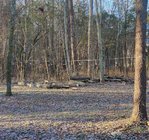
I decided to start up woodworking again after I bought this property last year. I did not expect to become a woodturner but I'm obsessed with it now. I feel no compulsion to do general woodworking right now. At any rate, you can see I won't need to buy any wood. I know it isn't good to have it sitting on the ground but I have to figure out how to move it. I guess I need a tractor now.
IMG_20231212_080130.jpg
 
I decided to start up woodworking again after I bought this property last year. I did not expect to become a woodturner but I'm obsessed with it now. I feel no compulsion to do general woodworking right now. At any rate, you can see I won't need to buy any wood. I know it isn't good to have it sitting on the ground but I have to figure out how to move it. I guess I need a tractor now.
View attachment 58353
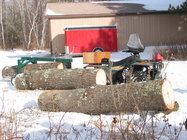
All you need is a logging arch and an ATV to pull it. This photo is about 25 years old but I still have both the arch and ATV and as the picture shows you can handle anything that will fit between th wheel arch.
113-1314_IMG.JPG
 
All you need is a logging arch and an ATV to pull it. This photo is about 25 years old but I still have both the arch and ATV and as the picture shows you can handle anything that will fit between th wheel arch.

I will look into that. I drag them around with the lawn mower but that would be better. It's the stacking and sticking part that really gets me. I have a block and tackle so I really only need to run a mini skyline and I should be able to lift them. OK, now I'm tired. ;-)
 
Lke Russell, I live in Alberta so the only local wood is poplar or SPF unless you get lucky and find someone taking down a tree of something more interesting. Like Russ, I am also a segmenter so I'm always looking for wood of different colors. Word has gotten out that I am a woodturner and a segmenter, so I am given a lot of wood, especially maple, walnut, and mahogany (I don't ask why, I just say thankyou). A fellow in our local woodworking club does a lot of dumpster diving (checking out the dumpsters in new home subdivisions) and he has found a huge amount of hardwood in those dumpsters, some of very interesting and exotic species. These are trim and flooring cutt-offs, but sometimes the quantity and quality is astounding. He's also found next to new tools, and I'm talking larger power tools like planers and miter saws. His jointer came from a dumpster! I do purchase exotic woods (purple and yellow heart, bloodwood, etc.), and with my huge number of little strips I'm learning how to make segmented pen blanks. More to use up some of the excess little pieces than anything else. I donate a lot of the pens to charities to use as fundraisers in silent auctions, etc.
 
I think I’m the odd man out here, most of my turnings are from purchased kiln dried lumber I glue up laminated blanks from.

Twenty or thirty percent of my turnings are from harvested logs, but processing these and then drying blanks etc is no small effort (besides waiting for a year to second turn them).

A few years ago I glued up some scraps from flat work and really liked the results. Since then I’ve been buying good wood and cutting it up into scraps to laminate :). The last few years I’ve been making about one run each year to a lumberyard just SW of Nashville (~2hrs) that has great selection and the best prices I’ve found. Each trip I buy 20-50bf+ each of a half dozen or more species, the last trip was a few hundred bf and four figure $$ (don’t tell my wife).

I’m able to glueup straight from planer or tablesaw with scores of clamps I’ve invested in. The laminating takes some time and creativity but I find it easier (and less messy) than processing logs. I need to start getting into some segmenting so that 90% of what I glue up doesn’t go out with the trash each week in shavings…
 
Twenty or thirty percent of my turnings are from harvested logs, but processing these and then drying blanks etc is no small effort (besides waiting for a year to second turn them).
Everyone has their own way, but you don't have to wait that long. I cut down a tree and once I'm done processing it, I immediately turn a bowl with it. Sometimes I have to wear a raincoat. ;) I then dry it (usually microwave). In a couple of days I have a finished bowl. Don't discard turning green logs.

What's the name of the lumberyard? I'm in Columbia.
 
@Kent Reisdorph - yeah, I turned a green cherry crotch a few months ago when I first-turned a bunch of blanks. Enjoyed it, but not sure I’m as big a fan of letting things warp. And your right, I was throwing water all over, but it is fun making big curls.

The place I recommend for kiln dried is Middle Tennessee Lumber in Dickson. It’s a bit of a drive for me, but pretty close to you. Good variety, and best prices I’ve found.
 
Back
Top