• December 2025 Turning Challenge: Single Tree! (click here for details)
  • Congratulations to Bob Henrickson, People's Choice in the November 2025 Turning Challenge (click here for details)
  • Congratulations to Guillaume Fontaine for "Old Tea Pot" being selected as Turning of the Week for December 15, 2025 (click here for details)
  • Welcome new registering member. Your username must be your real First and Last name (for example: John Doe). "Screen names" and "handles" are not allowed and your registration will be deleted if you don't use your real name. Also, do not use all caps nor all lower case.

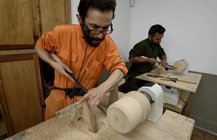
Japanese Bowl Turning

I’d love to learn that lacquer technique. Her turning is some nice scraping, gets a great surface. Interesting that both this video and the other show cutting right of center with lathe reversed.
 
One of the women appearing in the beginning of the video, Eiko Tanaka, will be demonstrating for the AAW's Symposium this year in Portland, OR. And those hook tools are not scraping at all. They are cutting the wood, quite efficiently. I hope I get the chance to attend her rotations.
 
One of the women appearing in the beginning of the video, Eiko Tanaka, will be demonstrating for the AAW's Symposium this year in Portland, OR. And those hook tools are not scraping at all. They are cutting the wood, quite efficiently. I hope I get the chance to attend her rotations.
I could have sworn she used a right angle bent tool with a flat edge on the outside. Definitely all hook tool on the inside.
 
At about the 6 minute mark, she uses a sharpened saw blade ( old jig saw) that she turns into a shear scraper. She’s getting whisper thin shavings from that tool. Same with that right angled flat tool. It may appear she’s scraping, but the shavings she’s getting are from a very fine shearing cut.
 
I wish I could spend a month or six over there learning those techniques. Hook tools are not really appreciated over here.

robo hippy
Me too. I’d settle for a few days though or a week. From my perspective many of those tools make more sense than some western ones. They aren’t difficult to make either. I spent two and a half days on a Blacksmiths course many years ago and I’m confident I could make some. I might give it a try but it’s not easy getting seasoned end grain wood over here, 99% of it gets turned into boards no thicker than 4”.
 
Me too. I’d settle for a few days though or a week. From my perspective many of those tools make more sense than some western ones. They aren’t difficult to make either. I spent two and a half days on a Blacksmiths course many years ago and I’m confident I could make some. I might give it a try but it’s not easy getting seasoned end grain wood over here, 99% of it gets turned into boards no thicker than 4”.
It does not look like they are using preseasoned wood at the beginning of the video they are cutting discs off of a log then making the turning rounds, mounting them, roughing the inside and outside and putting them aside to dry. Notice the view of a distorted bowl with a true circle around it, which apparently is their method of showing the effects of drying. Yard trees or city trees usually are crooked and not suitable for sawing into lumber, but you don't need long straight logs for end grain bowls.
101_0391.JPG
This is an example that I did in red oak with the pith included and the one below also in oak without the pith. I used a ring tool, which is similar to a hook tool, on the inside and conventional gouges on the outside for the initial shaping then burred shear scrapers both inside and out.
B324.JPG
The real beauty of end grain bowl turning is the lack of tear out compared to side grain bowls since every cut can be pure shear. The biggest lesson from the video I think is the practice - practice - and more practice.
 
It does look like she is doing some scraping cuts for finish work. That saw blade almost looks like it is being applied as a NRS. Not sure. Kind of hard to tell, but it looks like some of the bowls are end grain, and some are side grain. Have to check it out in person....

robo hippy
 
Scrapers are definitely a big part of this type of turning. Both hooked gouges (like our traditional hook tools) and hooked scrapers are used, as well as hand scrapers. An important part of this style is the almost exclusive use of pivot cuts. Apart from using the hand scrapers almost no push cuts or pull cuts are used. This is facilitated by use of the floating tool rest (a very neat innovation). With a pivot cut one can extend the tool far over the rest and maintain very great control and precision of cut. Especially helpful when trying to create a flat surface on a plate or platter.

This video shows clear use of the hooked gouges, the hooked scrapers and the hand scraper:

View: https://www.youtube.com/watch?v=l_v2VFCDh0Y


Another neat feature of their lathes is the ability to almost instantly start, stop and reverse using foot pedals - very efficient.
 
all of them have such similar unusual technique—cutting in reverse, tools and hand far over toolrest, toolrest way above center, no face protection or respirators, and this last guy was cutting at 6 o’clock. It’s fascinating. Keep them coming.

Bet there’s a Japanese forum where there’s a thread on the funny or different (to them) things we do turning.
 
That piece that Steven linked to appears to be end grain. Scrapers work far better for getting clean surfaces with end grain than with side grain, which is how most of us turn bowls. With my boxes, I get surfaces that 400 grit roughs up rather than smooths out...

robo hippy
 
Hi! So, the two videos above are both from Yamanaka Onsen, using a Yamanaka-style lathe, which is used sitting on the side of the piece. Yamanaka is famous for end grain turning, and forward and reverse are used. The scrapers, both handled and hand-held, cut with a burr, so you get very thin shavings. Other parts of Japan prominently use side grain, so they often sit facing the lathe. Concerning safety, turning this way is not safer than western turning; it is quite a bit more dangerous. The pivoting motion is very difficult to get right and catches in the beginning happen a lot. The tools also tend to break when catching, causing some very scary situations. Additionally, the wood is attached with jam and nail chucks only, resulting in pieces flying through the room a lot. Why do Japanese turners not use face shields then? I think it's a mix of two things: a full faceshield would really reduce visibility, and since the torso and head are so close to the table surface, it would get in the way. Secondly, Japanese craftspeople are not big on safety gear in general. I rarely come across any type of protection at all. I can't say that this is positive, but I feel like we in the West sometimes overreact when it comes to the use of safety gear. But after about 2 years of studying Japanese woodturning full-time, mistakes get very rare. I haven't had a piece of wood fly straight at me in at least 6 months now, fingers crossed
 
Last edited:
I’ve seen bad catches on conventional lathes and the tool can become airborne. I’ve no scientific evidence but the tool seems to launch towards the turner. I would guess anywhere from inline with the lathe axis to thirty or even forty degrees towards the turner?

I’ve not seen any catches with traditional Japanese turning (not good for YouTube videos 😆) but I’m guessing as it’s a trailing cut the tool would be pulled away from the turner?

Turning timber with the grain all in one direction, ie end grain, must also be more predictable than rotating end grain side grain in western turning?
 
I’ve seen bad catches on conventional lathes and the tool can become airborne. I’ve no scientific evidence but the tool seems to launch towards the turner. I would guess anywhere from inline with the lathe axis to thirty or even forty degrees towards the turner?

I’ve not seen any catches with traditional Japanese turning (not good for YouTube videos 😆) but I’m guessing as it’s a trailing cut the tool would be pulled away from the turner?
Turning timber with the grain all in one direction, ie end grain, must also be more predictable than rotating end grain side grain in western turning?
I am not sure what a "trailing cut" means exactly, but the difficulty with hook tools is that you need to pivot the tool below the centre and cut in exactly the right spot, or it will catch every time. Different to a Western set-up, this means the bigger you go, the more difficult it becomes. 30 centimetres is already a very big challenge and results in a super steep tool angle, which is quite risky. Anyone who has tried some pole lathe turning knows how easy it is to catch, and a Japanese lathe is the same thing, but at high speed. During the first 6 months of studying, we had daily catches, and the tool broke every time, resulting in a piece of wood with or without a blade sticking out of it, flying straight at you. It is true that the tool is being pulled inwards, but different to gouges, the tool itself will break, and the jam chucks don't hold very well if you make a mistake. Also, the table surface makes sure the piece of wood bounces straight back at you in most cases. My record is 4 broken tools in a day, and one of my teachers is proud of having 7 in a day.
 
Seeing the videos... I am not worthy!

It does make me think that I need to do more end grain turning, though.
 
Well, folks, this site, and other links within, may start you on the slipery slope of building your own Japanese-style lathe.

I've got to look away now. The last thing I need is something new like this tempting me to get involved. I don't have the space for more.
 
Very Humbling...we should all be ashamed when we whine about wanting the latest fad tool or gadget (personally, I'm not a gadget-seeker anyway).

Tim
 
Turning bowls in reverse makes good sense, easy to see the cutting action. I once had a threaded lathe faceplate that had the threaded portion slit in half with a couple socket head screws to clamping the halves onto a spindle to prevent unscrewing when run in reverse.

I also like the idea of hook tools. I wonder if the tool breakage mentioned is from the tool itself actually breaking or the tool is breaking away from its wood shank?
 
Japanese tools that I have seen in videos are not as smooth, polished or refined looking as western tools. I believe they are generally made by the turner and kept sharp on a waterstone or slipstone. That means the steel itself cannot be one of our harder, more 'exotic' steel alloys. All that adds up to a fragile variety of steel in the tools, and maybe explains why they break, when western tools would not. (Sorry about all the speculation. Maybe Rabea will educate us further. Please)
 
These are some of my most used hooks, which are all made from HSS steel. There are scrapers and Hooks in this picture, and you can see that the hooks have a very sharp-angled blade with only about 1-2mm thickness to support it. Since I use the corner to cut, I need the material to be that thin, which also results in the tool breaking off easily at exactly that point. A gouge, on the other hand, has loads of material to support it, even if it might be the same steel. Since it is such a small edge, to begin with, it is no problem to just reforge a new edge whenever needed, and a bar of steel will last me a few years.

Hakenwerkzeug.jpg
 
These are some of my most used hooks, which are all made from HSS steel. There are scrapers and Hooks in this picture, and you can see that the hooks have a very sharp-angled blade with only about 1-2mm thickness to support it. Since I use the corner to cut, I need the material to be that thin, which also results in the tool breaking off easily at exactly that point. A gouge, on the other hand, has loads of material to support it, even if it might be the same steel. Since it is such a small edge, to begin with, it is no problem to just reforge a new edge whenever needed, and a bar of steel will last me a few years.

View attachment 63946
I have to admit, this is starting to fascinate me. Thank you for sharing this information... and anything else you'd want to pass along.

20 years ago Alan Lacer held a session with the MN Woodturners Assoc. and we made a basic hook tool from O1 drill rod. I'm a bit embarrassed to admit I've not taken the time to master using it.
 
These are some of my most used hooks, which are all made from HSS steel. There are scrapers and Hooks in this picture, and you can see that the hooks have a very sharp-angled blade with only about 1-2mm thickness to support it. Since I use the corner to cut, I need the material to be that thin, which also results in the tool breaking off easily at exactly that point. A gouge, on the other hand, has loads of material to support it, even if it might be the same steel. Since it is such a small edge, to begin with, it is no problem to just reforge a new edge whenever needed, and a bar of steel will last me a few years.

View attachment 63946
Those look good. I’ve never seen annealed HSS available for sale and was told by a machinist I worked with years ago that specialist equipment is required to harden HSS.
 
Regarding the Japanese forged turning tools......

There may be a terminology mix up here. HSS is a difficult steel to hand forge needing temperatures close to 3000 degrees Fahrenheit. Along with very specialized heat treatment process.
 
Regarding the Japanese forged turning tools......

There may be a terminology mix up here. HSS is a difficult steel to hand forge needing temperatures close to 3000 degrees Fahrenheit. Along with very specialized heat treatment process.
I believe it is SKH51 that I forge using a gas torch and a hammer.. can't say how "proper" our tempering is, but it works well for woodturning

Edit: I searched and found out that Japanese SKH51 is equivalent to M2 steel, which is a medium-alloy high-speed steel often used for various tools. I found the following information on forging and hardening temperature and this is very similar to the process we do, although we eyeball it according to the colour of the steel. Still works great
 
Last edited:
I believe it is SKH51 that I forge using a gas torch and a hammer.. can't say how "proper" our tempering is, but it works well for woodturning

Edit: I searched and found out that Japanese SKH51 is equivalent to M2 steel, which is a medium-alloy high-speed steel often used for various tools. I found the following information on forging and hardening temperature and this is very similar to the process we do, although we eyeball it according to the colour of the steel. Still works great

Also


and here are other equivalents....


I've never considered forging and heating treating M2 myself, so have learnt about something new to me there, thanks Rabea.
.
 
Last edited:
Rabea

Is the following recommended heat treatment for SKH51/M2 HSS similar to what you do with your turning tools? I understand from what you have said and also from my interest in Japan hand forged knives that the smiths go by metal colour and not temperature readings, but is the sequence the same?

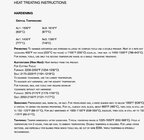
Heat Treatment of M2 Steel HSS

  • Anneal
Heat to 1600° F, soak thoroughly at heat. Furnace cool 25° F per hour to 900° F, air cool to room temperature. Approximate annealed hardness 241 Maximum Brinell.

Stress Relief of Unhardened Material: Heat slowly to 1200 to 1250° F. Soak for two hours per inch of thickness at heat. Slow cool (furnace cool if possible) to room temperature.

  • Harden
Heat slowly to 1550° F, soak thoroughly, heat to 1850° F, soak thoroughly. Soak time in the furnace varies from a few minutes to 15 minutes, depending tool size, heat capacity of the furnace, and the size of the charge. – Heat to 2150 to 2200° F for max. toughness and minimum distortion. – Heat to 2250 to 2275° F for max. hardness and abrasion resistance.

  • Quench
For full hardness, oil quench to 150-200° F. Air quench to 150° F. When quenching in hot salt maintain the quench just above the Ms temperature. After equalizing withdraw parts from the hot salt and air cooled to 150° F.

  • Temper
Double temper is mandatory, three tempers are sometimes preferred. Soak for 2 hours per inch of thickness. Air cool to room temperature between tempers. The best tempering range for hardness, strength and toughness is 1000 to 1050° F.
 
Regarding the Japanese forged turning tools......

There may be a terminology mix up here. HSS is a difficult steel to hand forge needing temperatures close to 3000 degrees Fahrenheit. Along with very specialized heat treatment process.
I was told it would be virtually impossible to correctly harden any type of High Speed Steel in a home workshop as specialist equipment is required.

For tools used on a relatively slow speed lathe like those used in traditional Japanese wood turning, high carbon steel should be more than sufficient. From videos I’ve seen on the process I suspect some Japanese turners are using something like spring steel. Unless you can properly harden HSS after shaping it’s likely no better than many carbon tool steels anyway.

Edit: I saw this on hardening M2 High Speed Steel. Not exactly a quick and easy process:

IMG_0625.jpeg
 
Speaking of "spring steel" (common grade for vehicle leaf springs?), 5160 is popular in the edge blade/tool forging community. I own a forged "wood cleaver" (think meat cleaver for splitting smaller sections of wood, a small froe, if you will) and it really works well. If anyone here hand splits wood billets for spindle work, take a look here, Jason Lonon makes them in small batches thru the year in 2 slightly different styles. Lots of great forged tools here.

Anyway, 5160 may be one to explore for home forging if looking for an alloy other than the really easy to work O1 tool steel (a great edge holding alloy itself).
 
Back
Top