• December 2025 Turning Challenge: Single Tree! (click here for details)
  • Congratulations to Bob Henrickson, People's Choice in the November 2025 Turning Challenge (click here for details)
  • Congratulations to John Dillon for "Chinquapin Oak" being selected as Turning of the Week for December 22, 2025 (click here for details)
  • Welcome new registering member. Your username must be your real First and Last name (for example: John Doe). "Screen names" and "handles" are not allowed and your registration will be deleted if you don't use your real name. Also, do not use all caps nor all lower case.

Lidded box question

Joined
Sep 24, 2024
Messages
40
Likes
13
Location
Front Royal, VA
I’ve decided to try my hand at some small boxes and I’m wondering what folks prefer (and why) for the tenon - does the tenon belong on the lid or on the base of the box??
I've seen boxes made both ways, and I am interested to hear any thoughts on preference or design considerations y'all have. My gut says I would prefer to see the lid have the tenon (or a rabbet maybe - not sure what the perfect term is) that sits down inside the bottom, so the bottom looks more "finished" when the lid is off. But is it just a preference thing or are there other reasons to do it one way vs. the other?
Thanks in advance, and Merry Christmas.
 
You are the artist, your decision. The tenon as a part of the lid does result in a "cleaner" look to the bottom of the box, as you stated. If you are uncertain, then perhaps some experiments both ways will aid in your decision making. Unless you plan to sell your output, then the customer(s) need to decide. Otherwise I recommend doing what makes you happiest.
 
I make boxes with both arrangements, though mostly with the tenon on the bottom. All of the boxes I make are meant to be used and that affects my planning.
  • For typical boxes, which for me commonly follow the Golden Ratio, I use a tenon on the bottom, unless there is a special reason to do otherwise. Like a knot or inclusion right at the spot where the tenon would be.
  • If the box is going to be kind of squatty, I will be sure to put a tenon on the bottom to give the box more volume to hold things. A saturn/oyster box is an example.
  • If the box is going to be relatively tall and slender, I lean toward a tenon on the top, so it's not too hard to get fingers in and objects out of the box. Plus, it's dark down there.
 
Chris Stott, from the UK I think, he is known for his 5 minute box. Small size, but about a 2 inch square blank, or less. Finish turn the outside. Put a parting tool to form the tenon, I use a 3/8 inch wide one, part the lid off leaving the tenon on the lid, and then hollow the inside, and done. I am not any where near 5 minutes on mine.... For the boxes I sell, I like the tenon on the bottom, and the recess on the lid. You can size your box so the tenon is the top of what the box will hold, but the outside porpotions just don't seem right to me. No matter how "dry" the wood is supposed to be, I rough turn all of them! Next step is to tape the ends together and let them "adjust" to having bulk, removed. For me, this is generally a month or two, but some times longer. This is especially true for larger diameter boxes, like anything over about 2 inches. I have done a couple that were in the 5 inch diameter range, and one did move a tiny bit after I finished it, and one did not, but mostly I keep them in the 3 inch diameter range. With the bigger boxes, to me, the idea is to make them from the same piece of wood. That way, when they do move, they should move the same amount which means you may not be able to spin the lid all the way around, but it will still come off. My "idea" of a "perfect" fit is a 3 to 5 second drop as in pick the box up by the lid and it takes the bottom 3 to 5 seconds to drop off. Sides of tenon and recess need to be spot on parallel. I have a dedicated skew/scraper that I use for truing up the tenon and a number of them for truing up the recess. A 6 inch ruler on the recess and tenon and then eyeball how close it is to being parallel with the lathe bed and you are close. It does take practice.... Just a tiny bit too much, and the lid is too loose. For these boxes, I am now doing 2 rough turnings. One for the insides of the lid and box, and now I am rough turning the tenon and recess. I do prefer end grain, and the straighter the end grain is, the easier it is to make the grain line up. With a lot of cross grain, it does leave a sizeable hole in the grain and they just never look right to me. Plus, you get a lot of tear out. I do consider boxes to be good practice for hollow forms too. Oh, I have been making mine not more than about 3 or 4 inches deep. Mostly because I need hollowing tools to turn the inside if it gets deeper than that. It is good practice for a skew, spindle detail gouge, and negative rake scrapers. On end grain, you can, eventually, get a surface that 400 grit abrasive roughs up. Oh, don't use solvent based finishes on the inside because the smell NEVER goes away. Also, I make my boxes all from one piece of wood. I don't do the bottom from one kind of wood and the lid from another. I would have to figure out how much difference there is in the 2 woods species, and that is too much work for me.... Richard Raffen and Tomislav both have videos up on turning boxes. I don't have one up, yet....

robo hippy

 
Great info, thanks all.

I've been tasked with making a small one for my son's guitar pics, so I have been making some prototypes for practice. I also have a small ash bowl I made that just seems like it wants to have a walnut lid when I get around to it. Not nearly enough time for all the things i want to try.
 
For me,
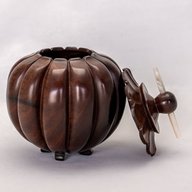
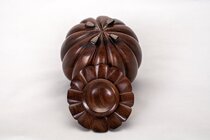
The tenon at the bottom of the box remains there as the foot, so its used as the fixing point for hollowing. The lid always inserts into the box and become the fixing point. I have a selection of small jaws custom made for this purpose and so care is taken to the dia of the lid tenon to match the custom jaws so as to leave no marks.
 

Attachments

  • BMA05801-Edit.jpg
    BMA05801-Edit.jpg
    222.9 KB · Views: 6
  • IMG_1480.JPG
    IMG_1480.JPG
    217.1 KB · Views: 7
I’ve decided to try my hand at some small boxes and I’m wondering what folks prefer (and why) for the tenon - does the tenon belong on the lid or on the base of the box??
I've seen boxes made both ways, and I am interested to hear any thoughts on preference or design considerations y'all have. My gut says I would prefer to see the lid have the tenon (or a rabbet maybe - not sure what the perfect term is) that sits down inside the bottom, so the bottom looks more "finished" when the lid is off. But is it just a preference thing or are there other reasons to do it one way vs. the other?
Thanks in advance, and Merry Christmas.
I put the tenon on the bottom for all of my boxes. One reason to consider the tenon on bottom method over the tenon on lid method, is the lid will be thicker and deeper with the tenon on the lid side, since the extra length for the tenon needs to be added to the lid's finished size. You also would see a mortise in the bottom, and I prefer to have a smooth walled bottom if possible. On the tenon on bottom method the bottom size stays the same height, the variable is just how much wood gets removed for the tenon. The bottom's side walls are also smooth on the tenon on bottom method.
 
Last edited:
I’m wondering what folks prefer (and why) for the tenon - does the tenon belong on the lid or on the base of the box??

I can think of a possible although perhaps unlikely functional difference.

Imagine filling a the base of a box completely to the top with something like rice, salt, or loose diamonds. If the lid/base junction has the tenon on the lid and the recess on the base, you can't put the lid on easily without "scrunching" the contents. You would have to notice and not fill the box base as much.

If the lid/base junction has the tenon on the base and the recess on the lid, the lid will always fit easily on a box base filled to the brim.

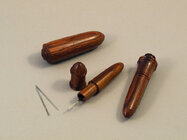
Of course, most people don't often fill boxes this way. But consider the small boxes sometimes called needle cases or pill boxes. Intended to be carried in the pocket or thrown in a sewing bag, the tenon is made extra long so the lid doesn't easily come off accidentally. If the long tenon were on the lid it might more easily run into the contents, whether long sewing needles or a box full of aspirin.

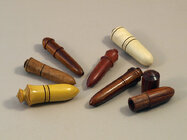
I've made a lot of these little boxes over the years. (Hint: people love them!)
1766894061256.jpeg 1766894085584.jpeg

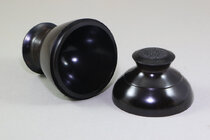
But I've never made a box and can't remember ever seeing one with the tenon on the lid. Well known box makers like Richard Raffan and Mike Stafford seem to always put the tenon on the base. This way is taught in classes and the books I've read. And maybe a lid without a tenon looks better when sitting on the table next to the box. :)

1766893434693.jpeg

JKJ
 
Back
Top