• The forum upgrades have been completed. These were moderate security fixes from our software vendor and it looks like everything is working well. If you see any problems please post in the Forum Technical Support forum or email us at forum_moderator (at) aawforum.org. Thank you
  • April 2026 Turning Challenge: Salad Bowl! (click here for details)
  • Congratulations to David Bartell, People's Choice in the March 2026 Turning Challenge (click here for details)
  • Congratulations to Ted Pelfrey for "Cherry Blossoms on Cherry" being selected as Turning of the Week for April 27, 2026 (click here for details)
  • Welcome new registering member. Your username must be your real First and Last name (for example: John Doe). "Screen names" and "handles" are not allowed and your registration will be deleted if you don't use your real name. Also, do not use all caps nor all lower case.

Maximum length for end grain box

Joined
Jan 24, 2010
Messages
3,437
Likes
1,091
Location
Cleveland, Tennessee
I'm in the process of turning an end grain box but a bit leery of the overall length of the blank which is 2-5/8 not including the tenon; diameter is about 2-1/4 inches. Lathe is a 12x16 if that is anything related to this. I could part it into two blanks and go from there. BTW, I tried hollowing with a spindle gouge as per a noted turner on YouTube...not good. Tried a square end tool...very slow. Did not try a round nose tool, BTW. Your recommendations are most welcome as always.

 
I'm not understanding what your concern is with the blank. 2 5/8 x 2 1/4 should be fine for a box.

There are several options for hollowing a box. I use whatever (usually bowl gouge) to remove material, and then a straight scraper down the side for the final finish.
 
Thanks, Kent. Watched to make sure it didn't break from the tenon.
Watched a YT video by John Lucas, using the Hunter Viceroy #1. Got one. Plus he drilled a hole as a starter for the Viceroy. Back to the shop tomorrow.
 
Using a 1/2" spindle gouge is how I hollow boxes up to about 5" deep. Push the nose straight in then tilt the flute to about 10:30 and cut from the center to the left.
Lately I've been techingvwith the Hunter viceroy. Its very easy for new turners to use and pretty darn fast for me to hollow. I drill a hole in the centervto the depth and then push abd pull like using a scraper. It leaves a finish close to as good as the 1/2" spindle gouge. I always finish cut the inside with the Hunter badger. It leaves a finish that barely needs sanding
 
Length is only a concern if you get near the maximum length of your bed, including the length of whatever is on the spindle and in the quill. DEPTH is an issue. Like John L, I can go up to about 5" deep with my usual tools (1/2" spindle, 3/4" 89 degree ended scraper, Hunter Badger). Deeper than that and I turn to hollowing tools, which I don't really like. John T, why don't you come over for a play date and we can do a couple together?
 
End grain,how long is a piece of string? Go as deep as you wish, for me about 400mm [16"] deep as far as I want go these days.
 
Dean, love to visit sometime. BTW, have made a couple of pens and reel seats with blue pine. Labeled the tag: Blue Pine, Montana. Still have a couple of pieces. Got anymore?
Re: John Lucas's reply, I think I might have been going in the opposite direction he mentioned. I'm of the opinion that we don't die until we learn it all.🤨
 
More than anything, depth is determined by the tools you are using. I generally don't go over about 5 or so inched deep. Beyond that, you need hollow form tools to be able to reach down inside. Deepest I have gone is about 10 inches, and it was about 5 inch diameter, so seeing down inside to make the cuts was not a problem. Most gouges are good for 5 or so inches, at least if you haven't worn it down to a nub yet.

robo hippy
 
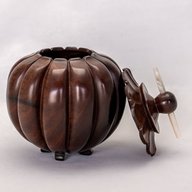
robo hippy, I cleaned off the Viceroy #1 and started hogging out wood. It did a good job, considering my rank amateur status. The depth is 1-7/16. Just need to flatten the bottom. Interior came through with a uniform thickness. Pondering a lid of some sort and finish.
 
John, I have a host of NRSs that are specifically designed for boxes. One can never have too many toys..... Some are shaped like an upside down 7, specifically for getting into the corner since I usually prefer a square corner. I had D Way/Box Master ship me a bunch of different unground 1/2 inch wide blanks.

robo hippy
 
robo hippy, mine is a DIY with the end slightly angled and about two inches of the side are ground for an edge to lightly take off wood. One can never have too many turning tools. Saw one on YouTube that I figure had two dozen tools on the rack. As I get older and turn more, I realize that tools are not "one size fits all." With that said, need to make another tool.
Unless you are this guy. Forgive me if I have posted this before but it is worthwhile watching.
View: https://www.youtube.com/watch?v=wnv0DAR_gWA
 
Unless you are this guy. Forgive me if I have posted this before but it is worthwhile watching.
View: https://www.youtube.com/watch?v=wnv0DAR_gWA
Definitely worth watching, if only to demonstrate what can get the job done. And don't dismiss this as a quaint video, of a mini-niche craft for entertaining tourists.. 200-500 years ago the woodturners guild was one of the largest and relatively well-paid craft groups in Cairo. Spindle work was ubiquitous, most notably as window lattice screens that would often be 6x10 feet, with 100-200 pieces per square foot, and furniture. Hundreds of houses had many screens -- often dozens.

All of it was done with with a bow lathe, *just as seen in this video*. Not even a pole lathe, certainly not a treadle lathe. Just a bow lathe. Yet hundreds of artisans made their living with this technology, equipping houses throughout Cairo.
 
Saw a photo of a chair found in an Egyptian tomb. All parts were beads and coves. Can't imagine how long it took to do an entire chair.
I marvel at furniture made 200 years ago with hand tools or bow lathes, etc., Joints are so precise, they look like one piece.
 
Back
Top