
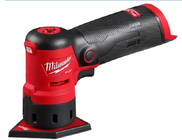
In a couple of recent threads that began as discussions of pneumatic sanders, some members mentioned the Milwaukee M12 cordless “polisher / sander” (model 2438-20) as a possible alternative.
Though I have had good success with my various corded angle drills, and an M12 cordless right angle drill, I was intrigued by this little pistol grip style polisher / sander, and so I got one. Here are my thoughts, some of which echo points that have been made in the earlier posts.
Bottom Line: This tool has several limitations and will not be for everyone, but I find it to be a light, agile addition to my power sanding arsenal.
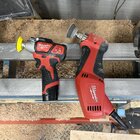
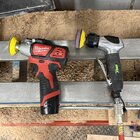
The attached pictures show the polisher / sander beside a typical corded 60º angle drill and the little Grex pneumatic ROS.
The limitations
-First, this tool was designed primarily for machine shops and automotive detailing operations, and so it has maximum speeds (2,800 rpm and 8,300 rpm) that are too high for woodturning sanding applications.
-Second, the tool has no reverse (this stems from its intended use with 2” screw-on Roloc sanding discs, which would screw off in reverse).
-Third, in an attempt to capture the accessories market, Milwaukee gave this tool a very rare—virtually proprietary—mandrel thread (female M9 x 0.75). As a result, aftermarket adapters are required to use 2” hook-and-loop sanding discs, which many of us consider to be standard fare.
Here are my thoughts on the limitations.
I have found that the speed of the M12 is manageable with the variable speed trigger, such that, in low gear (0-2800 rpm) it can run somewhat steadily at the speeds I want for sanding, usually around 250-500 rpm. It would be much better if you could dial-in your max speed and just squeeze the trigger. I might kluge some sort of limiting stop, but that will be a distant second-best.
I take advantage of the full 2,800 rpms when buffing. This tool has become my preferred method of buffing with a hand tool off the lathe, because its lightness allows me to hold the piece in one hand and the tool in the other. I recently buffed a dozen bowls through 3 grits in one session, quite painlessly. I spin non-woven polyester pads held by a 2” or 3" hook-and-loop sanding pad for this type of buffing, and the little Milwaukee is very nice addition to my options in this application.
The oddball M9 thread is a frustration, but not a fatal one. The tool comes with a 3” hook-and-loop pad, so that format is covered for as long as the supplied pad lasts. The 2” mandrel, however, has a dedicated Roloc pad. You can get a Roloc-to-hook-and-loop adapter pad, and you are good for 2” hook-and-loop sanding discs as long as you don’t sand in reverse.
But the better solutions to the M9 mandrel thread are the aftermarket thread adapters. The market reacted quickly to Milwaukee’s idiocy and produced adapters that convert the useless 9mm x.075 female thread to standard 1/4-20 male and 5/16-24 female threads. I got both adapters (from Amazon) for about $10 each, and so I can mount garden variety 2” and 3” pads made for shafts with 1/4-20 and 5/16-24 threads. (For a ready-made solution, Turningwood sells the very good Skilton 2” and 3” pads with the adapter already installed, so you can attach the Skilton pads directly to the Milwaukee.) There is also an adapter (offered on Amazon) that is a collet holder with 1/8” and 1/4” collets, but many sanding mandrels are hex shafts, so this collet adapter would be somewhat limited.
Comparisons
I have the little Grex pneumatic ROS, which I find to be excellent for fine sanding. Though the Milwaukee polisher / sander is a bit bigger, I find it to be similar in feel and it has the extra agility of not being attached to an air line. Also, it is capable of being much more aggressive than the Grex when that is what you want. I like them both, for different applications.
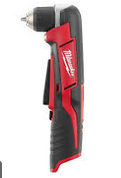
A fair question is: Why not just use a basic cordless drill? My M12 standard (pistol grip) cordless drill has more reasonable speeds, is reversible, and doesn’t require the mandrel workarounds. But the polisher / sander is noticeably lighter (1.6 lbs vs. 2.5 for the drill) and its shorter snout makes it more agile and easier to control. My M12 cordless right angle drill is light and agile-I quite like it for precision sanding—but it is not good for the bottoms of bowls. So, I have found the polisher / sander to be my most flexible choice among cordless options.
Conclusion
The M12 polisher / sander is not for a great choice for a turner who wants an off-the-shelf sanding tool, but with the aftermarket adapters, I quite like it. As with many of us here, I like having options (or maybe I just like having tools) and though I will continue to do most of my power sanding with my 60º and 90º angle drills, I have had fun getting this little cordless pistol-grip style sander into my arsenal.
Though I have had good success with my various corded angle drills, and an M12 cordless right angle drill, I was intrigued by this little pistol grip style polisher / sander, and so I got one. Here are my thoughts, some of which echo points that have been made in the earlier posts.
Bottom Line: This tool has several limitations and will not be for everyone, but I find it to be a light, agile addition to my power sanding arsenal.
The attached pictures show the polisher / sander beside a typical corded 60º angle drill and the little Grex pneumatic ROS.
The limitations
-First, this tool was designed primarily for machine shops and automotive detailing operations, and so it has maximum speeds (2,800 rpm and 8,300 rpm) that are too high for woodturning sanding applications.
-Second, the tool has no reverse (this stems from its intended use with 2” screw-on Roloc sanding discs, which would screw off in reverse).
-Third, in an attempt to capture the accessories market, Milwaukee gave this tool a very rare—virtually proprietary—mandrel thread (female M9 x 0.75). As a result, aftermarket adapters are required to use 2” hook-and-loop sanding discs, which many of us consider to be standard fare.
Here are my thoughts on the limitations.
I have found that the speed of the M12 is manageable with the variable speed trigger, such that, in low gear (0-2800 rpm) it can run somewhat steadily at the speeds I want for sanding, usually around 250-500 rpm. It would be much better if you could dial-in your max speed and just squeeze the trigger. I might kluge some sort of limiting stop, but that will be a distant second-best.
I take advantage of the full 2,800 rpms when buffing. This tool has become my preferred method of buffing with a hand tool off the lathe, because its lightness allows me to hold the piece in one hand and the tool in the other. I recently buffed a dozen bowls through 3 grits in one session, quite painlessly. I spin non-woven polyester pads held by a 2” or 3" hook-and-loop sanding pad for this type of buffing, and the little Milwaukee is very nice addition to my options in this application.
The oddball M9 thread is a frustration, but not a fatal one. The tool comes with a 3” hook-and-loop pad, so that format is covered for as long as the supplied pad lasts. The 2” mandrel, however, has a dedicated Roloc pad. You can get a Roloc-to-hook-and-loop adapter pad, and you are good for 2” hook-and-loop sanding discs as long as you don’t sand in reverse.
But the better solutions to the M9 mandrel thread are the aftermarket thread adapters. The market reacted quickly to Milwaukee’s idiocy and produced adapters that convert the useless 9mm x.075 female thread to standard 1/4-20 male and 5/16-24 female threads. I got both adapters (from Amazon) for about $10 each, and so I can mount garden variety 2” and 3” pads made for shafts with 1/4-20 and 5/16-24 threads. (For a ready-made solution, Turningwood sells the very good Skilton 2” and 3” pads with the adapter already installed, so you can attach the Skilton pads directly to the Milwaukee.) There is also an adapter (offered on Amazon) that is a collet holder with 1/8” and 1/4” collets, but many sanding mandrels are hex shafts, so this collet adapter would be somewhat limited.
Comparisons
I have the little Grex pneumatic ROS, which I find to be excellent for fine sanding. Though the Milwaukee polisher / sander is a bit bigger, I find it to be similar in feel and it has the extra agility of not being attached to an air line. Also, it is capable of being much more aggressive than the Grex when that is what you want. I like them both, for different applications.
A fair question is: Why not just use a basic cordless drill? My M12 standard (pistol grip) cordless drill has more reasonable speeds, is reversible, and doesn’t require the mandrel workarounds. But the polisher / sander is noticeably lighter (1.6 lbs vs. 2.5 for the drill) and its shorter snout makes it more agile and easier to control. My M12 cordless right angle drill is light and agile-I quite like it for precision sanding—but it is not good for the bottoms of bowls. So, I have found the polisher / sander to be my most flexible choice among cordless options.
Conclusion
The M12 polisher / sander is not for a great choice for a turner who wants an off-the-shelf sanding tool, but with the aftermarket adapters, I quite like it. As with many of us here, I like having options (or maybe I just like having tools) and though I will continue to do most of my power sanding with my 60º and 90º angle drills, I have had fun getting this little cordless pistol-grip style sander into my arsenal.


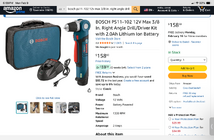
 . One of them does get warm but I’ve used these extensively for three years now (I spend four or five days a week in the shop 6-7 hours a day and there still going strong. I bought some cheap Twelve volt batteries(around twenty bucks) from amazon ,they don’t last per charge as long as the Bosch but they still work. I bought the second drill as drill only(no charger or case )for about 85 bucks.