What is the best epoxy/resin to use for a pine cone bowl

-
Congratulations to David Bartell, People's Choice in the March 2026 Turning Challenge (click here for details) -
Congratulations to Chris Lawrence for "Dragon's Grip" being selected as Turning of the Week for March 30, 2026 (click here for details) -
Welcome new registering member. Your username must be your real First and Last name (for example: John Doe). "Screen names" and "handles" are not allowed and your registration will be deleted if you don't use your real name. Also, do not use all caps nor all lower case.
You are using an out of date browser. It may not display this or other websites correctly.
You should upgrade or use an alternative browser.
You should upgrade or use an alternative browser.
Resin question
- Thread starter Ross Schuler
- Start date
Alumilite. It's a urethane resin and has a very low shrink rate. Polyester resins shrink and will cause issues when casting around included materials. One thing about Alumilite, it is very intolerant with moisture. You'll need to bake the pine cones to make them bone dry.
Thank you I will try itAlumilite. It's a urethane resin and has a very low shrink rate. Polyester resins shrink and will cause issues when casting around included materials. One thing about Alumilite, it is very intolerant with moisture. You'll need to bake the pine cones to make them bone dry.
Do you have to use pressure to reduce bubbles?Alumilite. It's a urethane resin and has a very low shrink rate. Polyester resins shrink and will cause issues when casting around included materials. One thing about Alumilite, it is very intolerant with moisture. You'll need to bake the pine cones to make them bone dry.
You can also use a two part epoxy. You'll struggle with Alumilite without pressure and 0% moisture. There are now two epoxies on the market specifically formulated for turning-- Royal Palm and Liquid Diamonds. They might be the same thing, actually. Both companies offer a low viscosity formula that is truly water-thin. You can get great results without a pressure or vacuum chamber with those.
Here are a couple recommendations for getting by without pressure:
If you have a vacuum chamber, degas the mixture
Use vibration when pouring. I have a HF orbital sander that orbits your hand while the sandpaper stays stationary. Great for vibrating out bubbles in your pour.
If you're coloring the resin, a few small bubbles are less of an issue than if you do clear. I would not want to try doing 100% clear castings without a pressure pot.
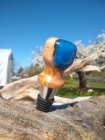
EDIT: I've even had good (but not great) luck with thicker epoxies using a vacuum chamber to degas, and vibration when pouring. Here's a bottle stopper I did with cheap Clearcast 7000 resin on unstabilized Maple using Acrylic paint for color. Definitely the cheapest resin/color combo out there. I did degas and use vibration while pouring and there are still a few stray bubbles, but the glitter in the paint helps camouflage.
Here are a couple recommendations for getting by without pressure:
If you have a vacuum chamber, degas the mixture
Use vibration when pouring. I have a HF orbital sander that orbits your hand while the sandpaper stays stationary. Great for vibrating out bubbles in your pour.
If you're coloring the resin, a few small bubbles are less of an issue than if you do clear. I would not want to try doing 100% clear castings without a pressure pot.
EDIT: I've even had good (but not great) luck with thicker epoxies using a vacuum chamber to degas, and vibration when pouring. Here's a bottle stopper I did with cheap Clearcast 7000 resin on unstabilized Maple using Acrylic paint for color. Definitely the cheapest resin/color combo out there. I did degas and use vibration while pouring and there are still a few stray bubbles, but the glitter in the paint helps camouflage.
Last edited:
I just ordered some Royal palm resin--I do have a pressure potYou can also use a two part epoxy. You'll struggle with Alumilite without pressure and 0% moisture. There are now two epoxies on the market specifically formulated for turning-- Royal Palm and Liquid Diamonds. They might be the same thing, actually. Both companies offer a low viscosity formula that is truly water-thin. You can get great results without a pressure or vacuum chamber with those.
Here are a couple recommendations for getting by without pressure:
If you have a vacuum chamber, degas the mixture
Use vibration when pouring. I have a HF orbital sander that orbits your hand while the sandpaper stays stationary. Great for vibrating out bubbles in your pour.
If you're coloring the resin, a few small bubbles are less of an issue than if you do clear. I would not want to try doing 100% clear castings without a pressure pot.
EDIT: I've even had good (but not great) luck with thicker epoxies using a vacuum chamber to degas, and vibration when pouring. Here's a bottle stopper I did with cheap Clearcast 7000 resin on unstabilized Maple using Acrylic paint for color. Definitely the cheapest resin/color combo out there. I did degas and use vibration while pouring and there are still a few stray bubbles, but the glitter in the paint helps camouflage.
View attachment 29002
Please share your progress. I've been working with System Three 15 minute and find my shop it too cold. Looks like casting up north will be a summer project.
I plan on bringing the pressure pot into a heated laundry room for the first 48 hrsPlease share your progress. I've been working with System Three 15 minute and find my shop it too cold. Looks like casting up north will be a summer project.

- Joined
- Feb 6, 2010
- Messages
- 3,520
- Likes
- 2,597
- Location
- Brandon, MS
- Website
- threeringswoodshop.square.site
A friend of mine said he has changed from Alumalite to Liquid Diamonds as it is less fussy and no vacuum chamber required.
A friend of mine said he has changed from Alumalite to Liquid Diamonds as it is less fussy and no vacuum chamber required.
I highly recommend degassing the mix in a vacuum chamber.
I have been mixing some of the epoxies indoors lately, with some ventilation. Very little fumes in the modern casting epoxies. Royal Palm shouldn't need to be under pressure for 48 hours. I usually demold after about 30-36 hours.