• The forum upgrades have been completed. These were moderate security fixes from our software vendor and it looks like everything is working well. If you see any problems please post in the Forum Technical Support forum or email us at forum_moderator (at) aawforum.org. Thank you
  • April 2026 Turning Challenge: Salad Bowl! (click here for details)
  • Congratulations to David Bartell, People's Choice in the March 2026 Turning Challenge (click here for details)
  • Congratulations to Ted Pelfrey for "Cherry Blossoms on Cherry" being selected as Turning of the Week for April 27, 2026 (click here for details)
  • Welcome new registering member. Your username must be your real First and Last name (for example: John Doe). "Screen names" and "handles" are not allowed and your registration will be deleted if you don't use your real name. Also, do not use all caps nor all lower case.

Small jewelry box ideas

Joined
Jan 12, 2014
Messages
499
Likes
2,111
Location
Crossville, TN
My wife wants me to make niece a smallish jewelry box. Says the inside needs to be flattish. Hard to get a pleasing outside shape that way. I would like to put on small pedestal. Needs a lid. Thinking 5 to 6” diameter . Any ideas? Pics would be great! Thanks
 
Right away, without a firm design, I think about starting with a 5/4" or 6/4" thick board for a bottom, a 3/4" board for a top, and 3 pegs as feet (instead of a pedestal) and a finial grab handle on the lid. You'll need a finial on the lid for a 5-6" diameter, she may not be able to grab that lid one-handed from the rim.

You could start with an even wider diameter base board, shaping a pleasing profile on the exterior diameter, to allow for a squarish/flattish interior. Consistent wall thickness outside to inside is not important.

First, shape the exteriors dish-like with decorative shoulder-tenon provisions to chuck-grab each piece from the finished exterior, like Raffan does, to be able to turn the insides second. While turning the outsides, drill deep holes for peg feet (short or long peg feet, your choice) and a sturdy finial lifting peg for the lid and glue them in (the feet and finial will need to be made first), then turn the base and lid interiors allowing the peg tenons to be visible as a finished detail. I think I'd want a good 3/16" of thickness left at the lid and base to assure durable glue joints at the feet and finial.

The lid can be fitted to the base as an interior recess fit to the base, or overlap the base, your choice. I would not seek the ego-boosting suction fit lid design- design the lid for easy one-handed on-off.

I suppose peg feet are important only if trying to maximize the volume of the base piece. Otherwise, a traditional/typical bowl foot design works too, skipping the three peg feet. A thicker base stock would allow for a taller bowl foot to create a pedistal appearance.

That's just a general, vague starting design that comes to my mind. I know Raffan has some similar lidded box/jewelry box design videos on utoob that you could scale up or down. Maybe use complimentary woods for base and lid. Have fun! (Huh, I should make one!)
 
Last edited:
I had a small piece of box elder that I wanted to utilize in a way to keep the red color. I decided I would cut some disks that will become round stacking trays inside a turned box for jewelry. I'm not done with it, so no photos, but maybe just the description will help inspire something.
 
I’d suggest you ask Google images. At 5-6” diameter, you want the lid to be a little looser to handle seasonal wood movement.
 
I would suggest that you use segmented rings and birch plywood for the bottom. The segmented walls would allow for the straight walls inside and a small amount of detail on the outside. The birch plywood is available in small sheets of various thicknesses and could be glued on the bottom in a dado so it would not be visible on the outside. The inside could be turned to a larger diameter on the top half thus producing a shelf for a tray inside. The top or the bottom could be made from 4 segmented plywood layers that you would make yourself.
IMG_1058.jpg This is a piece that I made for use as a blank for a lid. The segmented lid will be stable and will not have misalignment of the segments in the middle. The 4 segment layers should be an odd number of 3,or 5 and about 1/8" thick. The method I use so far has proven to be stable through the annual weather cycle, If this idea is of interest to you I could provide more detail for creating the layers.
 
I would bet she'd prefer a one-hand lid, so it could be a 'box' turned face-grain, or the traditional end grain box with the lid fit not snug. A flat bottom shouldn't be a limiting factor--Ray Key said the inside shape of a box doesn't have to match the outside shape, and if Ray said it, then it must be true. (I find a Hunter tool gives me a good inside box bottom, whatever variety I choose)
 
Well, first off, flat work or turned? If you are going to turn it, you have to rough turn it first, and then let it sit for 6 or so months so the wood can adjust to stock removal. I would even rough turn a tenon and recess as part of this step. You could also do a tray to fit inside the box and leave a step in the box interior for the tray to sit on. The tray could be compartmentalized if you want. I would rough turn the tray as well.

robo hippy
 
I have half a dozen on the go at present in Beach, glue up off cuts. But if you want some idea on small boxes look up Mike Stafford the Master of box making
 
Last edited:
Well, first off, flat work or turned? If you are going to turn it, you have to rough turn it first, and then let it sit for 6 or so months so the wood can adjust to stock removal. I would even rough turn a tenon and recess as part of this step. You could also do a tray to fit inside the box and leave a step in the box interior for the tray to sit on. The tray could be compartmentalized if you want. I would rough turn the tray as well.

robo hippy
Turned. But the tray inside would solve my problem, then I could turn any shape I want and still have a shallow flat area. Thanks Robo!
 
Interesting,
Someone says jewelry box and my lathe is the last thing that is on my mind,

but burl veneers or instrument grade curly boards and tiny brass hardware pieces with velvet liners and detailed box or dovetail joints definitely is.
Hmmm
 
The OP asked about a small jewelry box. The ones I made were about 8" by 12" with an interior height around 2" which could be considered small to medium.

They were Baltic birch plywood with exotic veneer and trim. Hinged lid with a mirror on the inside and metal locking clasp able to be easily opened with one hand. One of mine was weighted with a steel plate sandwiched between two layers of bottom, that gave a more substantial feel to the box. No turning although there could have be a turned piece on the top to open the lid.

To me a jewelry box is a utilitarian object with large interior with respect to the exterior. It can also be attractive. I can't quite visualize how turning would accomplish this.
 
My wife wants me to make niece a smallish jewelry box. Says the inside needs to be flattish. Hard to get a pleasing outside shape that way. I would like to put on small pedestal. Needs a lid. Thinking 5 to 6” diameter . Any ideas? Pics would be great! Thanks

I've made a number, sorry no photos. The biggest question for me - how much and what kind of jewelry will go in this box? Shallow, wide, and flat on the inside bottom is important to find things. Rings, brooches, pendants without chains, etc are good in such boxes. Both ear rings of a pair may be difficult to find both with too much in the box. Necklaces with fine chains in a jewelry box can be a nightmare - over the years I've spent a lot of time untangling fine chains.

A shallow box with flat bottom does limit the design somewhat. A decorative lid can add a lot to the look as can feet (carved or attached) to lift it a bit from the surface. Unlike a typical bowl/hollow form, there is no reason the outside shape needs to echo the inside (unless the wood is not dry - need some dry wood?) Regardless of the shape outside, straight or slightly inwardly tapered inside walls canmake it easier to find and access things compared to a container wider at at the inside bottom.

I think something VERY important is to NOT make a box with a "woodturners" suction fit. In my humble opinion this type of lid fit has ONLY one use - to impress other woodturners. Ask people who actually use boxes for jewelry, in the kitchen, etc, - they want a lid they can lift with one hand without holding the box body in the other hand! (The exception is a tiny box made as a needle case or pill box that may be carried in a bag or pocket so it won't open accidentally.)

What I sometimes do when designing something for someone else is make sketches of a bunch of options. These are usually side views, not all necessarily to scale, some with the front of one side cut away to show the shape of the inside. I may make a few or a bunch of quick sketches and let the person look and comment, returning to the drawing board if needed! Then maybe make a quick prototype for approval! (This method may not appeal to those who like to let the wood "speak to them" while designing at the lathe.

About wood, one thing I like to keep in mind: if the shape and form is interesting or detailed, the wood can be plain. If the form is simple it might be time to get out that treasured piece of cocobolo, burl, birdseye, or fiddleback maple!

The big question I'd ask: how much jewelry does she want in this box at one time? Is it a place to temporarily put a few things after use that day or the day before? Or a place to store jewelry for a longer term?

My Lovely Bride has a LOT of jewelry acquired over the last 1/2 century during various trips, commissioned by some artists, and some made by me in my lost-wax sliver casting days of over 50 years ago. She has struggled with the problem of storing these so she can find exactly what she wants quickly. A turned box on the dresser would be useless to her for storage since she couldn't find anything. (Failing vision makes it worse!)

We have several beautiful jewelry boxes made of flatwood with lids and drawers but she doesn't use them much.

What she finally settled on is keeping everything but necklaces in the large top drawer of the dresser. She has a stack of what look like plastic ice cube trays, each spot containing just one pair of earrings.

She has a number of small flat boxes each with things like pearl necklaces that don't have fine chains that might tangle easily, and accompanying ear rings or other accessories. Each small flat box is labeled on top so no hunting is needed.

For necklaces with fine chains that can get tangled, she hung a tall necklace organizer on a hook on the back of a door, wide wire hooks with two rows of 16 spaces for chains, soft black velour background so all are easy to see.

Rings go in a special box with shallow angled slots to make finding the right one easy. Rings used often go on turned ring keepers for quick access (a popular item for other family and friends as well, and quick to make!) Can put 4-5 rings on one keeper.
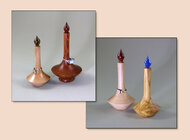
1772029100466.jpeg

(Things rarely worn but with some sentimental or monetary value go in the safe!)

Sorry, I have no good specific suggestions for your jewelry box question except to make the lid loose enough to lift with one hand (a tapered-fit lid is perfect for this - it can't possibly stick.)

Knowing more about the needs/desires may get more useful suggestions!

JKJ

 
Back
Top