
Here's an old tip about turning a 3-corner bowl from a cube. Many may already know of this technique but if not, maybe give it a try!
Many moons ago someone in our Knoxville club did a demo on starting with a cube and making a bowl-like thing with three corners. I had some fun playing with the idea, turning a couple for practice, one off-axis, then this piece where I joined two, inverting the smaller one to make "feet".
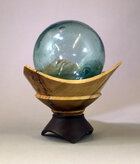
I used some type of spalted wood for the top and I think maybe African Mahogany for the base. The plan was for the smaller, darker base to lift the top off the table without, I hope, visually detracting from the upper part. I think the small bevel part way down the upper section echos the upper rim and helps to draw the eye to the spalting. If I'd thought of it at the time I might have made the angle of that bevel a little different and added a sloped groove at the top of the bevel to make it look a bit like a 3-corner bowl resting in a shallow round bowl on a 3-corner base! Maybe next time...
A kind gentleman brought me the antique glass fishing net float from one of his trips to Indonesia.
(I think the color combination is nice!)
Then, just today I was searching my email for something else and found a note from over 10 years ago with a link to the video below, an excellent tutorial for turning 3-cornered things from a cube. You may recognize the wizard who made the video.
I don't use the table saw to start but otherwise mostly use the same techniques. I think I held the opposing corners of the cubes between cup centers to turn a tenon for the chuck, turned another tenon in the top to allow shaping the base, then reversed and turned the inside of the bowl.
View: https://m.youtube.com/watch?v=VITQnHJnhFs
(I see the wizard uses the same trick I often use when crosscutting blocks on the bandsaw - I wonder how many others have independently come up with this method! It assumes the table is perpendicular to the blade, of course.)
JKJ
Many moons ago someone in our Knoxville club did a demo on starting with a cube and making a bowl-like thing with three corners. I had some fun playing with the idea, turning a couple for practice, one off-axis, then this piece where I joined two, inverting the smaller one to make "feet".
I used some type of spalted wood for the top and I think maybe African Mahogany for the base. The plan was for the smaller, darker base to lift the top off the table without, I hope, visually detracting from the upper part. I think the small bevel part way down the upper section echos the upper rim and helps to draw the eye to the spalting. If I'd thought of it at the time I might have made the angle of that bevel a little different and added a sloped groove at the top of the bevel to make it look a bit like a 3-corner bowl resting in a shallow round bowl on a 3-corner base! Maybe next time...
A kind gentleman brought me the antique glass fishing net float from one of his trips to Indonesia.
(I think the color combination is nice!)
Then, just today I was searching my email for something else and found a note from over 10 years ago with a link to the video below, an excellent tutorial for turning 3-cornered things from a cube. You may recognize the wizard who made the video.
I don't use the table saw to start but otherwise mostly use the same techniques. I think I held the opposing corners of the cubes between cup centers to turn a tenon for the chuck, turned another tenon in the top to allow shaping the base, then reversed and turned the inside of the bowl.
(I see the wizard uses the same trick I often use when crosscutting blocks on the bandsaw - I wonder how many others have independently come up with this method! It assumes the table is perpendicular to the blade, of course.)
JKJ