• The forum upgrades have been completed. These were moderate security fixes from our software vendor and it looks like everything is working well. If you see any problems please post in the Forum Technical Support forum or email us at forum_moderator (at) aawforum.org. Thank you
  • February 2026 Turning Challenge: Cookie Jar! (click here for details)
  • Congratulations to Matt Carvalho for "Red Mallee Folded Form" being selected as Turning of the Week for February 9, 2026 (click here for details)
  • AAW Symposium demonstrators announced - If the 2026 AAW International Woodturning Symposium is not on your calendar, now is the time to register. And there are discounts available if you sign up early, by Feb. 28. Early Bird pricing gives you the best rate for our 40th Anniversary Symposium in Raleigh, North Carolina, June 4–7, 2026. (There are discounts for AAW chapter members too) For more information vist the discussion thread here or the AAW registration page
  • Welcome new registering member. Your username must be your real First and Last name (for example: John Doe). "Screen names" and "handles" are not allowed and your registration will be deleted if you don't use your real name. Also, do not use all caps nor all lower case.

Trays - flat bottoms

Joined
Mar 11, 2018
Messages
13
Likes
7
Location
Vancouver, BC
Hi everyone. I've just started to try and turn some flat bottom trays/bowls. I swear that I saw an article in the American Woodturner about turning flat bottom platters or trays, but I can't seem to find it. Am I imagining things, does anyone know if one was published. I tried searching but noting came up. Anyways I'm looking for some hits/suggestions/tricks. I've included a picture of a small one I just did.
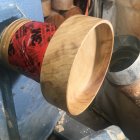

IMG_5935.JPG
 
A perfectly flat bottom might be practically impossible because the seasonal changes in humidity will cause the wood to change shape slightly. If I am making a platter I go for a very slight barely noticeable dish shape. This way you can eliminate the ripples-in-the-pond effect of a flat bottom. Personally I wouldn't use vertical sides for two reasons:
  • There's a greater chance over time that seasonal movement will cause the side to develop a crack
  • The vertical sidewall interferes with tool usage to work on the bottom whether you want a flat or curved bottom
I don't remember an article on this subject, but then I don't remember a lot of stuff since becoming a geezer.
 
The simplest way would be to use a paper joint with a glue block. If you already have a flat bottom piece of wood just glue the glue block to the bottom with a piece of paper in between. When your finished turning just push a knife through the joint and pop it off. The paper and glue can be cleaned off with White vinegar or you can scraper and sand it off.
to turn a flat bottom you could turn the plate and then reverse turn the bottom using a jam chuck or best of all a vacuum chuck.
 
If you use a vacuum chuck to reverse, use minimum vacuum. Otherwise, spring-back after vacuum is released may lead to a rocking bowl.
 
Thanks for the replies so far, just to clarify, when I say flat bottom I referring to the inside, not to the bottom that is sitting on the table, for that I know it needs to be dished out slightly.

Dennis thanks for the comment on min vacuum pressure. I just had that happen on a one that I had turned a bit thinner then planned. Easily fixed with some sand paper laid down on my table saw.
 
Back
Top