
-
Congratulations to David Bartell, People's Choice in the March 2026 Turning Challenge (click here for details) -
Congratulations to Chris Lawrence for "Dragon's Grip" being selected as Turning of the Week for March 30, 2026 (click here for details) -
Welcome new registering member. Your username must be your real First and Last name (for example: John Doe). "Screen names" and "handles" are not allowed and your registration will be deleted if you don't use your real name. Also, do not use all caps nor all lower case.
You are using an out of date browser. It may not display this or other websites correctly.
You should upgrade or use an alternative browser.
You should upgrade or use an alternative browser.
Wood identification
- Thread starter Bill Erickson
- Start date

- Joined
- Feb 6, 2010
- Messages
- 3,520
- Likes
- 2,597
- Location
- Brandon, MS
- Website
- threeringswoodshop.square.site
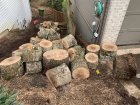
Not Maple but may be some type oak

Looks like red oak to me.

- Joined
- Apr 27, 2004
- Messages
- 9,334
- Likes
- 6,159
- Location
- Lakeland, Florida
- Website
- www.hockenberywoodturning.com
From the leaves maybe Oregon Myrtle.
The flower buds - do not look like those of oaks or maples I am familiar with.
I am an east coast guy.
@robo hippy may know
The flower buds - do not look like those of oaks or maples I am familiar with.
I am an east coast guy.
@robo hippy may know
Last edited:

From the leaves maybe Oregon Myrtle.
The flower buds - do not look like those of oaks or maples I am familiar with.
I am an east coast guy.
@robo hippy may know
Al… leaves? flower buds? The only leaves and possibly buds I can spot clearly enough are from rhododendrons in the lower left and way down the slope in the background. Definitely not myrtle as its leaves are smaller, less glossy and leathery.
I’m agreeing the logs are probably a red or white oak. I turn a fair bit of it and like it but both have fairly high drying differential between side grain and end grain and will crack if left too thick in a rough-out. One of my favorite ways to work Oregon white oak is to turn it wet to final thickness with a very good surface finish off the tools and let it warp and do what it wants to do. I then hand-work the surface, flatten the bottom, and often ammonia fume it, before varnish/oil finishing.
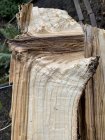
I'd have to see a close up of the end grain to see medullary rays to call it oak. I don't see any flecking in that split piece. Also really big growth rings in the split piece, not a characteristic of white oak. The split piece reminds me more of ash.

Whatever it is, it was cut into very short blocks. Rip them through the pith and get some sealer on the cut ends or put them in bags until you can turn them.

- Joined
- Jan 27, 2005
- Messages
- 13,223
- Likes
- 5,851
- Location
- Dalworthington Gardens, TX
- Website
- pbase.com
It's definitely FOG* wood. 
I agree with Richard. The pictures aren't good enough to even make a guess. What is needed is a very close up shot of the end grain (from a few inches away and in very sharp focus) so that the fine details of the growth rings can be examined.
I also agree with Dean's comment that the blocks should have been longer. You can still get turning blocks out of the wood, but they will just be smaller.
* FOG = Found On Ground, wood having an indeterminate taxonomy.
I agree with Richard. The pictures aren't good enough to even make a guess. What is needed is a very close up shot of the end grain (from a few inches away and in very sharp focus) so that the fine details of the growth rings can be examined.
I also agree with Dean's comment that the blocks should have been longer. You can still get turning blocks out of the wood, but they will just be smaller.
* FOG = Found On Ground, wood having an indeterminate taxonomy.
On occasion I have used Google Earth and Google Map to use the satellite image or road view image of a street address to identify a tree that has been cut down. If they list "firewood" on Craigslist and do not list the type of tree/wood that is available and they show a picture of a tree that has been felled I check for the street address and use the Google App to view the tree before it was cut down. Most of these images will show the shape of the tree and the street view you can usually get a good view of the tree bark and leaf shape to determine the wood species.
Well, not myrtle/California Bay Laurel. No clue really, could be several types of wood. Bring a chunk down to the Oregon Woodturning Symposium.... Next weekend...
robo hippy
robo hippy
That is so clever. Kudos to you, Mike!On occasion I have used Google Earth and Google Map to use the satellite image or road view image of a street address to identify a tree that has been cut down. If they list "firewood" on Craigslist and do not list the type of tree/wood that is available and they show a picture of a tree that has been felled I check for the street address and use the Google App to view the tree before it was cut down. Most of these images will show the shape of the tree and the street view you can usually get a good view of the tree bark and leaf shape to determine the wood species.
- Joined
- Jan 27, 2005
- Messages
- 13,223
- Likes
- 5,851
- Location
- Dalworthington Gardens, TX
- Website
- pbase.com
On occasion I have used Google Earth and Google Map to use the satellite image or road view image of a street address to identify a tree that has been cut down. If they list "firewood" on Craigslist and do not list the type of tree/wood that is available and they show a picture of a tree that has been felled I check for the street address and use the Google App to view the tree before it was cut down. Most of these images will show the shape of the tree and the street view you can usually get a good view of the tree bark and leaf shape to determine the wood species.
It's sort of like time traveling back a few years, but if Google hears of this they might start putting fuzzy spots over the trees because this voyeurism is an invasion of the tree's privacy.