• December 2025 Turning Challenge: Single Tree! (click here for details)
  • Congratulations to Bob Henrickson, People's Choice in the November 2025 Turning Challenge (click here for details)
  • Congratulations to Steven Gordon for "Dropped Ice Cream Cone" being selected as Turning of the Week for December 8, 2025 (click here for details)
  • Welcome new registering member. Your username must be your real First and Last name (for example: John Doe). "Screen names" and "handles" are not allowed and your registration will be deleted if you don't use your real name. Also, do not use all caps nor all lower case.

A way to turn accurate dowel / tenons

Joined
Oct 20, 2025
Messages
12
Likes
154
Location
Frankfort, KY
I like to make tools, I picked this up on the internet, and thought it might be worth sharing.

I bought a set of the cheapest combination wrenches that HF had to sell, 1/4" to 3/4", 9 pieces for less than $12.
You can use them as is as a fixed caliper for cutting a dowel or pin on the end of a spindle, which makes a very accurate, tight joint.

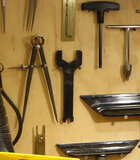
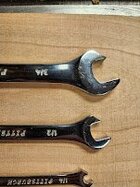
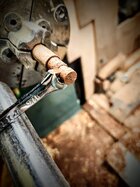
You can modify them into cutting tools by grinding of one side of the jaw of the open end wrench to around 38 degrees. (first picture).

The jaw sides are parallel, so if you have a square table on a disk or belt sander, just hold the wrench flat on the table and grind to the angle. I did not measure the angle, just tried to eyeball it to that of a skew. It is important to have the cutting edge at 90 degrees to the center of the wrench. I did not hone mine, they cut well with just the grind.

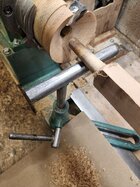
To use them, rough cut the space you want the to be the dowel, about 1/16" to 3/32" larger than finish, then set the tool rest with enough clearance for the open end of the wrench to clear the tool rest, with the height set so that the upper jaw, (cutting edge) is in line with the top of the cut. Apply slight downward pressure to the back of the wrench, so the longer jaw is rubbing the bottom of the dowel, (2nd picture) then feed the tool into the cut. If the pin is longer than the width of cut, reset and push in again. ( I have not had any luck moving the tool from side to side.)

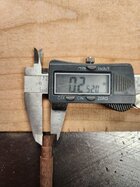
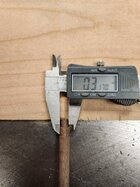
I took a 3/8" walnut dowel as a sample, used a parting tool to set the shoulder, then used the 5/16" wrench to size 5/8" of the end of the dowel , then parted a shoulder and used the 1/4" wrench to size the end. In picture 3, it shows the pin is 2 thousands of an inch larger than 1/4", and picture 4 shows the 5/16" pin is also .002 larger. both should fit nicely into its respective hole.

The cut is not glass smooth, so the glue will have small spaces to accumulate.

WH
 

Attachments

  • w1.jpg
    w1.jpg
    9.7 KB · Views: 53
  • w2.jpg
    w2.jpg
    46 KB · Views: 56
  • w3.jpg
    w3.jpg
    58 KB · Views: 52
  • w4.jpg
    w4.jpg
    54.6 KB · Views: 51
A good topic, one of my favorites. Turning a perfect cylinder of arbitrary diameter can be harder than it might seem. Turning a sloppy cylinder is easy.

People have their own methods for sizing. The method used may depend on how the cylinder will be used. Some use various versions of the wrench method.

I'm not knocking the wrench method - it's a old, well-proven method, However, I don't use it for several reasons. The diameters are limited to a set of discrete sizes. Modifying a set of good open-end wrenches can be expensive - not a problem if a supply of old wrenches is at hand. Also, the steel is typially not hardened HSS so it can't be sharpened into a long-lasting cutting edge. Some people don't modify the wrench but just use it with a wide parting tool for sizing.

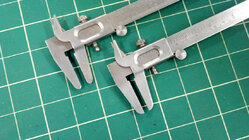
Here's my method. I round the "points" on some cheap vernier calipers, such as that at the top of this picture. (The one at the bottom is unmodified.) I bought a bunch of these when I found them for about $4 each on Amazon. I never measure with this type of caliper but set them to the desired size by another method.

When turning cylinders, I set one to the desired final diameter, plus a "smidgen".

1762023731802.jpeg

I use a very sharp diamond parting 1/8" tool to make a series of sizing cuts while holding the caliper in the groove. The thin steel of these cheap calipers easily slides into the 1/8" parting tool groove. The rounded tips let the calipers slip easily over the spinning wood without catching. After rough sizing, if appropriate, I use a skew ground flat across to make peeling cuts close to but a bit larger than the sized diameter, or if the spindle is thing, use planing cuts.
Finish up with planing cuts with a sharp skew.

To dress the cylinder to a perfect flat axial surface, if needed, sanding sticks made by gluing various grits of sandpaper on lengths of flat hardwood board are perfect.

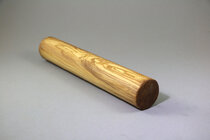
This method has worked for me for years and is not limited in size. For example, our resident chef prefers a rolling pin without handles - she said she can feel the dough better when rolling with her hands on the top of the rolling pin instead of with handles. I've also made "french" style rolling pins, but she didn't like those either. So about six years ago I made this "forever" rolling pin from dry Olivewood to her specifications. It's 2" in diameter, 12.5" long, end "corners" slightly rounded. The actual dimensions are not as important as the cylinder having a consistent diameter and made very straight down the length.

Rolling_pin_olive_IMG_8137.jpg

It get's used often. At this very moment, there is a fresh apple pie baking in the oven. Life is good.

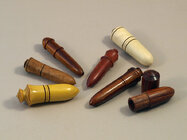
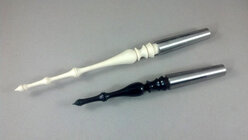
I use a similar method to cut precise tenons for small boxes, such as these needle/pill cases: I cut the lid mortise first, then size the tenon just like turning a larger lidded box. A little trickier since that tenon is relatively long.

1762025148111.jpeg

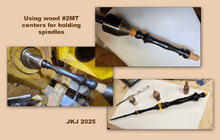
BTW, I keep one pair of calipers pre-set and locked to let me quickly turn short #2 morse tapers to hold thin spindles in the headstock. This method has several advantages over using centers, chuck, or collets. The two diameters that define the 2MT must be precise. (I've had a bit of practice while turning 100s of these.) I make two lines 1/2" apart, size at each line, then cut a taper between with a bit of clearance. One big advantage over a chuck is a partially finished piece can be removed from the lathe and remounted later with perfect registration. Detailed instructions are in my doc "Turning Thin Spindles".

1762024341588.jpeg

Sorry if this seems to have strayed off topic but I think it's related since the cheap calipers do provide a valid and flexible alternate sizing method.

Also, if the goal is is to simply make dowels and perhaps more than one or two are needed, there are other methods, including dowel/tenon cutters and dowel plates. These are fast and precise, aren't free, but for small diameter dowels may help with the issue of vibration while turning.

JKJ
 
If I need a gauge or jig I tend to make to suit my requirements. What you have described here looks like what the old chair bodgers you to make for green wood turning.
 
...What you have described here looks like what the old chair bodgers you to make for green wood turning.

Where would one find a copy of that book? I'd love to read it. I checked the stuartking web site but didn't see if it could be ordered.

JKJ
 
I like to make tools, I picked this up on the internet, and thought it might be worth sharing.

I bought a set of the cheapest combination wrenches that HF had to sell, 1/4" to 3/4", 9 pieces for less than $12.
You can use them as is as a fixed caliper for cutting a dowel or pin on the end of a spindle, which makes a very accurate, tight joint.

You can modify them into cutting tools by grinding of one side of the jaw of the open end wrench to around 38 degrees. (first picture).

The jaw sides are parallel, so if you have a square table on a disk or belt sander, just hold the wrench flat on the table and grind to the angle. I did not measure the angle, just tried to eyeball it to that of a skew. It is important to have the cutting edge at 90 degrees to the center of the wrench. I did not hone mine, they cut well with just the grind.

To use them, rough cut the space you want the to be the dowel, about 1/16" to 3/32" larger than finish, then set the tool rest with enough clearance for the open end of the wrench to clear the tool rest, with the height set so that the upper jaw, (cutting edge) is in line with the top of the cut. Apply slight downward pressure to the back of the wrench, so the longer jaw is rubbing the bottom of the dowel, (2nd picture) then feed the tool into the cut. If the pin is longer than the width of cut, reset and push in again. ( I have not had any luck moving the tool from side to side.)

I took a 3/8" walnut dowel as a sample, used a parting tool to set the shoulder, then used the 5/16" wrench to size 5/8" of the end of the dowel , then parted a shoulder and used the 1/4" wrench to size the end. In picture 3, it shows the pin is 2 thousands of an inch larger than 1/4", and picture 4 shows the 5/16" pin is also .002 larger. both should fit nicely into its respective hole.

The cut is not glass smooth, so the glue will have small spaces to accumulate.

WH
WH,

Thank you for posting this. I’ve seen this idea in the past but not tried it yet.

I often use a ¾” tenon for holding a piece in a collet chuck. So I want to try it.

Rich
 
Where would one find a copy of that book? I'd love to read it. I checked the stuartking web site but didn't see if it could be ordered.

JKJ
found this
The main publication about chair bodgers is "Going with the Grain: Making Chairs in the 21st Century" by Mike Abbott, which serves as a comprehensive guide to the traditional craft. Other relevant resources include historical accounts, such as the 1950s newsreel showing the last true bodgers, and general books on woodworking like Drew Langsner's work, which provides context and techniques for those interested in the craft.

Primary book
  • "Going with the Grain: Making Chairs in the 21st Century" by Mike Abbott: This is the most direct and comprehensive modern guide to chair bodging.
    • It is a step-by-step guide for making chairs using traditional tools and techniques.
    • Features over 600 color photographs.
    • Covers tools, techniques, and includes projects for making three stools and three chairs.
    • It is considered a sequel to Abbott's earlier books, "Green Woodwork" and "Living Wood".

Historical resources
    • 1950s Newsreel: A YouTube video documentary titled "The CHAIR BODGERS of the CHILTERNS" shows the last of the traditional itinerant bodgers practicing their craft in the Chiltern Hills.
    • Historical accounts: Wikipedia and other sources provide historical context on the trade, including production rates and the work of specific bodgers like Samuel Rockall.
    • Lithograph print: A specific 1937 lithograph print by Clare Leighton from the book 'Country Matters' is available through antique dealers like abebooks.com.


Related publications
  • Drew Langsner's work: Books like the one linked, which include content on Windsor and post-and-rung chairs, provide detailed instructions for novice chairmakers, covering many techniques used by bodgers.
  • Mike Abbott's website: Mike Abbott's own website also has information and resources related to his books and the craft.
see here

and here
 
Thanks, I'm interested in the historical aspects, tools, lifestyle. I've read a lot and have some old books but always looking for more.
 
I use the sharpened wrench method to create tenons to receive copper ferules for file handles. I have a couple of sizes that cut perfect-fitting tenons with compressed fiber to enable a consistent press-fit for the copper rings. It’s a great method.

Tim
 
Hey JKJ,

Sorry it took me so long to reply, Your reply to my glue joint dowel cutter gave me inspiration for a project. First I would like to point out a couple of things.

the steel is typially not hardened HSS so it can't be sharpened into a long-lasting cutting edge.
Most all wrenches of today are Chrome Vanadium Steel, It is not HSS but it will harden, and is very durable.
The diameters are limited to a set of discrete sizes. Modifying a set of good open-end wrenches can be expensive - not a problem if a supply of old wrenches is at hand.
I did mention that a 9 pc set at HF was about $12. Not very expensive compared to most lathe accessories. (and they are Chrome Vanadium steel)

With all the pictures you posted, I felt one was kind of close to the thread, turning a mortice on the end of a turning spindle, It intrigued me enough to make another "Bodgers tool" as hughie put it.

The tool turns a #2 Mortice in about 45 seconds at 450 rpm. The fit is spot on.

I doubt I will use it much, I have no problems registering a spindle in my chuck, but I do want to thank you and hughie, for the idea.

The process of taking an idea, creating working drawings, making a functional prototype, and then tweaking it to a serviceable tool , is a big part of why I come out to the shop.

Thanks again,
WH
 

Attachments

  • M#2.jpg
    M#2.jpg
    59 KB · Views: 39
With all the pictures you posted, I felt one was kind of close to the thread, turning a mortice on the end of a turning spindle, It intrigued me enough to make another "Bodgers tool" as hughie put it.

The tool turns a #2 Mortice in about 45 seconds at 450 rpm. The fit is spot on.

That would be a good tool to market. I use the #2MT method oftan, probably a lot since I do a lot of spindles! (BTW, these should probably be described as a tapered tenon rather than mortice). I like your "bodgers" tool idea - I've designed some similar but never built them. This would be great if you had a repeated use for the same taper. Your photo shows a long taper, but I suspect short cutting version could be made. (Often the blanks I use are limited in length so a very short taper is a help - and all that's needed.)

I've made custom gauges from brassin the past the but calipers avoid the effort of making the gauge.

Fortunately, the tapers are quite quick to turn with just calipers and a parting tool (for those unable or don't want to make a special cutting tool). I like the flexibility and simplicity of the caliper method.

Some things to keep in mind:
  • Some lathes have a different taper length than others, so a short wood #2MT that perfectly fits one might be a little too short for a different lathe (but easily extended). If I'm making them to use on a different lathe, such as for some unknown lathe for a demo, I'll make the taper a bit longer. A fixed cutting tool may have length limitations or compromises

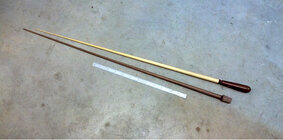
  • When using the short MTs, the tailstock end must be supported to keep the piece mounted. Where that is not possible, I tap a 1/4-20 threaded hole into the end of the taper and use a drawbar to hold it tight. (Make the tap by filing some angled grooves on the end of the 1/4-20 length of Allthread" I used to make the drawbar. Works well. I had to use the drawbar method to hold one of these (the wanut) long, tapered spindles to finish up. I supported it at first with the tailstock but when it got thin the end support was weakened so I finshed turning holding it tight with a drawbar. These are over 24" long and taper from about 1/2" down to maybe 1/8 or 1/16" Make great pointers for teachers!
pointers_IMG_20140311_11390.jpg

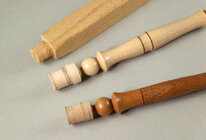
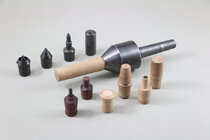
  • I often make short #2MTs to hold things in a live center in the tailstock. (I wrote about this before but will repeat in case someone interested missed it.) The Nova Live center uses a short MT taper to hold various metal points and things that are provided. I turn custom MT supports as needed. The Nova s my favorite for the flexibility so I keep several on hand for "just in case." This picture below shows some (but not all) of what comes with it plus some supports I made from wood. I often make them to fit a specific project and keep some spares on hand to modify in a flash.
live_center_MT2_IMG_7914.jpg

I sometimes use the short #2MTs to precisely hold both ends of some spindles. I this picture, while holding the blank with a chuck, both ends of this handle were first turned with spherical hollows to fit spherical acrylic inserts. The nice thing about this method is the holding is repeatable and the work can be removed and remounted as needed and maintain perfect registration.

1762794928877.jpeg

This was the handle (african blackwood) for the wand for the 2025 May forum challenge. This picture shows the three MT support pieces I used to turn the three sections. (Each has tenon since I turned alignment/support tenons on the three acrylic pieces.


I've used several methods over the years to turn these tapered tenons. Appendix 1 on page 20 of the attached document show the simple method I use these days. (This method will also work for #3MTs used in some equipment and #1MTs (used in Oneway-style live centers when you knock out the center point.) I also describe some other holding methods, each with advantages and disadvantages.


JKJ
 

Attachments

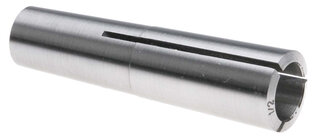
Another holding methodP #2 morse taper collets. Although the ER collets can be used with a variety of tenon diameters, the collet chuck and the individual collets can be expensive. MT collets are quite inexpensive! I've bought sets and individual collets from Little Machine Shop, Amazon, and elsewhere.

Here's an example. The collet does need a drawbar to hold it tightly into the headstock AND squeeze the work firmly. Drawbars are easily made.

Besides having to use a drawbar, the disadvantage is needing to turn a 1/2" tenon on the end first. However, the holding is tight and the piece can be removed and remounted with perfect registration. No tail stock support is needed for short spindles such as finials.

These finials, holly and ebony, have 1/2" tenons.

1762795611835.jpeg

The collets are cheap, threaded for a 3/8x16 drawbar. I buy them by a set that included from 1/8" to 1/2".

1762795662323.jpeg

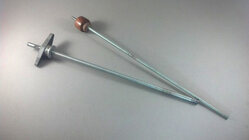
Drawbars are easily made from AllThread rod available from hardware stores and Home Depot, etc. Simply make a handle/knob to snug the collet into the lathe 2MT spindle. To release, tap the end of the drawbar lightly with a mallet or a chunk of wood or something.

For holding wood wood spindles with 2MT tapers when tailstock support is not practical, I use 1/4-20 threaded rod to make a drawbar . I make the end of the drawbar into a "tap" by filing three angle grooves deep into the threads with a triangle file - simple drill a slightly undersized hole and twist the threaded rod into the hole - no 1/4x20 tap needed.

Both of these are longer than needed! They only need to be long enough to fit through the headstockand leave a few inches sticking out on the left end. I like to grind a flat in a place or two so I can turn one with a wrench if it gets stuck when screwed too tightly (tightness is NOT needed!).

1762795946223.jpeg

JKJ
 
JKJ,

First off, I agree, not a mortice... ( thinking Morse) Old mind at work.

The tool can be used to cut any length tapered tendon, the diameter at the end closest to the turning stock will always be the proper diameter. The cutting the tool turns, the stock does not.

I do like the your caliper modification for setting the diameter. I was taught to use 6" or 8" outside calipers to do the same. Works well with the old diamond parting tools of at least 1/8" width, but would not work with the thinner flat parting tools.

I was playing around with the full length MT#2 taper to see if you could cut a small finial without the tail stock, with limited success. (more surface area, more holding power) but in this case, questionable.

The idea of a draw bar holding the piece IS the answer. I said that I didn't think I would use this method often, but adding the draw bar makes it the complete package.

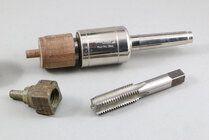
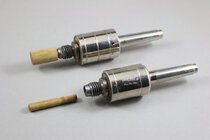
My main live center is a Oneway, I have a 3/4" 10 NC tap, and have made wooden attachments mounted on the threaded section of the center, I will keep in mind using the inside taper for smaller items.

Thanks,
WH
 
I do like the your caliper modification for setting the diameter. I was taught to use 6" or 8" outside calipers to do the same. Works well with the old diamond parting tools of at least 1/8" width, but would not work with the thinner flat parting tools.

That's exactly the reason I use 1/8" diamond or flat-sided parting tools. The cheap, stamped steel vernier calipers I use fit very nicely into the grooves.

My main live center is a Oneway, I have a 3/4" 10 NC tap, and have made wooden attachments mounted on the threaded section of the center, I will keep in mind using the inside taper for smaller items.

I also use the tap method of attaching wooden things too the Oneway (and the various Oneway clones that come with Jet and PM lathes)
I usually drill and tap then shape these to fit by inserting a piece of soft iron wire through the locking hole on the side and mounting the live center into the headstock.

1762818653585.jpeg

Here are a couple of pieces I made to fit the #0MT sockets that hold the points. (I think I made a mistake when I mentioned a #1MT in the earlier message.)

For those who haven't tried, these can be incredibly useful at times, often as revolving jam centers to support long things with holes in the ends.

1762818673103.jpeg
It surprised me how many taps and dies I found useful when turning.

Unrelated but interesting: I was surprised to find Morse Tapers came in so many sizes.
1762820013093.jpeg

Tiny obliquely related live-center tip: I seldom have to crank back on the tailstock wheel to eject a live center. It only takes one second to lever the centers out of the tailstock with the small end of one of my Nova chuck wrenches.

1762819635343.jpeg


JKJ
 
Back
Top