• January 2026 Turning Challenge: Turned and Bent! (click here for details)
  • Congratulations to Phil Hamel, People's Choice in the December 2025 Turning Challenge (click here for details)
  • Congratulations to David Wyke for "Maple Platter #567" being selected as Turning of the Week for January 5, 2026 (click here for details)
  • Welcome new registering member. Your username must be your real First and Last name (for example: John Doe). "Screen names" and "handles" are not allowed and your registration will be deleted if you don't use your real name. Also, do not use all caps nor all lower case.

A Woodturner's Life...Glenn Lucas

Joined
Jan 1, 2025
Messages
21
Likes
38
Location
Hesston, kansas
The 4th episode just dropped on YouTube. My son and I have watched each one and I have learned quite a bit about processing wood. I'm not a professional and I don't have a sawmill or a kiln. But I have a chainsaw, bandsaw and forklift and the nuggets of knowledge that Glenn drops along the way are so great.

For example he lays out his circles slightly overlapping so even though the rough turned bowl will have a flat spot and be a little 'oval' the differential shrinkage will be more round.

I think I enjoy the methods of work almost as much as I enjoy the woodturning itself.
 
I've really been enjoying this series! Led me to finally get off the dime and schedule a class with him (not until 2027) to give us an excuse to go to Ireland for a few weeks. The scale of is operation (and the amount of hard work involved) is really impressive. Love the spalted beech he gets.
 
Watched the four videos and amazed at the huge operation he manages. I was particularly interested in his routine for cutting logs into blanks. I have been putting off cutting logs but am confident that I can follow his directions to produce good blanks.
 
Thanks, Aron, for the heads up on the videos. I watched two and they have been fascinating! And I learned several things so far.
  • I need to make a coarse screen for my dust collector pickup at the lathe. I've already lost a wrist watch and a kitten. Just kidding, but have lost plenty of strips of sandpaper.
  • It would be great to have a building where I could keep my sawmill out of the weather. Unfortunately, that's not going to happen.
  • He makes good use of the fork lift. I can't imagine not having forks, although I use mine on the tractor and skid steer.
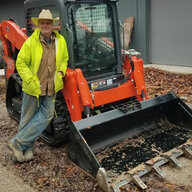
  • The highway weight limit Ireland. I assume there are special permits or fees or something if you really need to haul something heavy. I typically haul 4-ton loads of hay and that doesn't count the 18' gooseneck trailer. My tracked skid steer weighs a bit over 4 tons lbs with another 2000 for attachments (plus a the weight of the equipment trailer). Or loads of gravel, usually 20+ tons per load around here.
  • I love the the heavy plate he added to the trailer bed - fabulous idea. The typical wooden beds are the first things that need replacing.
  • Hey, another person to add to the list of those who like mini donkeys!
  • Glenn certainly has incredible tool control! He did mention he's turned a few bowls in the past. :)
  • If I ever say I want to become a production turner, someone please knock some sense into me with a stick. If that doesn't work, please lock me up!
A few years back we considered using Glenn Lucas' class to justify a jaunt to and around Ireland. Been to numerous points in the UK and Europe but never made it to Ireland. Bucket list.

JKJ
 
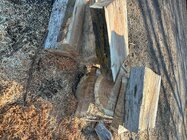
I was inspired this afternoon to harvest some bowl blanks.

6 4x13x13” from honey locust.

It is by far my favorite to turn right now for utilitarian bowls

I think I first heard Stuart Batty say he liked that species.
 

Attachments

  • IMG_5756.jpeg
    IMG_5756.jpeg
    1,001.7 KB · Views: 14
Episode 3

Banjo maintenance comment - if you don't have circlip/snap-ring/retaining-ring pliers, consider the convertible pliers - I keep several but the one I like the best has both internal and external, the mode changed by moving a thumb lever. It came with a set of hooked and straight clips to change to fit the job.

Don't know about those on most lathes, but some large rings used on other equipment can take some effort and hand strength. Pliers with longer handles can help. Another handy thing is a set or two of spare circlips in both metric and imperial sizes. Occasionally one will be bent or otherwise damaged (and I hate to say it but I lost one which slipped out of the pliers and flew to somewhere in the shop - always wear safety glasses)

His tailstock gauge for repeated bowl bottoms was genius

Yes, nice! Don't know if you've seen them but some people use 3D printed gauges with tenon and recess sizes that fit their favorite jaws. Guess they could be cut by hand from a piece of plastic sheet or thin brass/aluminum.
What puzzled me for a while was watching turners make a tenon without measuring it and it always fit. Some may just have calibrated eyes. Some apparently judge the size relative to the tailstock quill or live center. I measure or use dividers, depending.

I was inspired this afternoon to harvest some bowl blanks.... 6 4x13x13” from honey locust.

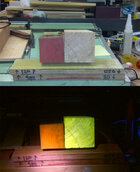
I like honey locust too. If not aware, locust wood can be distinguished from some other species by using a cheap 365nm UV light. Locust will glow bright green while osage orange, mulberry, and some others with somewhat similar end grain won't.

Here are Redheart and Locust blanks in white light and in UV light.
1768175909776.jpeg

This Wood Database article has a useful list:
Just for fun: I also use UV lights to judge the freshness of peacock, guinea, and non-white chicken eggs, The brightness of the fluorescence decreases as the eggs age. I think it might be oxidation of the shell surface. Handy when finding a nest in the weeds to see if the eggs are fresh enough to hatch.
I wish I could tie this to woodturning with Glenn Lucas but I can't. If anyone wants to hear more nearly useless things just ask. :)

1768175994120.jpeg

JKJ
 
Last edited:
Back
Top