• The forum upgrades have been completed. These were moderate security fixes from our software vendor and it looks like everything is working well. If you see any problems please post in the Forum Technical Support forum or email us at forum_moderator (at) aawforum.org. Thank you
  • February 2026 Turning Challenge: Cookie Jar! (click here for details)
  • Congratulations to Matt Carvalho for "Red Mallee Folded Form" being selected as Turning of the Week for February 9, 2026 (click here for details)
  • AAW Symposium demonstrators announced - If the 2026 AAW International Woodturning Symposium is not on your calendar, now is the time to register. And there are discounts available if you sign up early, by Feb. 28. Early Bird pricing gives you the best rate for our 40th Anniversary Symposium in Raleigh, North Carolina, June 4–7, 2026. (There are discounts for AAW chapter members too) For more information vist the discussion thread here or the AAW registration page
  • Welcome new registering member. Your username must be your real First and Last name (for example: John Doe). "Screen names" and "handles" are not allowed and your registration will be deleted if you don't use your real name. Also, do not use all caps nor all lower case.

anchoring a lathe? cement, or wood?

For my Australian Woodfast lathe, the four attachment points are tabs that will bend to fit the floor surface.......so, the floor doesn't have to be absolutely flat for this method of securing the lathe. (It does need to be close to flat, though! :))

ko
 
My concrete floor is fairly uneven (it was an outdoor parking pad before the shop was built over top).
And is of known thickness - so bolting it down was not necessarily a good idea
Plus I like turning large, unbalanced pieces - adding a ton of stress, twist, bounce
And the lathe was too low for me - I'm 6'3".

So...after discarding a lot of ideas, i came to one very simple conclusion: add more concrete!
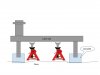
  1. Raised the lathe to the desired height, with a pair of car jacks.
  2. Levelled it
  3. Built forms around the legs
  4. Poured the concrete - from Ready Mix bags
  5. Poured right over the the bottom 4" of the legs. No bolts needed
That added 500 lbs of weight, its level, its rock solid. Admittedly not very portable....
Lathe anchoring.jpg
 
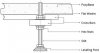
A floor can settle in time, and you never know how it will settle. A common approach in the industry
is to install long anchor bolts in the concrete with 1/4 of the bolts threads exposed above the floor.
A nut with heavy washers can be installed on each anchor bolt and the lathe legs positioned on top
of the washers and washers and nuts placed over the top to hold the lathe down. With this design
you can adjust each bottom nut up or down to level the lathe. You can use several nuts on the bottom
and lock them together on the larger lathes if their is a chance of the nuts loosening from vibration. This
type of mounting makes it very easy to use a laser to align the equipment. This method also allows you to
raise the level of the lathe to the working height that works for the user. On the drawing shown below the
cross bar would be foot of the lathe and disregard the Poxybase in the drawing.

still_mount_diagram.jpg
 
Back
Top