• December 2025 Turning Challenge: Single Tree! (click here for details)
  • Congratulations to Bob Henrickson, People's Choice in the November 2025 Turning Challenge (click here for details)
  • Congratulations to Dave Roberts for "Low Rider" being selected as Turning of the Week for December 1, 2025 (click here for details)
  • Welcome new registering member. Your username must be your real First and Last name (for example: John Doe). "Screen names" and "handles" are not allowed and your registration will be deleted if you don't use your real name. Also, do not use all caps nor all lower case.

Beall Polishing System - then what?

Joined
Feb 4, 2025
Messages
14
Likes
9
Location
Cape Cod, MA
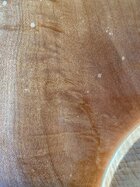
I'm looking for advice for applying a more permanent water-proof finish to my projects after following the three-step Beall Polishing System. While the Beall system dramatically enhanced the figure in my piece, I noticed that some light rain (going from the house to the car) left water spots on the carnuba wax finish (which don't buff out easily). I want to prevent this by applying a more permanent lacquer-type finish. Any examples out there? This project is a maple side table that is expected to see spills with regular use. Thank you! RobWater Spots.jpg
 
Did the droplets sit for a long time? I’ll occasionally rinse a chip or salad bowl with water and, as long as it’s dried quickly, I’ve never had a problem with this type of spotting.

That being said, if you want something truly waterproof, tabletop epoxy might be the way to go. Even then, you’ll want to use a coaster.
 
the Beale system is not a finish. It is a polishing system to polish whatever finish you use..the carnauba wax that is the last step is just that, a wax. It is not very durable. I don't use the wax step. I found that when people handled my hand mirrors it left marks. Without the wax step my mirrors hold up. They are finished with wipe on poly and then buffed with the Tripoli and white diamond.
 
It isn't the polishing system, it's what finish you are polishing.
Wax isn't water resistant. You can use the Beaal system to finish a finish )like lacquer/epoxy/poly, but the finish's resistance to any element is the finish, not the process.
 
My testing with using the buff bars (tripoli and others) demonstrated that these compounds leave a relatively soft waxy/greasy layer (its what holds the bars together). Putting hard carnauba wax on top of this soft layer causes lots of issues, which can be solved by wiping the surface with solvent to remove the soft layer, then apply carnauba, providing a much more durable wax layer.

As others stated, any buffing comes after a finish is applied and cured.

Don’t recommend the beall type wheel buffs for flat work, disc shaped buffs work much better. If the table will see much use, use a catalyzed lacquer or there are more abrasion resistant finishes. You will need to research “rubbing out finishes”. If I want a full gloss finish I use various grades of Meguiar’s compounds and finish with synthetic sealant, using different foam compounding discs depending on the compound. Its a separate skill set to learn.
 
Multi-coat varnish is the answer. Or epoxy.

Wax, when properly applied over the top of a wood finish, or a car hood, has over 99% of what you smeared on, removed in the buffing process. We aren't leaving "a layer of wax", we are using the wax to fill in the nearky invisible micro scratches resulting in a smoother surface that reflects light more uniformly. Waxes that also polish with micro abrasives are just mellowing bigger micro scratches to smaller micro scrathes. It's an appearance thing, not a protection thing.

On the hood of your car, those wax filled micro scratches lessen the chance for raindrops to hang around by friction, that is why the stay beaded up and roll off.

Wax is the single most fragile and short lived "finish" we can appy to any surface. We need to understand and accept its benefits and limitations. It is not a miracle product.
 
Did the droplets sit for a long time? I’ll occasionally rinse a chip or salad bowl with water and, as long as it’s dried quickly, I’ve never had a problem with this type of spotting.

That being said, if you want something truly waterproof, tabletop epoxy might be the way to go. Even then, you’ll want to use a coaster.
Thanks, Jaramiah! Droplets didn’t sit more than fifteen minutes.
 
the Beale system is not a finish. It is a polishing system to polish whatever finish you use..the carnauba wax that is the last step is just that, a wax. It is not very durable. I don't use the wax step. I found that when people handled my hand mirrors it left marks. Without the wax step my mirrors hold up. They are finished with wipe on poly and then buffed with the Tripoli and white diamond.
Understand it’s a polishing system. Interesting that you use step 1 and 2 after you have done the finishing. Very helpful! Thanks, John!
 
whatever finish you use..the carnauba wax that is the last step is just that, a wax. It is not very durable. I don't use the wax step. I found that when people handled my hand mirrors it left marks.

This is going to stir the pot here, but so be it. I'm with John here, I never put wax on my turnings. Wax is not a finish, it is not permanent, and it eventually (many years later) "evaporates" or otherwise disappears. Why go to the trouble of waxing something if you eventually have to wax it again?

For over twenty years I have been asking turners why they wax their turnings. I have never heard a satisfactory response from anyone. First I get the Deer in the Headlights look in their eyes. Then they say something about protecting the finish. Then I ask, protecting from what? More Deer in the Headlights. From handling, they say. Well if the turning is a display piece sitting on the shelf, it is never handled. If the turning is a utility piece, then maybe I can see it but I'm not convinced. I have stood up a meetings of various clubs and asked the question. Crickets.

My conclusion from this decades-old curiosity of mine is that most turners that wax their pieces do so simply because when they started turning that's what they were taught to do, or because everyone else does it. Those are not good answers. Ask them why and I've never heard a solid answer. Waxing is a waste of time and wax.

A buffed lacquer or poly or layered oil finish provides much more protection than any wax, in this old guy's opinion. (Note that "opinion" is the key here, but I'm open to being convinced otherwise although by now I'm pretty sure it isn't going to happen).

 
Last edited:
My testing with using the buff bars (tripoli and others) demonstrated that these compounds leave a relatively soft waxy/greasy layer (its what holds the bars together). Putting hard carnauba wax on top of this soft layer causes lots of issues, which can be solved by wiping the surface with solvent to remove the soft layer, then apply carnauba, providing a much more durable wax layer.

As others stated, any buffing comes after a finish is applied and cured.

Don’t recommend the beall type wheel buffs for flat work, disc shaped buffs work much better. If the table will see much use, use a catalyzed lacquer or there are more abrasion resistant finishes. You will need to research “rubbing out finishes”. If I want a full gloss finish I use various grades of Meguiar’s compounds and finish with synthetic sealant, using different foam compounding discs depending on the compound. Its a separate skill set to learn.
Thanks, Doug! I have had success with Meguiars products in the past and will definitely try those again in the future.
 
Multi-coat varnish is the answer. Or epoxy.

Wax, when properly applied over the top of a wood finish, or a car hood, has over 99% of what you smeared on, removed in the buffing process. We aren't leaving "a layer of wax", we are using the wax to fill in the nearky invisible micro scratches resulting in a smoother surface that reflects light more uniformly. Waxes that also polish with micro abrasives are just mellowing bigger micro scratches to smaller micro scrathes. It's an appearance thing, not a protection thing.

On the hood of your car, those wax filled micro scratches lessen the chance for raindrops to hang around by friction, that is why the stay beaded up and roll off.

Wax is the single most fragile and short lived "finish" we can appy to any surface. We need to understand and accept its benefits and limitations. It is not a miracle product.
Thanks, Steve!
 
I buff the exterior of my utility bowls because I like the way it feels when you pick up the bowl. I don't buff the inside because I want people to feel like they can use it - a "too good" finish on the inside might make them afraid to damage it and hesitant to use it.
Since I fully expect the piece to be used, I'm not concerned about durability if I wax the outside (I do care about the durability of the underlying finish). The wax, if I apply it, is mostly there to enhance the ooh-aah-factor at point of sale.

My $0.02 (which now you can round-down to $0.00)
 
Back
Top