• The forum upgrades have been completed. These were moderate security fixes from our software vendor and it looks like everything is working well. If you see any problems please post in the Forum Technical Support forum or email us at forum_moderator (at) aawforum.org. Thank you
  • February 2026 Turning Challenge: Cookie Jar! (click here for details)
  • Congratulations to Matt Carvalho for "Red Mallee Folded Form" being selected as Turning of the Week for February 9, 2026 (click here for details)
  • AAW Symposium demonstrators announced - If the 2026 AAW International Woodturning Symposium is not on your calendar, now is the time to register. And there are discounts available if you sign up early, by Feb. 28. Early Bird pricing gives you the best rate for our 40th Anniversary Symposium in Raleigh, North Carolina, June 4–7, 2026. (There are discounts for AAW chapter members too) For more information vist the discussion thread here or the AAW registration page
  • Welcome new registering member. Your username must be your real First and Last name (for example: John Doe). "Screen names" and "handles" are not allowed and your registration will be deleted if you don't use your real name. Also, do not use all caps nor all lower case.

Boring bars for hollowing

Joined
Aug 30, 2019
Messages
1
Likes
0
Location
Petal, MS
I am looking to make some boring bars for my hollowing rig (articulated arm system). I am using 3/4”. Can someone tell me the approximate bend angle on the bent bars?

 
just get online and look at a lot of the different tools. I made copies of the pictures and then blew them up on a copier and made my first bars. After that I had more experience and drew out my vessel shape, then took a coat hanger and bent it so that I could figure out what would reach into the shape i wanted to turn. then I just copied that on my 1/2" and 3/4" bars.
 
It is more of a bend than an angle.

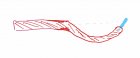
The critical part is the relationship of the cutter to the center line of the straight part of the tool before the bend. The straight part rests on the tool rest so it needs to be about 2/3 To 3/4 of the bar length.
The cutter should be in line with the center line.

If you plan to use a carbide you can put it right in line
With the center of the deepest cut.

In the diagram below I show the centerline at the midpoint on the usable part of the cutter. When it gets sharpened it gets shorter. A new cutter will be a bit left of center and a cutter near the end of its life will be right of center.

With an articulated system you can get away with cutting a little bit with the curve on the tool rest but you get more vibration. The cutter In line design is less vibration and it makes working with a laser or Camera easier since both the straight and curved tool will be in the same line.


C21E6D69-79B5-4302-8E7A-12F2F40C5B94.jpeg
 
Last edited:
Back
Top