

-
It's time to cast your vote in the March 2026 Turning Challenge. (click here for details) -
Congratulations to Chris Lawrence for "Dragon's Grip" being selected as Turning of the Week for March 30, 2026 (click here for details) -
Welcome new registering member. Your username must be your real First and Last name (for example: John Doe). "Screen names" and "handles" are not allowed and your registration will be deleted if you don't use your real name. Also, do not use all caps nor all lower case.
You are using an out of date browser. It may not display this or other websites correctly.
You should upgrade or use an alternative browser.
You should upgrade or use an alternative browser.
Burn Pile - Best of the worst
- Thread starter Webb Willmott
- Start date
I had that happen to a gouge handle years ago, and learned to look at the grain first.... It was one I had made, and I was tapping it to remove gunk that had built up. I pay close attention to grain in all my handled tools, shovels, splitting mauls, axes, and even hammer handles.... I did make one handle out of apple ply plywood, worked fine.
robo hippy
robo hippy

I already burned all my failed practice pieces. I'm sure there'll be more. I'm still making my bowls rather thick bottomed because I'm afraid of blowing through. But I'll post them when I get some.
This was a Hurricane scraper. Not of my doing but it was of my undoing.I had that happen to a gouge handle years ago, and learned to look at the grain first.... It was one I had made, and I was tapping it to remove gunk that had built up. I pay close attention to grain in all my handled tools, shovels, splitting mauls, axes, and even hammer handles.... I did make one handle out of apple ply plywood, worked fine.
robo hippy

I know you have one or two beauties you can share!
It's an opportunity to make a tool handle! That's the easy part.Time for some fun….. please share your your “oh my’s” and “I can top that” so you can make the guys and gals before you smile and realize it’s just a piece of wood.
I’ve seen some doozies posted. It seems a collection is only fitting.
Bummer that it took your project along with it.

I have a whole shelf of abandoned and destroyed projects that I look at every day. The bad work inspires me.
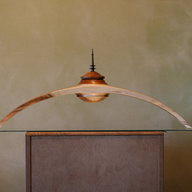
I get quite a few pieces that go the other way.... wood in the firewood pile ready to burn and then catch my eye saying I'd be better used for turning.... 

- Joined
- Jul 18, 2018
- Messages
- 1,385
- Likes
- 3,075
- Location
- Baltimore, MD
- Website
- loujacobswoodturning.com
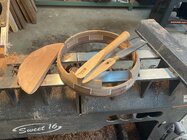
A red oak shallow bowl with a fatal flaw. Just waiting for this thread! Thanks Webb!

- Joined
- Jul 18, 2018
- Messages
- 1,385
- Likes
- 3,075
- Location
- Baltimore, MD
- Website
- loujacobswoodturning.com
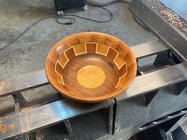
It wasn’t a funnel. It had a couple of cracks in the rim. You can just see one of them opening up at about the 1:00 position. Not worth trying to repair.
I keep a little "Box O' Shame" with small failures. I get this out to show people that yes, it happens to everyone. At least occasionally.
I read in an very old book about the traditional way to insure straight grain for strong tool handles.
A friend looks for such trees and rives wood for steam bending and for shaping on a shaving horse.
Splitting along the grain insures high strength with the grain running the length of the handle. People also used to make boards this way.
This handle was for my favorite shuffle hoe. Easy to turn with a big skew. I use the "left hand" steady rest to control vibration. This handle "stretched" the capacity of my 3520b, even with the bed extension. I put the bit of detail towards one end so it didn't look like a store-bought handle. I sometimes took this to thin spindle demos to illustrate that a "thin" spindle doesn't have to be small - the length-to-diameter ratio is what matters.
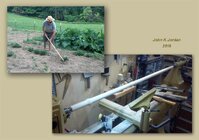
This earlier shovel hand is a little under "regulation" length due to limitations of the lathe I had then. If ever repeating this, I might make a temporary stand-alone "extension" to hold the tailstock. A friend told me some people align two lathes end-to end for turning long things.
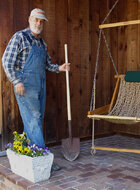
I had to search a while for a good froe. Finally found one for cheap at an antique store in Kentucky about 20 years ago. Had to make a handle for it but there are not side forces on it so the grain didn't have to be straight.
I actually found two. Made the handle and used the one at top. Doesn't need to be sharpened like a knife. The handle is used to guide and for leverage when splitting. The gluts extend the split easily.
The one with a wider blade would probably be used with a long handle. I gave that one to a guy I know who loves to sharpen things. Gave him a spare drawknife and several axe heads too, including a broad axe.
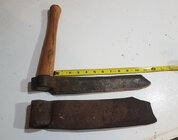
I also used a draw knife to shape a handle for an foot adze. (a relative had been using it as a weeding tool around her house). Some of those "traditional" ways to work with wood were great exercise. I think I had more energy 20 years ago...
JKJ
I had that happen to a gouge handle years ago, and learned to look at the grain first..... I pay close attention to grain in all my handled tools, shovels, splitting mauls, axes, and even hammer handles....
I read in an very old book about the traditional way to insure straight grain for strong tool handles.
- Select a fairly young hickory tree, straight trunk, no branches. Hickory with nearly all sapwood is good.
- Cut a log long enough for the longest handle. Best is freshly cut green wood which splits easily.
- Do not saw but rive with a froe smacked with a heavy wooden club, and a glut or two (wooden wedges). I read that gluts were traditionally made from dogwood. Apparently the heavy froe club/maul was also often made from dogwood so that's what I used.
- Split down the pith then split off pieces with enough cross section to make various handles.
- Put the pieces in the barn loft (to dry) and forget about them for a couple of years
A friend looks for such trees and rives wood for steam bending and for shaping on a shaving horse.
Splitting along the grain insures high strength with the grain running the length of the handle. People also used to make boards this way.
This handle was for my favorite shuffle hoe. Easy to turn with a big skew. I use the "left hand" steady rest to control vibration. This handle "stretched" the capacity of my 3520b, even with the bed extension. I put the bit of detail towards one end so it didn't look like a store-bought handle. I sometimes took this to thin spindle demos to illustrate that a "thin" spindle doesn't have to be small - the length-to-diameter ratio is what matters.
This earlier shovel hand is a little under "regulation" length due to limitations of the lathe I had then. If ever repeating this, I might make a temporary stand-alone "extension" to hold the tailstock. A friend told me some people align two lathes end-to end for turning long things.
I had to search a while for a good froe. Finally found one for cheap at an antique store in Kentucky about 20 years ago. Had to make a handle for it but there are not side forces on it so the grain didn't have to be straight.
I actually found two. Made the handle and used the one at top. Doesn't need to be sharpened like a knife. The handle is used to guide and for leverage when splitting. The gluts extend the split easily.
The one with a wider blade would probably be used with a long handle. I gave that one to a guy I know who loves to sharpen things. Gave him a spare drawknife and several axe heads too, including a broad axe.
I also used a draw knife to shape a handle for an foot adze. (a relative had been using it as a weeding tool around her house). Some of those "traditional" ways to work with wood were great exercise. I think I had more energy 20 years ago...
JKJ
John, we don’t want to know about handles. We want to see your infamous box of shame. Make us smile so we can all rejoice in our failures.
John, we don’t want to know about handles. We want to see your infamous box of shame. Make us smile so we can all rejoice in our failures.
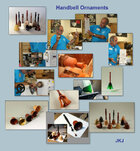
Well, you missed my handbell ornament demo in Sept. I brought the box there with some bells to show some things to NOT do. Like not using a straight grained blank (can break like a handle!), thinning the support too much before hollowing, not paying attention while hollowing, accidentally bumping the tool against the edge when thinned, etc.!
Hey, maybe I'll come to MS and do a handbell ornament demo and bring the actual Box O' Shame.
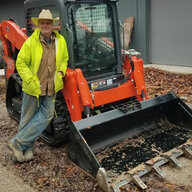
Demo photos from a 2014 demo before I went on a diet.

JKJ