• December 2025 Turning Challenge: Single Tree! (click here for details)
  • Congratulations to Bob Henrickson, People's Choice in the November 2025 Turning Challenge (click here for details)
  • Congratulations to Guillaume Fontaine for "Old Tea Pot" being selected as Turning of the Week for December 15, 2025 (click here for details)
  • Welcome new registering member. Your username must be your real First and Last name (for example: John Doe). "Screen names" and "handles" are not allowed and your registration will be deleted if you don't use your real name. Also, do not use all caps nor all lower case.

Burning a Turning

Well, I've never done that myself, but the burning process is consuming the wood, and forcing out whatever equilibrium moisture is present, and rapidly heat stressing the wood being consumed and the adjoining wood that is not burning, causing fibers and cells to tear apart...

Maybe you simply need to go a lot slower, more gentle with the burning. A smaller, more localized flame. Heat the surface to begin discoloration, but move away and let it cool, then come back. A lighter touch.

Maybe?
 
Last edited:
Probably burning too much. You just want it black not charred. Heat it gradually until you get where you want. I quit burning abd started painting them black. Then I got carried away and started sponge painting them with multiple colors. Or sometimes I carve or wood burned textures abd then paint those.
 

Attachments

  • 20251216_105152.jpg
    20251216_105152.jpg
    537.6 KB · Views: 19
  • 20240323_181441.jpg
    20240323_181441.jpg
    264.3 KB · Views: 19
  • 20240412_083514.jpg
    20240412_083514.jpg
    137.5 KB · Views: 19
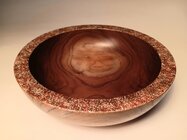
In 1993 Vic Wood did a demo for the MWA, I believe I was the President at the time and I have the bowl he demoed.
It is signed "Vic Wood 93 Demo Boxelder" I can't remember his process but it is flawless. The char looks like it is about 1 mm deep and very uniform.
I can't remember ever trying the process myself, but I believe this is an excellent example of the technique.
VicWood93Demo.jpg
 
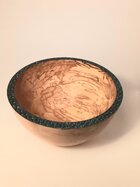
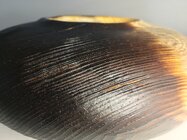
I've sometimes burned pieces. I like burning Ash (other similar open-pore woods would be good too) because the open pores char quickly and the closed pores resist. So I get black "tiger stripes". This works best with a small focused flame like from a kitchen brûlée torch, following the grain. Following this up with dye looks pretty cool.
IMG_7235.JPG
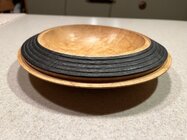
I've also done more "deep" burns to bring out texture. Some parts burn deeper so you reveal the texture of the wood.

IMG_6530.JPG
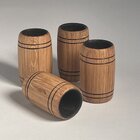
You can also char for just color (or surface treatment (Yakisugi aka Shou Sugi Ban), without trying to go so deep to get texture. I char the insides of my "shot barrels" (oak shot glasses) for both color and as a finish.
IMG_8120.JPG

In any case, heating the wood stresses it. The "tiger stripes" aren't too much problem, but with deeper burns I take defensive measures - usually leaving more wood around the burn and finishing the turning afterwards.

So if I'm burning a rim, I'll leave it thick and wide, burn it, then trim off the edges and finish the bowl's thickness. If I'm burning the outside of a bowl, I do it before turning the inside. My shot barrels are turned from a square blank, and I do the inside and char it while leaving the outside square for more bulk to resist the heat.

I also have a theory that for the more thorough burns, I want to go hot and fast. I use MAPP gas because it's hotter than propane. Get the surface charred in an area and move on. Don't linger and let the wood heat up too deep beyond the surface. Clean it up with a wire brush and come back for another pass as necessary.
 
MAPP (disc. in N. America in 2008) vs. MAP-Pro (the current yellow bottle replacement in NA), from our silicon friends at Google Art. Intel.:

MAPP Gas (Discontinued)
Composition: A specific blend of methylacetylene, propadiene, and propane.
Performance: Burned significantly hotter (around 5,300°F) than MAP-Pro, making it excellent for demanding jobs, says this YouTube video.
Status: Production ended in North America around 2008, notes Wikipedia.

MAP-Pro Gas (Current)
Composition: Primarily propylene (around 99.5%) with a small amount of propane (0.5%).
Performance: Hotter than blue propane tanks but cooler than original MAPP gas (around 3,730°F), providing faster heating than propane but requiring longer for some tasks than old MAPP.
Use: Standard replacement in yellow tanks for general brazing, soldering, and HVAC work.

And for fun, MAP-Pro vs. good ol' propane, via the same non-human source. All info should be verified by authoritative means as necessary.
MAP Pro (Yellow Tank)
Composition: Mostly propylene with some propane.
Temperature: Burns hotter, around 3,730°F (2,054°C) in air, allowing faster work.
Best For: Brazing, soldering larger copper pipes, heat treating, and professional tasks needing high heat.
Pros: Faster, more efficient, reduces job time.
Cons: More expensive than propane.

Propane (Blue Tank)
Composition: Primarily propane.
Temperature: Burns cooler, around 3,600°F (1,982°C) in air, ideal for precise work.
Best For: Small heating, soft soldering, basic plumbing tasks, and tasks where you need to avoid overheating.
Pros: Cheaper, better for delicate work where heat damage is a risk (like sweating fittings with seals).
Cons: Slower and less efficient for high-heat applications than MAP Pro.
Key Takeaway
Choose MAP Pro for speed and tough jobs where high heat is needed, and Propane for cost-effectiveness and delicate tasks where a cooler flame is beneficial.
---------

Moral of the story- today's MAP-Pro only burns about 130°F hotter than propane. And at my local big box retail sources costs more, today $5.98 for blue bottle propane vs. $13.99 for yellow bottle MAP-Pro. Not quite 2.5x more expensive for 130 additional degrees F, when propane is already chugging along at 3600°F, more than hot enough to set wood ablaze.

 
Maybe describe the process(es) you've tried. For example, what kind of torch?

Have you tried one of the mini butane torches for a more localized flame?
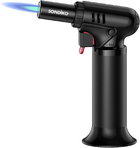
I use a couple similar to this in the shop:

1766335720961.png
www.amazon.com/Sondiko-Butane-Torch-Gauge-S907/dp/B08Y5M5V3X

(Works for creme brulee too!)

And too bad about the Mapp gas. Fortunately I still have a few bottles in a cabinet. But for brazing, etc, hard to beat the oxy-acetylene torch! Not as portable, though.

JKJ
 
Maybe describe the process(es) you've tried. For example, what kind of torch?

Have you tried one of the mini butane torches for a more localized flame?
I use a couple similar to this in the shop:

View attachment 83094
www.amazon.com/Sondiko-Butane-Torch-Gauge-S907/dp/B08Y5M5V3X

(Works for creme brulee too!)

And too bad about the Mapp gas. Fortunately I still have a few bottles in a cabinet. But for brazing, etc, hard to beat the oxy-acetylene torch! Not as portable, though.

JKJ
that's what I used... Actually it's one my wife bought years ago to make Crème brûlée. Butane burns about 1/3 lower temperature so you can control the flame much easier
 
MAPP (disc. in N. America in 2008) vs. MAP-Pro (the current yellow bottle replacement in NA)
Well foo. Thanks for that. I wish they'd have changed the bottle color at least - very sneaky.

Although I'll probably still keep using MAP-Pro as it reportedly performs better at altitude (I live at 7750 ft (2360m) elevation). And I just don't use that much - the 2 bottles I have will probably last several years.
 
Well foo. Thanks for that. I wish they'd have changed the bottle color at least - very sneaky.

Although I'll probably still keep using MAP-Pro as it reportedly performs better at altitude (I live at 7750 ft (2360m) elevation). And I just don't use that much - the 2 bottles I have will probably last several years.
Foo is right! And I'd agree about the altitude, too.

I had no idea MAPP was that much hotter than propane, nor that MAP-Pro and propane aren't that far apart.
 
Back
Top