• The forum upgrades have been completed. These were moderate security fixes from our software vendor and it looks like everything is working well. If you see any problems please post in the Forum Technical Support forum or email us at forum_moderator (at) aawforum.org. Thank you
  • February 2026 Turning Challenge: Cookie Jar! (click here for details)
  • Congratulations to Dean Center for "After Life" being selected as Turning of the Week for February 16, 2026 (click here for details)
  • AAW Symposium demonstrators announced - If the 2026 AAW International Woodturning Symposium is not on your calendar, now is the time to register. And there are discounts available if you sign up early, by Feb. 28. Early Bird pricing gives you the best rate for our 40th Anniversary Symposium in Raleigh, North Carolina, June 4–7, 2026. (There are discounts for AAW chapter members too) For more information vist the discussion thread here or the AAW registration page
  • Welcome new registering member. Your username must be your real First and Last name (for example: John Doe). "Screen names" and "handles" are not allowed and your registration will be deleted if you don't use your real name. Also, do not use all caps nor all lower case.

Calling attention to food safe or not food safe?

Joined
Jan 24, 2010
Messages
3,218
Likes
972
Location
Cleveland, Tennessee
Gearing up to display some turnings in addition to custom pens. How do you turners make it known if a turning is food safe or not food safe? I'm concerned in this day of lawsuits that a person buys a bowl and gets sick because they used it for breakfast cereal. I'm thinking to mark this on the bottom of the turning that can be used for food.
 
I dont worry about it. As near as I can tell from research all the finishes we use as turners are food safe once the volatiles have evaporated. I do use mahoneys food safe finish on my baby rattles and that's the only time I might mention it to close a sale.
So let it sit for a while before selling it? Thanks for your help.
 
How would you suggest that anyone can leach, or get a piece of the finish from the wood into their mouth? Cutting board of course, cereal bowl less likely. There is no warning on every plastic utensil, or any piece of plastic anything, that micro plastics are now in 99% of the fish we eat. Micro plastics are found in our rain and the air we breathe. Eating from a finished wood bowl is now healthier than eating from a plastic cereal bowl.
 
I approach this conservatively in today's litigious society. If the manufacturer of the finish isn't willing to say 'food safe' then I'm not about to vouch for them. With so many food safe identified finishes I'm not sure why anyone would take a chance.
 
It seems like some some of the same people that ask if a finish is food-safe, won't give a second thought about eating a burger from a styrofoam box or scraping their spoon around the inside of a plastic yogurt cup. 🙄

Like John said, all are safe once fully cured.
 
I’m going to agree with John Grace that there are too many finishes to chance something. I only use FDA compliant for food contact finishes. There are several. I have no idea if a person may have a reaction to something. The other side is a child might chew anything and if something wasn’t safe it wouldn’t be on the market.
 
I’m going to agree with John Grace that there are too many finishes to chance something. I only use FDA compliant for food contact finishes. There are several. I have no idea if a person may have a reaction to something. The other side is a child might chew anything and if something wasn’t safe it wouldn’t be on the market.
Kids used to chew wood window sills that had lead paint. Then came safer paint.
 
Could you expand on this? It's always been my understanding that the FDA does not test wood finishes for food contact?
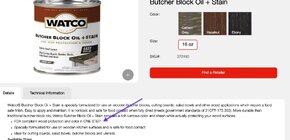
Many manufactures such as Waco Butcher Block will state their product is compliant with FDA guidelines for food contact. (likely FDA 21 CFR 175.300) Compliant doesn’t mean the FDA regulates the manufacture, but the manufacture has followed the guidelines established by the FDA.

This is from Rust-Oleum’s site.

Image 2-20-26 at 8.28 AM.jpeg
 
Last edited:
Allow me to clarify my original post. I try to sell nearly all of my pieces and I won't put it up for sale as 'food safe' unless the manufacturer has done all of their own testing. Again...with so many OEM approved safe finishes I don't understand why someone would choose anything else if the piece is for sale. just my opinion...
 
Allow me to clarify my original post. I try to sell nearly all of my pieces and I won't put it up for sale as 'food safe' unless the manufacturer has done all of their own testing. Again...with so many OEM approved safe finishes I don't understand why someone would choose anything else if the piece is for sale. just my opinion...
I'm with you there, John. I only sell once per year at the holiday bazaar at our facility (11 different studios, 1500 members). A significant percentage of the people who come to the sale are likely to care what kind of finishes are put on bowls especially. Not so much spindle projects, but still.... I used to go with the idea that any finish that is cured is food safe, but then I became more educated about things like "driers" (e.g., in so-called boiled linseed oil - less than a handful are made friendly by heat-treating). And recently, when I wanted to apply a bit of epoxy to a salad bowl, I learned about how not all epoxies are food safe. As an instructor and lathe program coordinator, I feel I must not compromise on any statement about "food safe." Such a hard line isn't for everyone, I know, just sayin'.
 
As a chemist, I can say it is true that nearly all finishes are food safe once fully cured. Also, there are very likely more toxins or allergy causing compounds in the wood than any finish.

That said, many people want to be able to say it is food safe without doubt. (This does generally ignore allergies). Compliance with a certification like FDA does support the safety and that the manufacture backs it, however, as mentioned above that doesn't include testing for toxicity or how the certification/classification is determined. IMO it's better than nothing. In addition one can:

1) Use an edible finish e.g. shellac (used as food coating among other things), mineral oil, vegetable oil...
2) Look at the Safety Data Sheet(SDS) (formally MSDS) required for all products. This shows what chemicals are actually in the substance rather than what the manufacture claims. If this showonly one or two components that are not toxic it is safer than most things. Sectioins 3 ingredients and 11 toxicity are most important. Caveat a) this requires determining what is toxic, and b) "proprietary" compounds are allowed to be excluded.
3) Does the manufacturer provide easy access its food safe criteria and/or its Safety Data Sheet.

Mahoney's does a pretty good job: https://mahoneysfinishes.com/food-grade-safety-info/
However IMO, it demonizes VOC's. Our food, wines, coffee's would taste pretty poor without a lot of VOC's. SDS shows the only ingredient listed on MSDS is walnut oil.

Tried and True says “100% safe for food contact surfaces." “Linseed oil and beeswax” on the can. MSDS ingredients: “Modified Linseed Oils” and “trade secret”. Sooooo, how modified? secret? Their website goes further in its claim on other safety/environmental issues. https://www.triedandtruewoodfinish.com/about/environmental-standards/

Having fun Pushing it too far?? are linseed oil, walnut oil, or tung oil toxic? Warning - google with give many different and wrong answers. See SDS.
Linseed: SDS: Linseed Following ingestion "Rinse mouth with water. Do not induce vomiting. Never give anything by mouth to an unconscious person. Call a doctor or Poison Control Center immediately." ?? Does not sound good! That's likely for drinking it straight. Section 11 No other toxicity data listed

Walnut Oil: SDS: No acute or cronic toxicity. Ok, its a vegtible oil
Tung Oil: SDS: Section 11 toxicity either says not toxic or no data. But for fun see the SDS for Minwax tung oil especially sections 3 & 11 https://web.mit.edu/tsg/sds/minwax_tung_oil.pdf Finishes labled "pure tung oil" are often not.

Sorry for the long post, you decide.
Lary

 
Back
Top