• December 2025 Turning Challenge: Single Tree! (click here for details)
  • Congratulations to Bob Henrickson, People's Choice in the November 2025 Turning Challenge (click here for details)
  • Congratulations to John Dillon for "Chinquapin Oak" being selected as Turning of the Week for December 22, 2025 (click here for details)
  • Welcome new registering member. Your username must be your real First and Last name (for example: John Doe). "Screen names" and "handles" are not allowed and your registration will be deleted if you don't use your real name. Also, do not use all caps nor all lower case.

Can't Get A Glossy Finish To Save My Life

Joined
Jun 20, 2024
Messages
5
Likes
1
Location
Long Beach, CA
I need some real help here.

I will try not to ramble on too long with my issue.

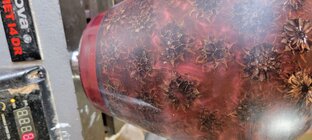
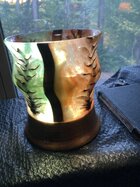
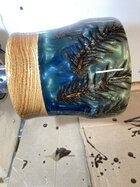
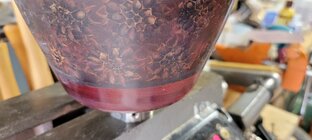
I am about a year and a half into wood, turning now and about three months into resin work. I have turned a couple of pretty nice things but as always, my issue is the finish. I did the obligatory, sweet gum pods in resin and I cannot for anything get a real transparent shiny finish on this vase. The surface is smooth as glass and i'm very happy with it but it just does not pop at all. It's very dull. I have tried Maguire's polishes. I have tried the Mohawk high gloss buffing compound with a handheld polisher, and what I think are the appropriate buffing wheels, but still no dice.

I am definitely an advocate of the handheld polisher versus putting it on the lathe (buffing wheels, etc.). No matter what I do, though, the finish always ends up kind of dull and almost cloudy. What am I doing wrong?
 

Attachments

  • 20251226_124901.jpg
    20251226_124901.jpg
    223.1 KB · Views: 38
  • 20251226_124854.jpg
    20251226_124854.jpg
    296.5 KB · Views: 38
I've never done resin work like you are doing, but two things come to mind:

1- is the resin kit you are using for a high gloss final effect? Does the manufacturer give advice on polishing the final coat? Or-

2- is there something, or some product, in your polishing sequence that is not buffing to a high enough sheen? With this, I am really out of my experience realm, so I can't advise on what different to do in the polishing phase.

Why resins? (Are these casting resins, some sort of epoxy?) With careful application, other finish products can provide a high gloss, built-up final look. But not to the thickness of casting resins (like bartops). Shellac, lacquer, high quality varnishes... I'd recommend (as other will, too) the Bob Flexner book "Understanding Wood Finishing" (3rd edition). He takes you through the layperson's world of all things wood finishing science. This book will be a big help to you.

[Edit- I see why the resin- you're infilling a very irregular surface. Whatever that is, it's pretty cool.]

On the chance you are thinking waxes, skip them, they do not magically make a transparent, high gloss surface. That book covers waxes, too.
 
I see what appears to be a lot of scratches, tell me about how yyou are sanding, what type of paper, what grits, then tell me how you are using the mowhawk or maquires.

The amount of gloss you will achieve is directly related to how well and how high of a grit you sand too.
 
I agree, there looks to be quite a few scratches. I have 4 suggestions that may or not be necessary but might be helpful. I don't have much experience specifically with resin, but most of the videos of epoxy river tables that I have watched put a top coat like varnish, hardwax oil, etc on the resin. I would consider wet sanding of the resin (with water) for grits 600 and finer. Next, I am not sure why you would so readily dismiss buffing wheels on the lathe; I am quite happy with the Beall system. Buffing a piece sanded to 400 grit definitely produces a glossy sheen, on both wood and epoxy inlays. A similar effect to buffing is a sanding paste, like Yorkshire Grit. Many turners use these pastes instead of sanding to the highest grits.
 
You definitely need to sand through each grit being sure to sand out all the scratches from the previous grit. With resin for a high gloss you really need something like Micromesh, wet sanding through each of its grit to its highest grit. Only then will the Meguires do its job. Try to avoid overusing the dry sandpaper, the grit breaks down and gets irregular then you tend to push it too hard and gouge the surface.
 
Back
Top