• The forum upgrades have been completed. These were moderate security fixes from our software vendor and it looks like everything is working well. If you see any problems please post in the Forum Technical Support forum or email us at forum_moderator (at) aawforum.org. Thank you
  • It's time to cast your vote in the March 2026 Turning Challenge. (click here for details)
  • Congratulations to Chris Lawrence for "Dragon's Grip" being selected as Turning of the Week for March 30, 2026 (click here for details)
  • Welcome new registering member. Your username must be your real First and Last name (for example: John Doe). "Screen names" and "handles" are not allowed and your registration will be deleted if you don't use your real name. Also, do not use all caps nor all lower case.

Ceiling or wall plug?

Joined
Feb 25, 2025
Messages
717
Likes
906
Location
Jackson, MS
My new shop has 10’ ceilings. My table saw will have the plug in the ceiling but I’m wondering about the lathe plug. Looking for recommendations.
 
I use a ceiling fixture. I do not want my lathe to be close to a wall. Also you may want to bring dust collection, compressed air, and vacuum connection to the lathe. These will best be distributed at ceiling level.
 
Will your lathe be positioned out in the middle of the room? I keep mine next to a wall so a wall receptacle was a no-brainer. Dust collection and compressed air is also on the wall or the end of the wall.

For random tool use I did install some ceiling receptacles with 110v retractable reels.

JKJ
 
If you use ceiling mounts you can have a drop of cord to plug into any level you want. This i how I have the lathe set up and if I ever want to move it that is an easy job. Everything else worked for either wall outlet or power strip on neighboring bench or Dust Closet.
 
I have both wall and ceiling outlets. The lights are all powered by the ceiling fixtures and all the lathes were powered by wall fixtures. Yes they were tripping dangers but all participants were well aware and we never had a problem. The Powermatic has one of those drive over tunnels the cord runs under.
 
As you can see in the picture I posted in your other thread (lathe placement), my lathe is on a wall receptacle. When I built the shop last year, I ran a 2" Sched 40 PVC conduit in the floor to the middle of the shop. I have 2 240 20A circuits and 1 120v 20A circuit going to the center on the floor. One 240 runs my table saw, the other runs my bandsaw. Then the 120 runs my small bandsaw and the outlet strips mounted underneath the bench tops. The only ceiling receptacles I have are for my lights and the air filter (which is mounted on the ceiling joists). I personally don't like wires hanging down from the ceiling - but that's just a personal preference. If you do have ceiling receptacles, make sure they are locking so your plug doesn't come undone over time (from the weight of the wire).
 
If you’re still in the planning phase I highly recommend running power and dust collection to the table saw under the floor, much nicer than having drops you have to work around. I did this for TS and planer that sit relatively in the center of my shop.

My ceiling is only 9ft but I have a ceiling outlet for a air filter, and a spring wound power cord.

I have twenty-some 120v outlets around my 18ft x 25ft shop on the walls both at 14” height for stationary tools and at 4ft height for plug access, these are wired on ~4 20A breakers, interleaved so outlets near each other are on different breakers.

I also have dedicated 240v outlets placed on all walls at 14” height for power tools beside the floor 240’s for TS and planer (BS, DC, lathe) with a couple extra should I want to move things around.

My lathe sits near the wall between a window and a corner. This gives me light, and views as well as access to two walls to hang tools on as well as run power, air, and DC from.

Since my back is to the door of my shop I also have a sign outside, and have trained my wife well, to knock before entering and if I haven’t noticed to flash the overhead lightswitch on the wall just inside the door. Being surprised while concentrating on a turning is no fun.

Lastly, just like outlets and clamps, you can never have too much light in a shop; especially as we get older :)
 
All my outlets are at waist or above bench height so I don't have to bend over to use them, except for things that are not near walls, those are on the floor (I used "tombstones" rather than floor outlets to help keep them from filling up with dust) . I'd avoid wiring drops from the ceiling if at all possible. Having to get a ladder to plug and unplug is a pain, having unnecessary obstructions hanging in the space over your tools is even worse.
 
My lathe is plugged into the wall - the headstock is next to a wall, so the power cords (lathe and 115v for lights, accessories) have about a foot or so gap to cross to the wall. All my outlets are above bench height. I do have a few ceiling outlets used for the hanging air filter, bluetooth speaker, and one pull-down extension cord.

In a previous shop, my lathe was more in the middle of the floor, so I put in a twist-lock outlet in the ceiling, right above the back corner of the headstock, so the cord was never in the way. That worked out pretty well. Had the similar arrangement at the bandsaws, with the drops behind the column.

So it's dependent on personal preference and how you plan to set up your shop. Ceiling drops can be great for getting cords off the floor, but if they're not positioned right relative to the machines, the hanging cord will be in the way way worse than something across the floor.
 
The plug will be switched.
Lightning energy can arc through a typical switch. Google agrees;
Yes, a lightning strike can absolutely arc through an open knife switch
.

While an open switch breaks a normal electrical circuit, a lightning strike carries such immense voltage—often tens to hundreds of millions of volts—that it can easily break down the dielectric strength of the air (insulation) between the switch contacts
 
My lathe room is a concrete floor, so no in the floor plugs. My old shop was a pole barn, so no problem running conduit down the walls and plugs that way. I got a PM 24 inch planer, and it needs a 50 amp circuit. It had to be run through the attic and is a drop down. Some day, I will get it off the pallets it is on and onto a base I am half way through making. Not excited about the drop down, but it was the only option.

robo hippy
 
All my tools in the center of t shop ae wired to ceiling outlets, in every case there is an extension cord from the ceiling to the tool so i can unplug them when needed. But my lathe isn't one of those tools, while it isn't against the wall it still gets plugged into a wall out;et.
 
All my large machines, including lathe, are ceiling drops. I had the electrician put in drops from the ceiling, so thejunction box is mounted there and then the cord drops with the female receptacle at the end. No need to pull out a ladder and I dropped them all where the machines go. A tension protector is installed at each drop point so the cord doesn’t pull down and put stress on the wires.
 
Before my shop floor was poured I drove a 1/2" 6' copper rod 5 1/2 ' into the ground below where the 100 watt service was going to be located. I believe I have 20 circuits for the shop, 2 220 V and 18 115V. Above I said only two things plugged in but I do not climb the 8' ladder to unplug the ceiling lights in the 10' ceiling. If I were to do it again I would make 8' ceilings and not buy a 10 ft step ladder ( 10' ceiling why would I not figure I needed a 10' ladder:rolleyes:)
 
Before my shop floor was poured I drove a 1/2" 6' copper rod 5 1/2 ' into the ground below where the 100 watt service was going to be located. ...( 10' ceiling why would I not figure I needed a 10' ladder:rolleyes:)
Requirements differ in places When I built my shop 250' from the house with underground wiring (#1 copper in conduit for overkill) to a 100 amp sub panel it was recommended by friends at the utility company to put in three ground rods about 6' apart, the first connected directly to the box and the others jumpered.

It was also recommended) to jumper the ground to rebar and bring it out to a jumper to the other ground rods. Apparently 1400+ sq ft of rebar in concrete can make a significant ground.

Many are concerned about the cost of big copper wire but I think it's insignificant compared the overall cost of the building materials. The oversized wire gives me less than 1% voltage drop even when two big motors cut on at the same time. I have a bunch of 50amp receptacles inside and outside the shop for welders, plasma cutter, etc.

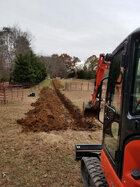
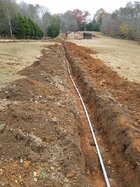
All utilities on our farm are underground, even the 800' water and 1200' power lines I ran down the horse pasture and then to the security gate. #2 copper in conduit to an 80amp box for this run.
1775150577936.jpeg 1775150616876.jpeg

With the property designated as agriculture use in this county there are no permits required for any construction that can be related to agriculture and no one inspects. I grow, use, and sell wood products, hatch and raise game birds, do animal care and surgery as needed, and maintain farm equipment. I was told this property qualifies. However, I do follow all codes.

Another thing many but not everyone around here knows is if you have at least 15 acres (we have 27) with some of it forested a landowner might qualify for a Forestry Greenbelt program. A forester comes out and walks the property, makes a map showing different zones and their history (trees on previous fields, old growth, etc), makes recommendations and approves the Greenbelt application. This immediately cuts property taxes to about 1/2.

A couple of years later I asked to forester to come back and give feedback on my progress. He was surprised - he said almost everyone gets on the Greenbelt program for the tax reduction and almost no one does anything afterward. He said I was one of the very few who was actually following his recommendations! (We stood out in the rain talking for a couple of hours - what a great and knowledgeable guy!

I can't imagine how many tons I've removed of Ailanthus altissima (tree of heaven), bush honeysuckle, privet, choking poison ivy, wild grape vines, and the worst invasives ever introduced by people with defective brains: bittersweet. My goal is also to take down every pine tree on the property and let the hardwoods grow. The place sure looks better for it. Helps to have big equipment. Working on cleaning up another acre in my spare time.

Hey, I've found poison ivy vines over 4" in diameter! Big enough to put pieces on the lathe. (I was told the wood from poison ivy was sometimes used to make mother-in-law spoons. Wonder what that means...)

JKJ

 
Back
Top