• The forum upgrades have been completed. These were moderate security fixes from our software vendor and it looks like everything is working well. If you see any problems please post in the Forum Technical Support forum or email us at forum_moderator (at) aawforum.org. Thank you
  • Congratulations to David Wyke, People's Choice in the April 2026 Turning Challenge (click here for details)
  • Congratulations to Ted Pelfrey for "Cherry Blossoms on Cherry" being selected as Turning of the Week for April 27, 2026 (click here for details)
  • Welcome new registering member. Your username must be your real First and Last name (for example: John Doe). "Screen names" and "handles" are not allowed and your registration will be deleted if you don't use your real name. Also, do not use all caps nor all lower case.

Chuck Jaw storage idea?

I have both 3 and 4-jaw chucks for my metal lathe. Been a year and a half since I turned anything on it - can't remember what's scroll and what's independent. I see I used a 3-jaw for cutting a couple of tapers on this ferrule. Thought the jaws were independently adjustable but I'll have to check.

View attachment 87866

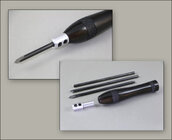
Made a tuning "hammer" or my favorite piano tuner. a bit of metal work, a little woodturning. Life is good.

View attachment 87867

JKJ

JKJ
Im curious if i could do some minor machine work on my wood lathe, found some chucks that mount with a MT2 and draw bar and found tooling holders and cross slide tables i could adapt to my lathe, just wondering what others think? Had a friend who told me he did that with his powermatic and the results were acceptable, but am curious what other guys think before i drop some coin on the hardware, for simple tapering and drilling maybe even reaming i think it may be good enough but just not sure
 
I've seen others use a cross slide at the wood lathe. I've done a lot of machining of aluminum and brass at the wood lathe with woodturning tools, but free hand. I've also reshaped steel chuck jaws with a Thompson scraper but that was less pleasant. Some possible problems with machining steel at the wood lathe may be getting the speed low enough to suit, and lubrication. My metal lathe is mounted in a big tray and it always collects oil inside. I shaped the steel jaws on the wood lathe without lubrication. Sharpened the scraper more-or-less like a metal lathe tool bit.

I've also used a metal lathe tool bit with a triangular carbide cutter on the wood lathe to clean up a couple of steel chuck inserts that didn't suit me. Worked fine without lube with the tool bit held by hand. Cleaning up dinged chuck jaws was also easy.

Should be no problem machining aluminum and brass without a cross slide. (All that said, I'd love to find a good cross slide with an adjustable angle.)

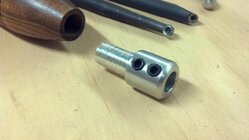
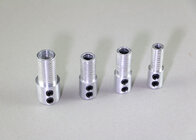
Using a cross slide could allow more precision but for the things I usually do don't require precision - sizing with parting tool and calipers and cutting with gouges, skews, and scrapers is sufficient. I've posted pictures of the handle inserts from aluminum, all done with hand-held tools. (I cut rough grooves on purpose in the part that glues into the handle.)

I start with a piece of 6061 aluminum rod cut about 3" long (bought from Online Metals). The only other tool needed for these inserts is a drill press and taps. The set screws are usually too long so I hold them in an allen T-wrench and shorten the at the bench grinder.

1777933394755.jpeg
1777933901855.jpeg
1777933527456.jpeg
I think I've done three demos so far on turning metals and I know several that make these tool inserts now.

I posted my document here:

JKJ
 
I've seen others use a cross slide at the wood lathe. I've done a lot of machining of aluminum and brass at the wood lathe with woodturning tools, but free hand. I've also reshaped steel chuck jaws with a Thompson scraper but that was less pleasant. Some possible problems with machining steel at the wood lathe may be getting the speed low enough to suit, and lubrication. My metal lathe is mounted in a big tray and it always collects oil inside. I shaped the steel jaws on the wood lathe without lubrication. Sharpened the scraper more-or-less like a metal lathe tool bit.

I've also used a metal lathe tool bit with a triangular carbide cutter on the wood lathe to clean up a couple of steel chuck inserts that didn't suit me. Worked fine without lube with the tool bit held by hand. Cleaning up dinged chuck jaws was also easy.

Should be no problem machining aluminum and brass without a cross slide. (All that said, I'd love to find a good cross slide with an adjustable angle.)

Using a cross slide could allow more precision but for the things I usually do don't require precision - sizing with parting tool and calipers and cutting with gouges, skews, and scrapers is sufficient. I've posted pictures of the handle inserts from aluminum, all done with hand-held tools. (I cut rough grooves on purpose in the part that glues into the handle.)

I start with a piece of 6061 aluminum rod cut about 3" long (bought from Online Metals). The only other tool needed for these inserts is a drill press and taps. The set screws are usually too long so I hold them in an allen T-wrench and shorten the at the bench grinder.

View attachment 87890
View attachment 87893
View attachment 87891
I think I've done three demos so far on turning metals and I know several that make these tool inserts now.

I posted my document here:

JKJ

Guess i better save my pennies and get me a small metal working lathe, just less hassle im sure, was kinda skeptical when the guy started telling me how a metal lathe was not necessary, and chucked about abusing his wood working lathe, sorta looked at him a little crooked and just nodded and said huh interesting a lot.
 
Back
Top