Follow along with the video below to see how to install our site as a web app on your home screen.
Note: This feature may not be available in some browsers.
The forum upgrades have been completed. These were moderate security fixes from our software vendor and it looks like everything is working well. If you see any problems please post in the Forum Technical Support forum or email us at forum_moderator (at) aawforum.org. Thank you
Congratulations to David Bartell, People's Choice in the March 2026 Turning Challenge (click here for details)
Congratulations to Chris Lawrence for "Dragon's Grip" being selected as Turning of the Week for March 30, 2026
(click here for details)
Welcome new registering member. Your username must be your real First and Last name (for example: John Doe). "Screen names" and "handles" are not allowed and your registration will be deleted if you don't use your real name. Also, do not use all caps nor all lower case.
I'm old school. Pen and paper. I often make sketches and then may refine it for the final drawing. I do this mostly for spindles and finials. I find that if I design it first, even roughly, the end product is usually better than if I design while turning. Hollow vessels are too dependant on the grain and figure in the wood to decide up front what shape it will be. I might start out with an idea but quite often I make subtle changes as I turn based on how the wood is showing itself. Of course I'm not computer literate and the drawing programs I tried were not intuitive to me at all.
Charlie makes a good point
One of my best woodturning books was south western pottery
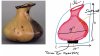
I used Apple Pencil to make a sketch of how I do pitcher forms from a half 1/4 log.
Note the log is not round.
Mostly I want an idea for the rim diameter what the height will be after I use 1 1/4 for the faceplate.
I can get a notion of where the sapwood will show.
I do a refinement of the shape when roughing between centers.
We need to draw by hand, even those as terrible at drawing as me. The hand is prone to making natural compound arcs. Turning is a skills of the eyes and hands, and the design should echo that. But that's just my strongly held opinion.
I use an old version of AutoCAD on my laptop. Makes it very easy to draw up all the layers of a segmented bowl and gives you all the needed dimensions for each segment. Sectional views and Face views of an item are a snap once you are used to the program. Its all done by picking an icon like "draw a line" or "draw a circle" or "draw an arc". Enter the size dimensions and there it is. Save it and print it on your printer.
This site uses cookies to help personalise content, tailor your experience and to keep you logged in if you register.
By continuing to use this site, you are consenting to our use of cookies.