• The forum upgrades have been completed. These were moderate security fixes from our software vendor and it looks like everything is working well. If you see any problems please post in the Forum Technical Support forum or email us at forum_moderator (at) aawforum.org. Thank you
  • Congratulations to David Bartell, People's Choice in the March 2026 Turning Challenge (click here for details)
  • Congratulations to Steve Gray for "White Oak Handled Bowl" being selected as Turning of the Week for April 6, 2026 (click here for details)
  • Welcome new registering member. Your username must be your real First and Last name (for example: John Doe). "Screen names" and "handles" are not allowed and your registration will be deleted if you don't use your real name. Also, do not use all caps nor all lower case.

Coring systems

Joined
Aug 14, 2007
Messages
6,775
Likes
3,935
Location
Eugene, OR
I did a coring demo for our local club, the Beaver State Woodturners covering how to use the 3 coring systems. One question that came up that I did not expect was "which system would you recommend for a beginner"? Well, for sure, the McNaughton is not on that list. I would guess the Oneway and Woodcut are left. The Oneway if you can afford it, and probably remember that you will need to get the Hunter Korepro to go with the blades, or the Woodcut is better for the beginners, and cheaper. They are ready to go straight out of the box, but I did sharpen the cutter first. I think it is a bit more simple to use than the Oneway.

robo hippy
 
Having started coring with the McNaughton, and after 3 years of trying (and studying Mike Mahoney’s DVD), I still could not get comfortable using it. I had been turning for 3 or 4 years when I tried the McNaughton. I was given a club member’s Oneway Coring set up to use for a few months. Sold the McNaughton immediately. I agree that Oneway is much easier to use, But I would not recommend attempting to core bowl blanks (using any of the systems) if you are in your first couple of years turning.
 
Having had all three the McNaughton would not only not be recommended to a beginner but I wouldn't recommend it to anyone. Up until a year ago my first recommended coring system for a noobe would have been the Woodcut but the Turning Shed brought out Templates for the Oneway Coring System (before I can recommend something I have to own it). Now this comes as a download and you print it out and put it in a three ring binder. If you can afford to buy the Oneway system you can afford to spend $80 on this Template system. It's possible that a blind person could core successfully using this system. So I would recommend the Oneway with the Templates or the Woodcut to a noobe.
Actually $74.99
 
Last edited:
Having had all three the McNaughton would not only not be recommended to a beginner but I wouldn't recommend it to anyone. Up until a year ago my first recommended coring system for a noobe would have been the Woodcut but the Turning Shed brought out Templates for the Oneway Coring System (before I can recommend something I have to own it). Now this comes as a download and you print it out and put it in a three ring binder. If you can afford to buy the Oneway system you can afford to spend $80 on this Template system. It's possible that a blind person could core successfully using this system. So I would recommend the Oneway with the Templates or the Woodcut to a noobe.
The templates from the Turning Shed are well worth the $80 especially for the amount of time that went into developing them.
 
When our club first started, we didn't plan for demos. So, the topic came up for the next month and I asked if any one had the McNaughton and knwe how to use it, so that was the next demo. That demo gave me enough clues so that I was ble to have a go at it and figure out how it worked. Well, at least I could make it work. Part of the reason why I made my video about using it. The 2 biggest problems that I could see are one the blades do not follow a "perfect" curve arc. Not hard to see if you look at things the way I do. My guess is that the blades are profiled first, then they are bent. If you want a perfect arc of a curve in metal bending, you have to bend it several inches longer than what you need, and then you snip off the extra length. This is why the system ALWAYS drifts off to the outside of the kerf. The second issue is that there is a lot of "flex" designed into the system. For short cores, not a problem. For deeper cores, a big problem, unless you have figured out that you need to have the blade set at 1/4 inch or so above the center line. What this does is keeps your cutter slightly above center line all the way to the bottom of the cut. Probably the nastyiest of catches I have had with it, and it took a while to figure out why this was happening, was from being below the center.

Funny thing about the Oneway coring system. I e mailed them to ask why they didn't have a laser pointer system for their coring system. I have not had any response. It would be easy to set up. In the demo, my friend Randal, who helped me silver solder the Big Ugly tools together demoed the Oneway system. He bought his spacer templates from home. He has a 3520B, and the club lathe is a 3520C. There was about a 1/2 inch difference for his spacer blocks, the C model being slightly farther away than the B model. One thing I noticed is that with the Hunter Kore Pro, his shavings were 1/2 inch wide. The Woodcut and McNaughton were much smaller. I do grind my McNaughton tips down square rather than the spear points.

Here is a link to the demo if anyone is interested:

View: https://www.youtube.com/watch?v=JBefcwZO6SA&t=


robo hippy
 
Having had all three the McNaughton would not only not be recommended to a beginner but I wouldn't recommend it to anyone. Up until a year ago my first recommended coring system for a noobe would have been the Woodcut but the Turning Shed brought out Templates for the Oneway Coring System (before I can recommend something I have to own it). Now this comes as a download and you print it out and put it in a three ring binder. If you can afford to buy the Oneway system you can afford to spend $80 on this Template system. It's possible that a blind person could core successfully using this system. So I would recommend the Oneway with the Templates or the Woodcut to a noobe.
I agree, in my opinion the templates from the Turning Shed are worth the money for someone using the Oneway system for the first time. I bought the Oneway system and the templates from the Turning Shed last January. I was able to get up and running very quickly and have cored several dozen bowl blanks without any trouble.
 
Oh, another side note.... I think 2 people in the club mentioned that they had problems coring on the 16 inch Robust lathe, which is one speed. I ALWAYS core on low speed/torque. I do core with the McNaughton on my Robust Liberty lathe which Brent didn't make for very long. Maybe having the tool rest set above center helps. With the 3520A I had, I did try in to core in high speed range, which is where I turned bowls mostly, and it would stall out. This was probably before I figured out I had to start above center. I don't have rpm indicators on my lathes, other then the Vic 240, but I can't see the monitor as I am turning. I would guess that much of the time, my speed is in the 500 to maybe 1000 rpm range. I do use end grain collars on my McNaughton system, ALWAYS!

robo hippy
 
I had a early Mcnaughton, it worked OK once you get the hang of it. Although I wasnt enamoured with the Stellite cutter and the flexing, also had to up grade the yoke to improve the rigidity, eventually so sold it off. I like the Woodcut, although I caught a glimse of a Rolly Munro coring tool with 6mm carbide replacable tip. But most of his gear i hard to come by and these days dont have one.
 
I went with the Woodcut for cost and simplicity. Works fine on my AB, but I would suggest that if you are going with Woodcut, go with the Series 4. It seems to be heavier built and stronger with less flex. Wish I had known.
 
The Woodcut is a nice little system. Only thing I don't like about it is that you have to use the tailstock, and I never have the tailstock on when turning bowls. It is an extra production step. No holes in my elbow from forgetting to remove the live center!

robo hippy
 
I agree, in my opinion the templates from the Turning Shed are worth the money for someone using the Oneway system for the first time. I bought the Oneway system and the templates from the Turning Shed last January. I was able to get up and running very quickly and have cored several dozen bowl blanks without any trouble.
Templates are good but be aware that its a one shot download, if you open the files on your phone save them right away because you wont be able to open them again and they are about the most un helpful people ive ever dealt with, pretty sure i had a right to be pissed that i couldnt access the files i PAID FOR
 
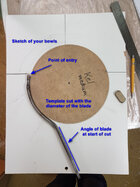
The first thing to remember is that all coring systems have to cut along a circle arc. The radius of the cut is locked to the blade you use, but you can place the centre where you want, at least with McNaughton and Oneway. I have the McNaughton but don´t use it often. Easy to use if you take a little time to understand how it cuts. I made some very simple templates to let me cut whatever I want. One for each curvature of blades. Just mark the blank where you want to start and start with the blade at the angle according to the template. Worked well from my first cut.


Template.jpg
 
… I do use end grain collars on my McNaughton system, ALWAYS!

robo hippy
Are you referring to a stop collar on the 1” rest post? Or is there something else magical that can improve my use of the McNaughton?

I purchased the McNaughton system 15-20yrs ago. After the first handful of cores that scared me to death I’ve come to be comfortable with it. But only core a dozen, or two, bowls every year or two with it. I don’t make thin stacked sets, just get more blanks out of logs that I turn twice.
 
Why can't you open the files? The files didn't go anywhere. Mine are still able to be opened.
Yea, if you download them,
I made the mistake of not opening and saving them right away, open them to check them on my phone before downloading them onto a computer system i use for drafting etc, typically when you buy something like that you can at least open them as many times as you want from the source
 
A "stop collar" for me is a piece of wood that sits under the tool post so that it keeps the tool rest at a certain height. I prefer mine to be so that when I get to the end of the core, it should be about 1/4 inch above bowl center. I would get a lot of chattering some times, and found out that I was below center. With scrapers, and yes, coring tools are scrapers, they need to be slightly above center on the inside of a bowl. I got to the point where I could "feel" that I was below center when trying to core a piece all the way off. There is a lot of flex designed into the McNaughton center saver system. I took a piece of end grain, cut a hole through it to fit the tool rest post, left a bit of clearance, and cut it to length. You can always make them smaller.... Oneway does not flex at all. Woodcut flexes a bit, but that is more from having it on a some what flexible plate, and the tailstock engagement.

robo hippy
 
Yea, if you download them,
I made the mistake of not opening and saving them right away, open them to check them on my phone before downloading them onto a computer system i use for drafting etc, typically when you buy something like that you can at least open them as many times as you want from the source
I don't understand. I did save them right away and they are still right where they were downloaded to and they open as many times as needed. If I get a file on my phone I can then transfer it to the computer and it will open. I don't understand your problem.
 
I don't understand. I did save them right away and they are still right where they were downloaded to and they open as many times as needed. If I get a file on my phone I can then transfer it to the computer and it will open. I don't understand your problem.
I think he's saying he opened them from the website and did not save them to phone.

However, many may not realize that if you opened it on your phone , your phone HAS downloaded it, but it may be stored in a cache in out of the way places (such as temporary files) , it could still be re-opened from there, generally and then saved...

but the basics of it is , he's saying he opened it direct from website without saving it first , when he attempted to re-open it from the website again (or download & save as) , website's design prevented him from doing so..

could be he didn't know how to save the file from browser (depends on phone and phone browser, but some can be really obscure about how to do simple things like that) so tried to "download" as opposed to "open" (both are similar in the background, difference is in what phone does with it once downloaded..)
 
I made a laser light set up similar to the one outlined in a recent AAW article for the Easy Core system. Works great to be able to see where the cutter will enter and how deep it will go. Easy to see what the different cutter arms will do. Best of all I drilled a proper sized hole in my bench for the laser and now I can see how a blank will core without having to set the the coring system base on the lathe.
And I heartily agree with Robo Hippy that the Karpo cutter is much superior to the Oneway cutters,
 
After getting an extra laser for my Monster Hollowing Systems many years ago I used it on the Oneway Coring System just to show the depth of each of the 4 cutters before starting the cut. Worked well but really didn't need it as I wasn't trying to get the most cores out of the wood. I may get it back out when I start on the 600 lbs of Central American burl I have. Will be giving the Korpro a real workout.
 
Bernie - could you further explain what you mean by drilling a hole in your bench for the laser? I use a laser too, but have it in an adjustable arm the is put in the easy core base but I’d love to see how you are doing it.

Thanks, tom
 
Bernie - could you further explain what you mean by drilling a hole in your bench for the laser? I use a laser too, but have it in an adjustable arm the is put in the easy core base but I’d love to see how you are doing it.

Thanks, tom
The laser “arm” that you place in the easy core base is 1” diameter IIRC. I drilled a same size hole in the bench and set the arm in it with a collar so it doesn’t drop thru too far. Place the blank under the laser and rotate the arm and/or move the blank until you see the best setup.
 
I did a coring demo for our local club, the Beaver State Woodturners covering how to use the 3 coring systems. One question that came up that I did not expect was "which system would you recommend for a beginner"? Well, for sure, the McNaughton is not on that list. I would guess the Oneway and Woodcut are left. The Oneway if you can afford it, and probably remember that you will need to get the Hunter Korepro to go with the blades, or the Woodcut is better for the beginners, and cheaper. They are ready to go straight out of the box, but I did sharpen the cutter first. I think it is a bit more simple to use than the Oneway.

robo hippy
I would have to disagree with you here. Sooner or later, any carbide cutter will need to be replaced. A replacement cutter costs USD35, and the Korepro Cartridge is another USD200. If you hit a nail in the blank, you’ll have to toss the cutter immediately; if you’re working with roots, the sand will kill the edge instantly. You could, of course, try to regrind it slightly, but you’ll never get back that factory sharpness. My father considered switching to carbide right after buying the Oneway, but decided to wear out the stock cutters first and only then buy into that system. For several years now, we have been actively using the original HSS cutters which are easily sharpened if you get the Oneway sharpening kit. So, to summarize: after processing more than 50 logs, we haven’t even used up a quarter of the HSS cutters' lifespan. The first two blades for large forms are sharpened rarely since there aren't many forms like that. We mostly use the cutters for smaller forms. Those we sharpen much more often. They hold their edge very well. We resharpen every 3 or 4 bowls. I wouldn’t recommend switching to carbide given such high upfront costs. We are currently building a hollowing system, and after analyzing the prices and lifespan of carbide, we’ve made our choice in favor of HSS cutters. Yes, you have to sharpen more often, but the cost per use is pennies.

Tim "Wooden Boy"
 
Well spoken for someone who has not used the Korpro. Just to let you know that once used the Korpro becomes the go to cutter. Each side of the Korpro insert lasts a very long time and it cuts so much smoother than either the regular or the carbide cutters from Oneway. As far as hitting a nail that is not a forgone conclusion as carbide is made to cut steel and it would depend on how fast you were pushing as that nail only comes around once a rotation. I also use the Hunter tools for hollowing and again the edge lasts a very long time. Most of my hollow forms are small and I'll bet that I can hollow well over a hundred or two before I even have to move the cutter. Again carbide inserts are made to cut steel and wood is no where as tough as steel. It is good that you and your Dad can make do with the regular cutters. Nice to see younger folks interested in turning. I stand with Ukraine!
 
Thank you Bill for your support!) You are absolutely right—we haven’t used the Korepro Cartridge yet, so our opinion is quite subjective. We would love to hear more about your experience. How many bowls can you typically complete with a single replacement cutter? And after how many bowls does it actually become cost-effective? Could you provide some average statistics on this? Thank you.
Well spoken for someone who has not used the Korpro. Just to let you know that once used the Korpro becomes the go to cutter. Each side of the Korpro insert lasts a very long time and it cuts so much smoother than either the regular or the carbide cutters from Oneway. As far as hitting a nail that is not a forgone conclusion as carbide is made to cut steel and it would depend on how fast you were pushing as that nail only comes around once a rotation. I also use the Hunter tools for hollowing and again the edge lasts a very long time. Most of my hollow forms are small and I'll bet that I can hollow well over a hundred or two before I even have to move the cutter. Again carbide inserts are made to cut steel and wood is no where as tough as steel. It is good that you and your Dad can make do with the regular cutters. Nice to see younger folks interested in turning. I stand with Ukraine!
 
The Korpro does work. As for a beginner, cost is usually a factor, and that is why I suggested the Woodcut over the Oneway. And that is not even including the Korpro cutters. One thing I didn't like about the Korpro is that it removes a 1/2 inch wide shaving. That is a LOT to take off in one pass, especially on bigger bowls. If it were up to me, I would go to AZ Carbide and place an order for cutters, made from carbide, and about 3/8 inch wide at the cutting edge, and tapering back to the blade width, and they would have those ribs on the bottom which are a "specialty" of the Oneway coring blades. AZ Carbide told me 300 piece minimum order. If I still ran a business, I might opt for that, but the business took up all of my play time. Another project I would take up would be making a custom lathe for myself, probably with a sliding headstock and 3 speed ranges rather than the standard 2.

robo hippy
 
The Korpro does work. As for a beginner, cost is usually a factor, and that is why I suggested the Woodcut over the Oneway. And that is not even including the Korpro cutters. One thing I didn't like about the Korpro is that it removes a 1/2 inch wide shaving. That is a LOT to take off in one pass, especially on bigger bowls. If it were up to me, I would go to AZ Carbide and place an order for cutters, made from carbide, and about 3/8 inch wide at the cutting edge, and tapering back to the blade width, and they would have those ribs on the bottom which are a "specialty" of the Oneway coring blades. AZ Carbide told me 300 piece minimum order. If I still ran a business, I might opt for that, but the business took up all of my play time. Another project I would take up would be making a custom lathe for myself, probably with a sliding headstock and 3 speed ranges rather than the standard 2.
If the idea is packaged correctly, maybe there would be enough people for a 300-piece order. It's strange that Oneway didn't take the Korpro idea and come up with their own carbide solution. This solution would definitely have found its niche.
 
The concept of woodturning to a beginner right from the onset is that nothing is inexpensive and my guess is that 90% of beginners know what they are getting into. Nothing about this pastime is inexpensive and most of you folks know that. What most of us do know is that usually everything you by from the beginning has been replaced especially if you started on the low price end of the aisle. How many started with a lower price lathe and have upgraded as well as tools etc. How many agree that a place like this helped but also lent to a lighter wallet. Now think about what it took Mike Hunter to bring out the Korpro. First a lifetimes work in the carbide industry including staying on the cusp of what happens in the industry. I don't know what it cost to get the Korpro up and running but I'll guarantee it was not cheap! Now take a Korpro and start coring. How do you expect you'll do? Would it surprise you that you got 50 cores, or 60 cores before having to turn the cutter around? Well folks have done that and they do it with a lot less angst. I happen to know Mike Hunter and I do consider him a friend and I am quite aware of things he has done and for sure I have had no qualms about putting 4 Korpros on my four cutters. Do the Oneway cutters work? Yes they do but do they work as well as the Korpro? Not even close in my estimation. Now about Tim over there in Kiev there is not a lot I can do. I suspect that it would be pretty difficult to get something there as there is so much turmoil in country and countries around with hoops to jump through. All I know is that woodturning there with I'm sure air-raid sirens going off has to be difficult. Again I'm happy for Tim and his Dad for getting this done. And again I and I hope many of you STAND WITH UKRAINE!
 
Tymur, you and your dad have done an impressively thorough evaluation. One thing to also consider is the value of your time. The Korpro cutter, which is carbide, is more durable, but it is also faster in use. If you are coring many bowl blanks, and doing it to make money, the saving in time would be valuable. You would have to decide how much time you would save, both in coring and in sharpening, and how much your time is worth.

For those of us who turn for fun, and don't turn a lot of blanks, our time is not important. For a production bowl maker, like Glenn Lucas for example, it's critical to succeeding financially.

Мені шкода, що наш уряд не підтримав Україну краще. американський народ на вашому боці.
 
The concept of woodturning to a beginner right from the onset is that nothing is inexpensive and my guess is that 90% of beginners know what they are getting into. Nothing about this pastime is inexpensive and most of you folks know that. What most of us do know is that usually everything you by from the beginning has been replaced especially if you started on the low price end of the aisle. How many started with a lower price lathe and have upgraded as well as tools etc. How many agree that a place like this helped but also lent to a lighter wallet. Now think about what it took Mike Hunter to bring out the Korpro. First a lifetimes work in the carbide industry including staying on the cusp of what happens in the industry. I don't know what it cost to get the Korpro up and running but I'll guarantee it was not cheap! Now take a Korpro and start coring. How do you expect you'll do? Would it surprise you that you got 50 cores, or 60 cores before having to turn the cutter around? Well folks have done that and they do it with a lot less angst. I happen to know Mike Hunter and I do consider him a friend and I am quite aware of things he has done and for sure I have had no qualms about putting 4 Korpros on my four cutters. Do the Oneway cutters work? Yes they do but do they work as well as the Korpro? Not even close in my estimation. Now about Tim over there in Kiev there is not a lot I can do. I suspect that it would be pretty difficult to get something there as there is so much turmoil in country and countries around with hoops to jump through. All I know is that woodturning there with I'm sure air-raid sirens going off has to be difficult. Again I'm happy for Tim and his Dad for getting this done. And again I and I hope many of you STAND WITH UKRAINE!
I agree with the concept that this is all not inexpensive, and after a short time of working with it, you realize you made the wrong choice and should have bought something else from the start. That’s exactly what happened to us with turning tools. We spent a long time choosing and reading. We decided on an 8-piece Robert Sorby set, but after a couple of weeks of work, we realized we needed something different. In the end, we settled on tools from Carter and Son and Stu Batty, which are what we use all the time now. It’s not that Sorby tools are bad; it’s just that my father and I immediately felt they didn't sit right in the hand. I think it’s subjective.

Regarding Korpro, perhaps there is also a subjective denial of the effectiveness of carbide cutters. While exploring the world of chucks, I was very impressed by Easy Wood Tools chucks. They seemed very modern, fast, and convenient. And that’s how it turned out—the feeling didn't fail me this time. An excellent choice. However, their hollowing blades were a bit disappointing. Replaceable cutters cost a fair amount of money, but because they are round, you don't always remember how much or in which direction you rotated them. I was making small vases from oak and small roots, and to my disappointment, their lifespan was extremely short. I remember my father prepared large and small fruit tree roots. No matter how thoroughly he washed them, sand still remained. After the very first root, a brand new cutter went dull. I had to rotate it immediately. It makes you wonder if such expenses were worth it. The cutter is not cheap and is supposed to work for a long time, but under these unfortunate circumstances, it dulled instantly, leaving a subconscious feeling of disappointment. On oak blanks, the cutters work well, but for some reason, not very long either. After 8-10 medium vases, they have to be rotated. Perhaps I lack experience, but I can't even dream of one side lasting through 50 small vases. To me, that’s pure fantasy right now.

I read Robo Hippy's post from yesterday and immediately felt the truth in what he said, which I probably understood subconsciously. Looking at the picture, the square shape of those [Korpro] cutters is a bit intimidating because of the amount of material they can remove. Standard Oneway cutters remove 6 or 8 mm (I don't remember exactly), but as Robo Hippy pointed out, these remove a full 12.5 mm! That is a lot. Not every blank will allow for such heavy removal when working with the full set of 4 cutters. I looked further into his post and read about AZ Carbide products, and I immediately noticed hollowing sets somewhat similar to Korpro. On one hand, I want them; on the other, I wonder if it will be another unsuccessful experience like we had with our Easy Wood Tool. These are just my inexperienced and subjective observations, but that’s why I’m here—to clear these things up for myself.

 
Tymur, you and your dad have done an impressively thorough evaluation. One thing to also consider is the value of your time. The Korpro cutter, which is carbide, is more durable, but it is also faster in use. If you are coring many bowl blanks, and doing it to make money, the saving in time would be valuable. You would have to decide how much time you would save, both in coring and in sharpening, and how much your time is worth.

For those of us who turn for fun, and don't turn a lot of blanks, our time is not important. For a production bowl maker, like Glenn Lucas for example, it's critical to succeeding financially.

Мені шкода, що наш уряд не підтримав Україну краще. американський народ на вашому боці.
Dean, I am a subscriber to Glenn Lucas’s channel; he is an outstanding craftsman. I know he uses Oneway and has even made some improvements to their mounting system. I was under the impression that he used the original Oneway cutters. I will definitely re-watch his videos and pay closer attention to that.

Thank you for the support. All Ukrainians are grateful and will always remember the support of the American people.
 
Tymur, Oneway did come out with a carbide tip for their coring system, but it is still the same design as their standard tip which has a spear point and you have to take it off of the arm to sharpen. In my opinion, worst coring tip ever. They are happy with their design as is. No clue as to why.

robo hippy
 
Tymur, Oneway did come out with a carbide tip for their coring system, but it is still the same design as their standard tip which has a spear point and you have to take it off of the arm to sharpen. In my opinion, worst coring tip ever. They are happy with their design as is. No clue as to why.

robo hippy
Indeed, they did release it. I visit their site from time to time, but I didn't even notice its arrival. The shape is the same, which is probably why I missed it. I suppose it holds an edge longer, although in our subjective opinion, the standard cutters also stay sharp for a long time. I was a bit surprised by the appearance of a laser system for the coring system; it was already quite convenient to work with even without it.
 
Back
Top