
The things we run across on the internet... If anyone reading this post is also a fine art oil painter, you are likely familiar with dammar varnish (sometimes referred to as damar varnish and dammar gum varnish, and copal varnish). Please chime in with your thoughts and experience.
I've never used this before, and I just learned of it today. Before I get started, I'll proclaim that this "varnish" apparently acts similarly to shellac, in that dammar crystals dissolve in a solvent (high quality gum turpentine is traditional as they are both tree-sourced, although I came across citrus solvent references as well), and after being cured can be re-softened for repair or removal with the same solvent. It does not seem to cure into an irreversible plastic film, like typical oil/water-based varnishes woodworkers are familiar with. It looks like high gloss is its main characteristic, but do your research for other traights.
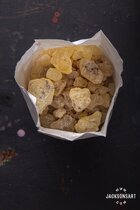
Dammar is the crystalized sap of a SE Asian family of trees. Ready to be dissolved, it looks like quarts stones, and impurities are often present that need to be filtered. One video I saw (link below) showed how he bagged the nuggets in a double ziplock bag, then crushed them down to powder and granules for faster dissolving. It does not seem that expensive, either.
Some other woodworking forums and websites do proclaim its use in woodworking. Musical instruments, such as violins, are finished with dammar varnish. With what I learned, furniture finishing may not be the best use for it, but I don't see why it could not be useful to woodturners looking for a high gloss surface finish.
I've reached the end of the road with anything to say about it, but I bet there will be someone here curious enough to buy some and make a batch to achieve a high gloss film finish. (High gloss surfaces aren't really my thing, so I won't be experimenting with it.) I'm thinking lidded boxes, lace bobbins, other similar stuff. I'm including links here for you to learn more. If you jump at it, please post your results, thanks.
Wikipedia-

 en.wikipedia.org
The family of trees it comes from-
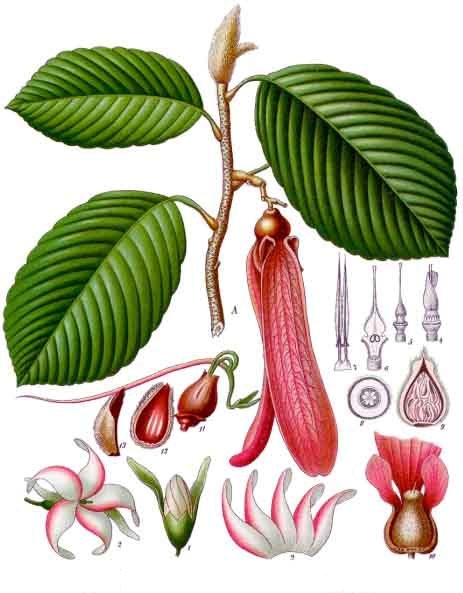 en.wikipedia.org
More about dammar varnish from an artist's site-
This photo of dammar from the site above, looks about the si-
Youtube video of making a small batch (crushing the crystals) and applying over an oil painting-
View: https://youtu.be/UGMFZDSw_bs
A source-

 www.naturalpigments.com
Another source (and recipe)-
 www.earthpigments.com
Source and more info-

 gumdamarsuppliers.com
And... Amazon-
You'll find other woodworking forum board discussing it as well. There were no hits for dammar on this forum.
Somewhere I saw a reference to ready-made dammar varnish at Blick Arts, but one reviewer said the manufacturer may have changed things and she was not pleased with the product. I think I'd go for making it at home.
Have fun!
I've never used this before, and I just learned of it today. Before I get started, I'll proclaim that this "varnish" apparently acts similarly to shellac, in that dammar crystals dissolve in a solvent (high quality gum turpentine is traditional as they are both tree-sourced, although I came across citrus solvent references as well), and after being cured can be re-softened for repair or removal with the same solvent. It does not seem to cure into an irreversible plastic film, like typical oil/water-based varnishes woodworkers are familiar with. It looks like high gloss is its main characteristic, but do your research for other traights.
Dammar is the crystalized sap of a SE Asian family of trees. Ready to be dissolved, it looks like quarts stones, and impurities are often present that need to be filtered. One video I saw (link below) showed how he bagged the nuggets in a double ziplock bag, then crushed them down to powder and granules for faster dissolving. It does not seem that expensive, either.
Some other woodworking forums and websites do proclaim its use in woodworking. Musical instruments, such as violins, are finished with dammar varnish. With what I learned, furniture finishing may not be the best use for it, but I don't see why it could not be useful to woodturners looking for a high gloss surface finish.
I've reached the end of the road with anything to say about it, but I bet there will be someone here curious enough to buy some and make a batch to achieve a high gloss film finish. (High gloss surfaces aren't really my thing, so I won't be experimenting with it.) I'm thinking lidded boxes, lace bobbins, other similar stuff. I'm including links here for you to learn more. If you jump at it, please post your results, thanks.
Wikipedia-
Dammar gum - Wikipedia
The family of trees it comes from-
Dipterocarpaceae - Wikipedia
More about dammar varnish from an artist's site-
This photo of dammar from the site above, looks about the si-
Youtube video of making a small batch (crushing the crystals) and applying over an oil painting-
A source-
Dammar
Dammar is the most popular natural resin for making spirit varnish. This is imported ABC Grade gum from Indonesia. Add turpentine and you have golden clear concentrated dammar varnish.
www.naturalpigments.com
Another source (and recipe)-
Instructions for making artist's dammar varnish
www.earthpigments.com
Source and more info-
The Magic of Damar Gum: Its Role in Paint and Varnish
Damar gum, a natural resin harvested from trees in Southeast Asia, has been revered for centuries for its versatility and remarkable properties. Among ...
gumdamarsuppliers.com
And... Amazon-
You'll find other woodworking forum board discussing it as well. There were no hits for dammar on this forum.
Somewhere I saw a reference to ready-made dammar varnish at Blick Arts, but one reviewer said the manufacturer may have changed things and she was not pleased with the product. I think I'd go for making it at home.
Have fun!