• The forum upgrades have been completed. These were moderate security fixes from our software vendor and it looks like everything is working well. If you see any problems please post in the Forum Technical Support forum or email us at forum_moderator (at) aawforum.org. Thank you
  • February 2026 Turning Challenge: Cookie Jar! (click here for details)
  • Congratulations to Chad Eames for "Red Tines" being selected as Turning of the Week for February 23, 2026 (click here for details)
  • Welcome new registering member. Your username must be your real First and Last name (for example: John Doe). "Screen names" and "handles" are not allowed and your registration will be deleted if you don't use your real name. Also, do not use all caps nor all lower case.

Dealing with end bumps?

Joined
Jan 24, 2010
Messages
3,253
Likes
990
Location
Cleveland, Tennessee
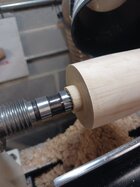
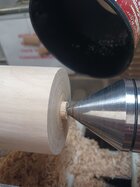
I'm working on turning some crosses for the upcoming Easter season. Got everything started with a live center and a spur drive, squared off with a 1/4 inch parting tool. Now...I'm looking at the ends with the bumps. How do you deal with them? Photos enclosed.
20260307_113917.jpg20260307_113928.jpg
 
First of all, I would use a smaller spur drive, such as a half-inch drive or a ring center (see link below). If you use the Steb-type drive shown in the photo for safety's sake, the ring center provides the same level of safety and drive capabilities without leaving big marks or needing to leave nubs at either end. I suspect, also, using this set-up would save sanding time - the parting tool leaves a very rough, torn-out surface. If the stock was originally cut clean at the ends (miter saw, table saw, good bandsaw blade), the ring marks and teeny-tiny hole from the ring set from Axminster (or others?) would be easy to sand out.

If you prefer the drive and live centers you have, try leaving longer nubs, bevel the nubs down ward toward the project until there's a very small amount of wood left, face off the ends with a sharp skew rather than a parting tool and proceed to 4emove the nubs

 
Last edited:
I turn small then cut with a saw, finish by hand with a skew.

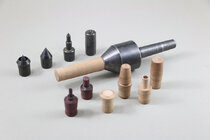
But another easy way is to make wooden pressure tips for live centers. You can cut them away completely without damaging the tool edge.

Below the Nova live center in this pic are some I've made for various things. Knocking the included steel centers out of the live center reveals a short #2Morse Taper - I just turn short MTs to fit and make what I need at the time.
1772913205262.jpeg

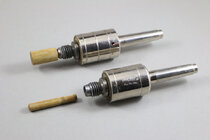
You can do something similar with the common Oneway live center and clones - knock out the center tip and the turn a short #0 Morse Taper with the wooden extension or attachment desired.

1772913451806.jpeg

BTW, I use these types of custom wooden centers a LOT. Just the thing to, for example, support the end of a longish thin spindle such with a hole drilled in the end, or the end of a conductors baton without a hole - in this case I drill a small hole in the live center extension to fit.

JKJ
 
the parting tool leaves a very rough, torn-out surface.
This is true. Can get a MUCH cleaner end surface with a facing cut with the long point of a sharp skew but it does take a bit of practice to avoid catches. (Or use my invention, the "catchless skew". They laughed when I described it but it works. Limited to just a single purpose, though.)

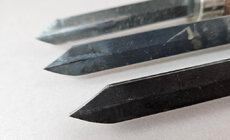
But if using a parting tool, I grind like the one at the bottom of this pic. Lets me basically do a peeling cut, cleaner than the typical rough scraping cut with the parting tool.

1772914118031.jpeg

JKJ
 
Knocked off the headstock end with the bandsaw and finished with the belt sander. Other end was cut on the bandsaw and a light tough on the disk sander.
 
I'll attack those nubbins any number of ways, in no particular order:
-Parting tool to clean cut one end, then remove the other by way of...
-this small flush cut trim saw, and I bought a replacement blade for it as well. https://www.leevalley.com/en-us/shop/tools/hand-tools/saws/japanese/101323-japanese-kugihiki-saw
-a very sharp carving knife to pare away the waste wood.
-sandpaper.
-and usually any combination of the methods above.
Or a trained termite? BTW, have a fine blade saw.
 
Back
Top