• December 2025 Turning Challenge: Single Tree! (click here for details)
  • Congratulations to Bob Henrickson, People's Choice in the November 2025 Turning Challenge (click here for details)
  • Congratulations to Steven Gordon for "Dropped Ice Cream Cone" being selected as Turning of the Week for December 8, 2025 (click here for details)
  • Welcome new registering member. Your username must be your real First and Last name (for example: John Doe). "Screen names" and "handles" are not allowed and your registration will be deleted if you don't use your real name. Also, do not use all caps nor all lower case.

DIY Chuck...

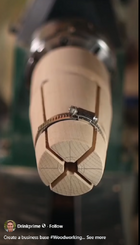
If you don't have a chuck, something like that could work, as long as you make your tenons or pieces about the same size/shape. You can either screw it to a faceplate, or put a morse taper on it to fit your spindle. The flexibility of the "jaws" might vary, so it might not be perfect accurate.

I'd be tempted to wrap something around the hose clamp to make it less of a hazard.
 
Hello friends, I don't have a small chuck and would like to know what would be your aproach to make one of these? Or if you made one of these, if you can explain the process. By the pic, those kerfs look too wide for your everyday bandsaw blade.
Here is the link of the video : https://www.facebook.com/reel/798776249613704
Thank you
View attachment 82566

Manny,

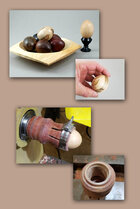
I have chuck jaws that hold various sizes including small diameters. But I've made a similar "chuck" for special purpose - to finish the ends of wooden eggs!

If making one just like that and you have a bandsaw, you could make two or more cuts to get the width. It would be safe to cut if the round piece were secure. (Easy to support securely with one of the handscrew clamps - I use these a lot. Made like this with two screws for adjustable angles if needed:
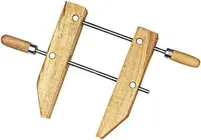
1765333827816.webp

This is the "chuck" I made:
1765333897985.jpeg

Some points:
  • I made more than four segments.
  • Used eastern red cedar since it was fairly soft and flexible.
  • Since cedar IS soft, I turned and glued in an threaded insert made of strong/hard dogwood, tapped to fit the lathe spindle. You certainly wouldn't need that if holding the thing in a chuck lie you show.
  • The hose clamp works well but can be a hazard to fingers!
If making one like you show I might want the wooden "jaws" to be harder to hold up.
Since you will be holding this in a chuck, due to the way wood compresses it might not run true if removed then mounted again. It would help to use dry, fairly hard wood with the mounted diameter very close to the minimum chuck jaw diameter. Also, something I always do when removing a tenon that I might want to remount later: I make a mark of the chuck body with a sharpie (I like to put a dot between jaw #1and #4 and put a dot on the wood before loosening the jaws. This can help me put the tenon in the same spot later.

Seems like one disadvantage to the one you show is the sides of the wooden "jaws" would not stay perfectly cylindrical as they are squeezed. However, this might not make much difference and no practical difference if the tenon they grip is very close to the unclamped diameter.

Hey, there's another way if you haven't tried it: if you remove the jaws completely from a chuck the jaw slides can be used to hold small diameter work.

Look at "D" in the pic below: It shows a square blank being held but it also works with round. Has some limitations but will work if nothing else is available. However a set of pin jaws are better. And my newest favorite for small things: the dome jaws, "C"! Can hold REALLY small diameters. (This is a section of my document on Handbell Ornaments.)
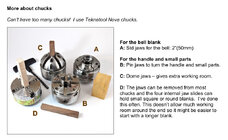
1765334963168.jpeg

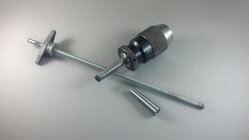
Another option for small diameters is to use #2 Morse Taper collets. They are cheap and hold securely. Mount directly in the taper in the headstock The downsides are they need a drawbar (but easily made for very little cost) and the tenon on the wood needs to be turned to a fairly close diameter. I have a complete set but use only the 1/2" collet for wood (the largest diameter you can get for a #2MT.
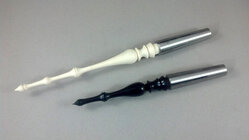
1765335410487.jpeg
.
JKJ
 
Not sure I understand threaded for a draw bar. Please explain because I’ve turned a dowel into a knob using a drill chuck and it was an inexpensive run of the mill drill chuck.
The narrow end of the morse taper (of some chucks) is threaded. A draw bar is threaded rod thru the headstock to hold the chuck in place. The morse taper can work loose, especially if you're applying side pressure (vs towards the headstock). The drawbar keeps it secure.

 
Thanks Dave, explained perfectly.

It’s perhaps worth mentioning that you can buy a screw in tang so that a threaded arbor can also be used in a self ejecting manner, if required.

IMG_6851.jpeg
 
For eggs and other special processes the diy approach makes sense, but if you just want to hole smaller shank sizes (long tenon, bolt threads, etc), there are collet chuck systems that aren’t expensive. I have a set similar to the link below - M2 collet chucks, 1/8-1/2”, fit into the HS taper, threaded for std 3/8”, use 3/8” allthred to make a draw bar. They work very well and for <$40 it isn’t worth the frustration of making them. There are other types that thread onto the spindle, place the collet in, then a cap threads onto the housing and pushes the collet in - much more expensive, but they go larger than 1/2”.

 
Well, for sure, that will work, and the screw could be a problem with the hose clamp. There are MANY variations of the same thing. I have considered doing some thing similar with all the boxes I turn, mostly wanting to secure them as I finish off the bottoms. More than anything, it depends on what you are turning with it, and getting it perfectly centered. There are also MANY variations of jamb chucks.

robo hippy
 
For eggs and other special processes the diy approach makes sense, but if you just want to hole smaller shank sizes (long tenon, bolt threads, etc), there are collet chuck systems that aren’t expensive. I have a set similar to the link below - M2 collet chucks, 1/8-1/2”, fit into the HS taper, threaded for std 3/8”, use 3/8” allthred to make a draw bar. They work very well and for <$40 it isn’t worth the frustration of making them. There are other types that thread onto the spindle, place the collet in, then a cap threads onto the housing and pushes the collet in - much more expensive, but they go larger than 1/2”.

Thank you, how does the collect holds the workpiece securely? you are saying to use a 3/8" alltrhread as a drawbar? you use a washer and double nut on the other side ? thanks
 
Not sure I understand threaded for a draw bar. Please explain because I’ve turned a dowel into a knob using a drill chuck and it was an inexpensive run of the mill drill chuck.

I have several Jacobs (drill) chucks with #2 Morse Tapers. All of mine are threaded on the narrow end to accept a draw bar when using them in the headstock. Drawbars keep the Jacobs chuck from spinning when drilling large or deep holes. Also keeps it from working loose from the headstock when using it for other things.

They are all threaded 3/8"x16tpi. I make drawbars from a piece of all-thread rod (say from Home Depot, hardware store), and a 3/8x16 nut, preferably mounted in a handle of some sort. The handle here already the proper threads so all I did was epoxy a washer to the front to bear against the lathe handwheel.

1765402877163.jpeg

I use the same drawbar for #2MT collets.

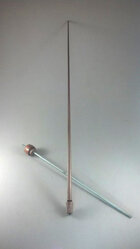
I also made 1/4-20 drawbar for another purpose, to hold wooden spindles (with turned 2MTs) tightly into the headstock spindle. This helps when they can't be properly supported by the tailstock. (A chuck would work too but I like this method better.) This walnut spindle tapers from 1/2" to 1/16" over 25". 1/16" is a bit too thin to provide proper tailstock support so I drilled a hole into the end of the short 2MT on the end and tapped it for 1/4-20 to hold it tight while turning.

I turned the wooden handle so it would fit into the handwheel.

1765403269892.jpeg

To use with wood, I made the end of the drawbar into a tap by filing some angled grooves on the end with a triangular file.

Another thing to do with drawbars: near the end that extends from the back of the headstock file a couple of flats. These will let you use an adjustable wrench to hold and turn the drawbar while using it as a tap AND remove it when it gets too tight to remove by hand. (not "if" but "when)

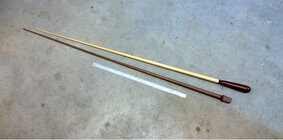
I made these long, thin tapers to show students and take to spindle turning demos to show what's possible using just a skew and the hand - no steady rest needed. I do have nor ever used a steady rest.)

These might make good blackboard and whiteboard pointers for your favorite teacher! (But since blackboards are extinct in this part of the world the one from light wood is useless for that!) I turned it from a piece of shelving pine from Home Depot just to see if I could.

1765403587239.jpeg

JKJ
 
I tried one of those a few years back. Didn't work very well. Too complicated to build for how weak it was. One trick I learned was you can use 2 inch or even 4 inch chuck jaws as 1/2 inch. All chuck jaws have a small hole in the middle. Just because it doesn't have raised dovetails doesn't mean you can't use them as small jaws. I also really like jam chucks for specific applications.
 
Manny, if you're going to make a DIY collet chuck, I would suggest it be a straight cylinder where the hose clamp goes. If it's tapered, as shown, it will tend to slide, and loosen in use. I use these very occasionally, mounting the collet jig in a chuck, so no concerns about using a draw bar.
 
Manny, if you're going to make a DIY collet chuck, I would suggest it be a straight cylinder where the hose clamp goes. If it's tapered, as shown, it will tend to slide, and loosen in use. I use these very occasionally, mounting the collet jig in a chuck, so no concerns about using a draw bar.
Why not kill 2 birds with one stone and turn a rabbet that the clamp sets in. It can’t slide AND the gear tighter will be no longer be a raised spinning danger.
 
Thank you, how does the collect holds the workpiece securely? you are saying to use a 3/8" alltrhread as a drawbar? you use a washer and double nut on the other side ? thanks
Put a tenon on the work at least as long as the chosen tenon OD - say 3/8”, then then tenon needs to be 3/8-1/2” long.

See @John K Jordan post #15, the 1st photo. The long cylinder in the photo is a an M2 collet. Slip it in the spindle M2 taper, slip the allthread through the center of the hand wheel all the way until it starts pushing the collet out. Thread the collet onto the allthread. Tighten the nut/hand wheel on the other end of the allthread (in JKJ photo you see a washer and I assume a wheel with a nut in it. The washer and hand wheel are custom selected/made by you to fit your outboard spindle end)

Only take up the slack, insert your tenon (I use the TS to center the other end), and tighten the wheel, which pulls the collet into the m2 taper, tightening it around the tenon. As the tenon is pulled in, advance the TS quill to keep the far end centered.Its an iterative process. The short items like a bottle stopper, the TS may not be needed. I use this setup mainly for long slender finials. Keep asking if you don’t follow.
 
Back
Top