• December 2025 Turning Challenge: Single Tree! (click here for details)
  • Congratulations to Bob Henrickson, People's Choice in the November 2025 Turning Challenge (click here for details)
  • Congratulations to Guillaume Fontaine for "Old Tea Pot" being selected as Turning of the Week for December 15, 2025 (click here for details)
  • Welcome new registering member. Your username must be your real First and Last name (for example: John Doe). "Screen names" and "handles" are not allowed and your registration will be deleted if you don't use your real name. Also, do not use all caps nor all lower case.

Doctors Walnut Oil/Carnauba Wax/Shellac Finish

Joined
Jul 24, 2008
Messages
760
Likes
222
Location
Montfort, Wisconsin
I'm wondering if anyone applies this off the lathe or is it best applied on the lathe? I have a platter I've wet sanded with Mahoney's walnut oil but would like to get a little more gloss by using the Doctor's product. I thought about sending an IM to Reed because I know he uses them, but thought other's may have the same interest.
 
Well, I never wanted any gloss for a finish on my utilitarian bowls. Main reason is that the gloss is gone the first time you wash it. Others should chime in here, but with the walnut oil and carnuba wax finish, I think you can buff it out after it is dry. Not a process I would use because it is an extra step, and the gloss goes away.

robo hippy
 
I tend to leave all my utility ware with a matt finish and most common finish would be my own recipe for DO. Several coats depending on the species of wood is use and a lengthy drying time. The time depends on the season and species but ideally 4-6 days
 
I slop it on for the first coat, let it sit while I sand out another bowl, then apply a very heavy coat again. I like to let them sit for a week or so before wiping off the excess. I have been using one plate for a couple of years, and haven't applied any oil to it. Doesn't seem to really need it, but it wouldn't hurt it either.

robo hippy
 
Some interesting experiments/experience with Mahoneys oil. Several years ago when I got some, I had heard it could take a long time to actually cure. To test this I put a drop on clear plastic, and set it in the house. It took almost 3 months to actually cure.

Experience with blo and poly had shown a great way to speed up drying was higher temperatures. I use a cardboard box with a small heat source to get ~100F. I tried my drop of walnut oil on plastic in the heated box. It cured in ~3 days. I have since finished several pieces with Mahoneys, usually 3 heavy coats to saturation, done over 3-4 days, then wiped off. I then put them in the heat, check a couple times a day and wipe off bleed out. The surface becomes much more “filled” getting the oil to fully cure out. Give a try and see what you think.
 
I do remember the walnut oils taking longer to cure than I wanted. I placed a light bulb under my drying rack. That did make a big difference in drying time.

Side note, and I have posted this before, I did a number of 'tests' to see if the oil soaked rags I had would do the spontaneous combustion thing. Never happened, until one day, I had left one on a black plastic bag full of shavings in the summer sun. It started smoking. The sun light speeded up the curing to the point where heat was generated. So, safe if you are out of the sun light....

robo hippy
 
For drying type oils I prefer to leave my bowls out in the sun for a few hours. Assuming the wood is dry from any moisture to avoid cracking and the color isn’t affected by the sunlight (I.e. not good for red flame Box Elder). If the weather isn’t cooperating then I use a 260w red heat lamp.
 
I do remember the walnut oils taking longer to cure than I wanted. I placed a light bulb under my drying rack. That did make a big difference in drying time.

Side note, and I have posted this before, I did a number of 'tests' to see if the oil soaked rags I had would do the spontaneous combustion thing. Never happened, until one day, I had left one on a black plastic bag full of shavings in the summer sun. It started smoking. The sun light speeded up the curing to the point where heat was generated. So, safe if you are out of the sun light....

robo hippy
NO safe until it combusts and burns your shop to the ground. Don't make the assumption that those finish soaked rags will not undergo spontaneous combustion. I throw mine over a bust at the shop door to dry and sometimes if the trash can is empty drape it over lip of the receptacle. Bucket of water is good too.
 
I use both the Dr. oil, oil/wax combo and Mahoney's. The Dr. oil/wax combo product is intended to be applied on the lathe so you can generate some heat while applying to "set" the wax. I've not seen a lot of difference to be honest. Likely operator error. As Bill says, a little heat, some quick buffing and you can get a good sheen using wax over the oil. I recently decided to try some wood wax from Walrus Oil. It's intended for cutting boards so very "food safe", so it says.. It's a little thicker than I thought it would be so not sure yet if I'll keep using it but net is some sort of natural wax applied over the oil and a little buffing should give you a nice sheen. Watch a few Richard Raffan videos if you want to see a basic finish application that's durable and has some nice sheen. He makes it super simple.

My drying time experience is it can vary a lot depending on the wood and temp. As for when I call it dry is when I don't get a sheen on my fingers when I handle it and it doesn't leave a ring on a piece of printer paper when left overnight. It can take a week or a couple of days. It varies a lot. I've had pieces that seemed to never want to dry and others that were dry in a day.
 
The Doctor's oil does not need heat for the wax to spread and even out. It is his process of 'microaggregated' particles or he now calls it micro crystal. No clue as to how he does it, but he did a demo for our club and explained it. Most carnuba wax needs heat or a solvent for it to be able to spread. The Kiwi shoe waxes are examples, turpentine is the solvent.

robo hippy
 
Doctors walnut oil/carnuba or the same with the microcrystal wax are my go-to for bowls, etc. I find that Mahoney’s muddies the colors a bit, while doctor‘s is very clear. I think I get more contrast that way.
I apply as much as the wood will hold, spend 10 or 15 minutes slathering it on, then work it in with the lathe on. With a little pressure on the oil soaked rag, working from center out, can literally watch the gloss (soft) behind the pad.
I know that the luster will go away the first time it’s washed, but that new car shine is fun, while it lasts.
And if it happens to just sit on the shelf, it looks wonderful.
 
I ran the following controlled experiments on the curing of walnut oil a few years ago. I soaked small pieces of paper towel in four samples of walnut oil: Mahoney's and three brands of grocery store walnut oil. I chose paper towel because it contains most of the ingredients of wood should that be a factor and because it will become crisp when the oil hardens. I hung one set of these in a dark closet and another in a sunny window. The temperature of both sets was room temperature. The set hung in the window all turned crisp in about three days. The set hung in the closet were still wet after about six weeks. My conclusions are: (a) exposure to sunlight will greatly reduce curing time and (b) there is no significance difference in curing time between Mahoney's oil and grocery store brands. Note: I did not investigate whether ambient room light would also speed up curing.
 
The Doctor has one specific mix for bowls, which is both wax and oil. You do need to shake it a bit before applying. I just got another gallon of it since I am almost out. It does have to be shipped via ground delivery, no air mail or shipping. I am just down the road from him....

robo hippy
 
Dave, I don't think that is the particular one. I never buy anything from Amazon. On his web site he has 'Microcrystal wax bowl finish', and I buy it by the gallon. He does not have the gallon size on his web site, but an e mail to him and he sent it out.

robo hippy
 
The "finishing oil" is 100% walnut oil, no wax added. This is what I use mostly, primarily for wet sanding. Beall buffing this oil produces a nice shine and the wood ends up with a thin wax coting. I also add film finishes on top of the oil. (Both of these, you need to allow the oil to cure.)
Michael, I am interested - what are you able to successfully lay on top of the cured walnut oil? I do like to wet sand with walnut oil, but I haven't been doing it if I thought the piece was going to end up with Seal a Cell (linseed oil/poly varnish blend) on top of it.
 
Have used both Mahoney's walnut oil and doctors woodshop oil with the microcrsystal wax. I even applied one over the other. I think the Doctors Woodshed oil with the wax blend is a bit better than the other for a nice even satin finish. I ended up trying the tried and true danish oil, varnish oil and original also to compare. Met someone at a show in Windsor this summer and said all he ever used was the original. HIs work was the exact look of satin I was after. Still haven't reached a verdict on the tried and true products vs. Doctorshop woodshed oil wax yet. Just my 2 cents.
 
Michael, I am interested - what are you able to successfully lay on top of the cured walnut oil? I do like to wet sand with walnut oil, but I haven't been doing it if I thought the piece was going to end up with Seal a Cell (linseed oil/poly varnish blend) on top of it.
I have used oil base poly, Danish Oil, and Osmo Polyx on top of a walnut oil. Seal a Cell should be no problem.
 
NO safe until it combusts and burns your shop to the ground. Don't make the assumption that those finish soaked rags will not undergo spontaneous combustion. I throw mine over a bust at the shop door to dry and sometimes if the trash can is empty drape it over lip of the receptacle. Bucket of water is good too.
I avoid the whole “spontaneous combustion” question by using paper towels - a tip I picked up from a Chris Stott video. Using paper towels for years. Works great.
 
Hi. I just turned my first walnut bowl. I applied walnut oil but it looks very dull and I don’t really like it. I’m wondering if I could use a spray lacquer over the oil? Or would they react with each other?
Thanks
 
They wouldn't react with each other per se, but the lacquer would not stick well to the wood, and likely would look horrible. However, walnut oil is perfectly capable pf coming out with a nice glossy finish, you just need a LOT of time , patience and multiple coats applied over months, once fully cured, can be buffed to a high gloss finish. However, the underlying wood can make a big difference in how many coats of finish it takes to get the gloss you may be after - Sanded to 220 grit, might take 4-5 coats of walnut oil , sanded to 320 grit, maybe a couple coats less.. I have gotten a nice high gloss finish with just 2 coats after sanding to 600 grit (But I use linseed oil/ beeswax mix) You MIGHT be able to apply a coat of shellac over the oil, once it has fully cured (not just "dry" , but full cure) and then a lacquer or water based gloss poly can be applied over that. Shellac is nice that way, but again it will only be a film finish so it can be prone to chipping and cracking of the finish if the bowl is bumped , dropped, or even exposed to extreme climate changes (humidity, making the wood move)

Just my 2 cents worth.... (and 2 cents ain't worth much anyways! LOL!)

 
They wouldn't react with each other per se, but the lacquer would not stick well to the wood, and likely would look horrible. However, walnut oil is perfectly capable pf coming out with a nice glossy finish, you just need a LOT of time , patience and multiple coats applied over months, once fully cured, can be buffed to a high gloss finish. However, the underlying wood can make a big difference in how many coats of finish it takes to get the gloss you may be after - Sanded to 220 grit, might take 4-5 coats of walnut oil , sanded to 320 grit, maybe a couple coats less.. I have gotten a nice high gloss finish with just 2 coats after sanding to 600 grit (But I use linseed oil/ beeswax mix) You MIGHT be able to apply a coat of shellac over the oil, once it has fully cured (not just "dry" , but full cure) and then a lacquer or water based gloss poly can be applied over that. Shellac is nice that way, but again it will only be a film finish so it can be prone to chipping and cracking of the finish if the bowl is bumped , dropped, or even exposed to extreme climate changes (humidity, making the wood move)

Just my 2 cents worth.... (and 2 cents ain't worth much anyways! LOL!)
Cheers Brian,
How long does walnut oil take to cure?
 
Cheers Brian,
How long does walnut oil take to cure?
It rather depends on the manufacturer - Probably should read the label on the can? Some oils can take several weeks to fully cure (Though you can reapply coats before that) depends on the formulation - some may cure in as little as a couple days. - Might suggest also looking up on the manufacturer's website and see if they have information there?
 
I've not had good luck putting any kind of surface finish on top of walnut oil but my opinion would be to use shellac. It sticks to about anything, fairly easy to apply but as Brian says, it and anything else would be a thin surface finish that could scratch or chip. I use shellac quite a bit for items I want a gloss finish on. As for how long walnut oil takes to fully dry, my experience is it depends. Sunlight and warmth help a lot but I've had it take a few days to a week or more. It's likely not fully dry but dry enough to use or sell. Some woods vary. My opinion would be to apply a beeswax/carnauba wax to it and buff it. I do that quite often over walnut oil. While not a deep gloss it does add a good deal of sheen and protection to a piece and can go right over the walnut oil after it's dry. My test for walnut oil being dry is to set it on a piece of printer paper. When it doesn't leave a ring after sitting overnight then I consider it dried.

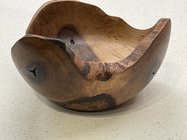
My two cents - the finish in your picture looks good and appropriate for a natural edge bowl. I wouldn't want a high gloss but a little wax and buff would be great.
 
I've not had good luck putting any kind of surface finish on top of walnut oil but my opinion would be to use shellac. It sticks to about anything, fairly easy to apply but as Brian says, it and anything else would be a thin surface finish that could scratch or chip. I use shellac quite a bit for items I want a gloss finish on. As for how long walnut oil takes to fully dry, my experience is it depends. Sunlight and warmth help a lot but I've had it take a few days to a week or more. It's likely not fully dry but dry enough to use or sell. Some woods vary. My opinion would be to apply a beeswax/carnauba wax to it and buff it. I do that quite often over walnut oil. While not a deep gloss it does add a good deal of sheen and protection to a piece and can go right over the walnut oil after it's dry. My test for walnut oil being dry is to set it on a piece of printer paper. When it doesn't leave a ring after sitting overnight then I consider it dried.

My two cents - the finish in your picture looks good and appropriate for a natural edge bowl. I wouldn't want a high gloss but a little wax and buff would be great.
I’ll try that, thanks
 
It rather depends on the manufacturer - Probably should read the label on the can? Some oils can take several weeks to fully cure (Though you can reapply coats before that) depends on the formulation - some may cure in as little as a couple days. - Might suggest also looking up on the manufacturer's website and see if they have information there?
Oh dear… I used walnut oil - the food variety. I didn’t realise there was any other.
Well I’m embarrassed..
 
Claire, no need to be embarrassed. From the beginning and even today I do things that I'm glad no one was watching and then tell myself well, that was a learning experience, and I've made hundreds of bowls. A lot of people use Mahoney's walnut oil. There are a few others out there. The difference is it's processed so it dries in the wood. It's made to be a wood finish, not a salad dressing. I don't think any harm done by using what you did so should still be OK.
 
I think Randy may have hit it with your finish being good for a NE bowl. I have not done this but I do believe you could apply a couple coats Watco Natural Danish oil to get the shine if you want that. I almost exclusively use DO on Walnut and it works beautifully.
IMG_8092.JPG
 
I disagree. Maybe some kinds of grocery store oil will cure, but not all, or even most.
Yep - grocery store (salad) walnut oil may or may not not cure (and may vary bottle-to-bottle).
However, that just puts it in the same category as, for example, mineral oil. And lots of turners will use such a finish, especially on utility items like bowls and spoons that they expect to be re-oiled often anyway.

I personally prefer my walnut oil to cure, but I understand that the other side may have a valid argument - even if they're wrong :)
 
Back
Top