Potentially big subject.
A few things I thought of just now.
I built my shop 24'x62'; office, main shop, welding room, wood storage, large back room (more wood storage, little machine shop, maintenance.)
Some things I'm sure glad I did: Keep in mind this is a separate building on the farm, near the barn, down the hill from the house.
Note that LONG before I started putting up walls and forming for the concrete I designed all of the space, where the equipment would go, all the walls and storage spaces, and every wire and switch (and every receptacle (both 110v and 220v and the big 50a 220v receptacles for the welders and plasma cutter), both inside and outside power. A thick notebook has drawings for everything. The weeks I spent planning and sketching saved untold hours of frustration, do-overs, wasted materials, and "oops, I sure wish I'd thought of that earlier."
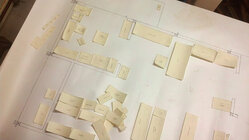
To make sure I had plenty of walking room between machines I made circles to represent the space I needed to carry something and slid them through spaces. Paper cut outs made adjusting things easy - one in progress:
 CONCRETE
If poring concrete consider heated floors depending on the climate.
If doing your own rebar do NOT use the plastic or even wire "chairs" commonly specified by architects to hold up the rebar. My concrete surfacing friends told me they often feel these "chairs" collapse when they are walking in the concrete while working. This pushes the rebar down towards the ground negating the advantage of having it in the upper third of the concrete. Instead, I broke bricks into chunks and put dozens around to support the rebar at the height I wanted. Rebar is supposed to be wired and NOT welded on industrial/commercial projects due to the chance of corrosion, especially on high rise. I have no problem with welding for a 4" and a 6" slab for a 1-story workshop so that's what I did. I built the footer into the edge of the slab with rebar in place and secured to the rebar in the floor. Tractor, backhoe, auger, and skid steer helped a lot with getting things ready.
SPACE
I built in an 8'x12' office just inside the entrance door. This has desks for instruments like microscopes, computer, a display cabinet, shelves for all the farm equipment manuals, and a small library of woodturning and wood-related books. Spare shotgun, spare varmint rifle, spare bright flashlights at hand. First aid kits, hearing, and eye protection right by the door.
POWER AND INTERNET
Underground power. I didn't want the traditional 3% allowable voltage drop but calculated wire size for a 1% maximum drop, even at the expense of larger gauge copper. The cost of even big copper wire is trivial compared to the total cost of the building the entire shop. DON'T fall for the often-recommended underground aluminum service feeders intended for mobile homes. May be OK in conduit but never in direct burial.
I ran a spare 2" conduit containing nothing but a length of rope. For possible future upgrades.
I ran two ethernet cables in separate conduit. I thinking was if one failed somehow I'd have a spare. An ethernet switch and separate wifi router provides high speed data. Remember that all underground conduit eventually fills with water - use directly burial ethernet cable.
LIGHTING and SWITCHES
I used 3-way and 4-way switches nearly everywhere so lights could be controlled from more than one location.
I like to put lights in "zones" so one switch doesn't light up the shop like a baseball stadium. 6 switches at the entrance door.
One turns on a string of lower level lights from the entrance entrance door/office all the way to that end of the far room. That way I with one switch I can see my way everywhere to fetch or return tools, wood blanks, etc.
One switch turns on the bright overheads in the main shop area.
One switch lights the wood storage area.
One switch controls outside lights at the entrance end of the shop.
Each bright T-5 overhead fixture has a ballast that allows a wire to go to a second switch which disables one of the two bulbs in each fixture. I mount these second switches in boxes above the main switches so if I want more light for a task I just reach up and flip the upper switch.
One switch turns on the overheads over the lathe area. Can turn them off when I use small lights on adjustable arms when turning.
A second wall switch at the lathe enables a number of mostly hidden outlets that power the lathe lights on adjustable arms.
One wall switch at the bandsaw enables a quad outlet and to turn on all the bandsaw lights at once.
A switch at the sharpening station lights that area.
A wall switch outside the welding room lights that before I step inside.
A switch at the wood storage area turns on those lights in the event I don't turn them on at the door but feel a need for wood.
A single switch at the back door lights the back room.
Two double switches on the sides of the back room and next to rollup doors activate outside lights on both sides of the buildings.
A switch in the air compressor/cyclone closet lights that area.
I use some lights outside that come on when it gets dark.
Inside near the entrance door is an emergency EXIT sign with battery-powered lights that will come on automatically in case of power loss.
DOORS
Exterior man doors have electronic keypad locks so I never have to carry a key.
All exterior doors are insulated.
Three double-wide exterior doors are strategically placed to bring equipment and long lumber in and out. The table saw is between the welding room with a set of double doors and one of the exterior double doors. This will let open both and rip long stock if needed.
The back room has two insulated industrial garage doors, one 10 and one 12' wide, plus a 10' on the other side of the room.
A double door in the lathe nook lets me easily move lathes and such in and out. Used it for wheelchair access when a friend visited. Don't forget about wheelchair access!
EQUIPMENT
I planed the placement of every major piece of equipment - lathes, table saw, drum sander, bandsaw, hydraulic press, HVAC unit, ect before I started construction. This let me plan lighting and wiring with no unpleasant surprises later.''
I put the bandsaw across the "aisle" from the primary lathe, withing quick reach and near the entrance door to easily bring it wood chunks for sawing.
To save space, the 22-44 drum sander sits tucked to the side of the walkway to the back room. Since it's on wheels, I can easily roll it out into the walkway when sanding longer pieces.
SECURITY
A set of cameras inside and out record constantly and are viewable over ethernet in the house or anywhere over internet. I had to use one to show a lazy farm sitter that no, she did NOT fill the water tub for the llamas: Here on Tue you dragged the hose to a peacock house. On successive days the hose was never moved. I didn't ask her to come back the next time.
Some external lights are motion activated.
Sensors at the security gate alert me at the house of someone entering, even if walking. Or sometimes if they are a deer...
From the upstairs bedroom window I have a clear view of the shop, barn, security gate, driveway, and both front and back fields. This was by accident but fortunate. Hear some odd noise - a spotlight from the window sees all.
WALLS
Although 2x4 studs are typical I used 2x6 studs (along with 6x6 posts and triple beam construction) for two reasons - extra strength, and space for extra insulation. The attic has multiple diagonal bracing.
HVAC
For me a must. Didn't cost that much more for the year-round temperature and humidity control benefit. Saved bunch by installing the HVAC myself. External + internal unit.
OUTSIDE
Concrete pads outside some doors can be helpful, especially outside the welding shop. On nice days I can cut and weld outside.
COMPRESSED AIR
A 5hp 60 gal 2-stage air compress is in the sound-insulated closed with the cyclone dust collector. Put all controls, valves, and filters OUTSIDE the closet for monitoring and switching on and off.
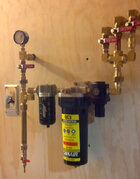
The entire shop is plumbed for compressed air with outlets within reach where needed. Two retractable reels, one just inside one of the big powered garage doors reaches outside on that end of the building for tires and impact wrenches and such. Another reel is on the civilized end of the shop.
DUST COLLECTOR
A 5hp Clearvue cyclone in a sound-insulated closet with the air compressor collects dust from multiple places through 6" ducts hidden in the trusses above the ceiling.
WALLS
Not permitted by some codes such as for rooms/garages attached to living spaces: I used 1/2" radiatia pine plywood for on the ceiling and on every wall. Put all sheets up with screws so they could be removed if needed - did that once when I added a 220v line for a new lathe. The plywood allows me to hang anything anywhere with screws - shelves, tool racks, etc. That plywood has two good sides. The outside walls have 1/2" sheathing covered with 4x8 sheets of siding. I discovered that the lumber company would sell sheet goods with dinged corners for $5 each, a fraction of the normal price. Since I was trimming off a few inches in most places I bought every "defect" sheet they had.
EFFORT
I think it took me 5-6 years from clearing and leveling the ground to filpping the circuit breaker on the last wire. I moved the lathe in and took woodturning breaks before all the walls were up. I tell visitors I built the shop with my bare hands but I lie, I used tools...
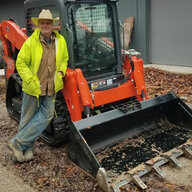
I hauled and placed all materials with my truck, big trailers, and unloaded with forks on the skid steer and tractor.
A friend with a crane and two friends put up the trusses and the roof. The far left corner needed 4' of fill which could be a problem ("fill always settles") but I did three things: filled and compacted in 3" lifts with a wheeled skids steer with a ton of rock in the bucket; built a rebar-reinforced grade beam for that corner, and strategically buried big 3x4x5' rocks sitting firmly on undisturbed ground and extending a few inches into the 6" slab. Zero settling detected today.
I got help from my son to raise and set two of the interior 6x6 posts into their holes, concrete punch pads already in place. I used big c-clamps extensively to brace the beams and allow fine adjustments until they suited me.
Friends with a concrete finishing company poured and finished the floor. I sloped the entire floor 3" over 62 feet in case of the need for drainage and to make the roof gutters come out nice

- that slope has no effect on any shop function.
Suggestion: put professional, servicable fire extinquishers within quick reach everywhere. Get them professionally inspected on a schedule. Haven't had to use one yet.
All was good clean fun. Last time I checked I still wasn't an architect but it went together well and is still stout today. If I did it all over I can't think of anything I'd change. Maybe make it 6' wider. A bathroom and kitchen would be nice (and I still might add them) but hey, it's only a 250' walk up the hill to the house.
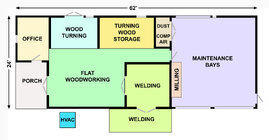
All that was so much fun I've prepped the ground and designed a second, simpler building just a bit down from this one. It will be 24x48', gravel floor, open bays on the front to store big equipment and mowers out of the weather. Since I'm getting older and lazier I'll have a company put it up with steel trusses and siding. Should go up in a few weeks once I'm ready. Can't have too many buildings on a farm.
JKJ