• December 2025 Turning Challenge: Single Tree! (click here for details)
  • Congratulations to Bob Henrickson, People's Choice in the November 2025 Turning Challenge (click here for details)
  • Congratulations to Dave Roberts for "Low Rider" being selected as Turning of the Week for December 1, 2025 (click here for details)
  • Welcome new registering member. Your username must be your real First and Last name (for example: John Doe). "Screen names" and "handles" are not allowed and your registration will be deleted if you don't use your real name. Also, do not use all caps nor all lower case.

Dream table saw

Most of the higher end saws are similarly priced, so excluding price, what would you buy?

I have my dream lathe so now it’s time to update my table saw. While your posting, please include bandsaw if inclined.
I have an older PM66 5HP/1PH I purchased used for $1,500. Its' a fantastic machine, safe, and powerful.
 
There is no excuse for not exercising good safe tool use. The extra protection on a Saw Stop is just that. It’s extra which is a plus.

I’ve used a Dewalt contractors saw for years because it’s on a rolling collapsible stand and pull it out when needed. It’s starting to show its age and I need to replace. My new shop will be an addition on the house we are building and it will be so nice to have a stationary good saw.

There are a lot of nice saws out there as people have mentioned and they all have safety features but to me the Saw Stop has the advantage for a home based woodworker that is by himself. To me it’s like picking up a gun. I assume it’s loaded and ready to fire. I wouldn’t treat a Saw Stop any differently. I would acknowledge the saw might not stop as designed so my digits are still vulnerable. I won’t use any less care when operating because I don’t really want a up front and personal demonstration and I’m glad it’s there just in case and I prefer the odds it will do its job.
Wise words
 
Having owned Craftsman and then Dewalt contractor saws I had always wanted a Powermatic cabinet saw. A lightly used, 5 hp PM2000 fell into my lap for a great deal a couple of years ago and I love it. And I say that with a healthy dose of respect for it which is exercised each time that it is used. It isn't the best table saw in the world, but it far exceeds my hobbyist needs.

As for the bandsaw, a Minimax 16 would be my dream band saw. Currently I am happy with a 20" Delta, a PM 141, and a PM143. They do the job and will likely be with me for a while to come.
 
The "safety" of any tool, well most of them, is the user. Some designs do require extra thought....

robo hippy

Absolutely. Any tool needs to be approached with safety in mind and respect for the tool's ability to cause harm if not used properly. Even a simple screwdriver can be a hazard if used incorrectly or with poor technique.
 
Had Unisaws over the years. Now due to downsizing of shop space have a baby Unisaw. The 8" blade baby Unisaw was only made for a couple years around 1950. Kind of rare just a scaled down version of the 10" Unisaw.

Speaking of Sawstop, was at a customer's shop when the state safety inspector came by for an unannounced inspection. They were written up for having parts stacked on the table of one of their Sawstops. Instead of the usual $100 fine it was reduced to a warning since the inspector was pleased with their replacement of all table saws with Sawstop.
 
Late to this game. Sorry, I didn't have time to read all the posts.
Many have good saws. Many are happy with their saws so they recommend them.
Almost any quality saw with and accurate cut can be your "dream" saw.
I have three "table" saws and several chop/"sliding" compound miter saws. All are for different uses.

But there are some questions to answer (to yourself) that I can think of:
  • Hobby or profession.
  • Casual or serious.
  • How much space in the shop. (existing or planned)
  • Budget.
  • Horsepower needed/wanted
  • Electrical power available.
  • How to get power to the saw if the saw is in the middle of the room.
  • Dust collector considerations. Many tablesaws are horrible dust creators. Overarm DC solves much.
  • Preference: left or right tilt.
  • What things and sizes do you want to cut. Thickness, hard/softwoods. Boards. Sheet goods.
  • Max length of stock - infeed and outfeed space needed.
  • Length of stock to crosscut.
  • Plans to cut dados, use shaping cutters.
  • Plans to make cabinets, furniture.
  • Intentions to do segmented turning.
  • How careful you are.
  • How much you plan to use it.

I have a PM66 I bought new along with jointer, etc. before I built my shop since I knew once I built it I wouldn't have any more money.
  • It has a long extension table to the right. The total width of the saw is 70"
  • It has a sliding attachment on the left, 87" total width.
  • Will easily handle 4x8 sheet goods.
  • The slider allows safe crosscutting and angle cutting. But there are other ways.
  • My saw sits near the middle of a larger room in my shop. I literally built the shop around it - put the crate inside with a fork lift when the roof was up. Uncreated, positioned, and assembled after I put up the exterior walls. I positioned double doors in that part of the shop so they could be opened I for bringing in and ripping long boards.
When I built my shop I didn't yet have clear goals but wanted flexibility to follow whims so I bought the PM. These days I rarely use that big saw and could easily do without it. Last use was maybe 4 years ago. With a focus on woodturning, these days I do almost no cabinetry and make no furniture. I'd prob use the table saw if I got interested in segmented turning. When I kick the bucket maybe whoever buys this property can use a big shop with heat and air and lots of big tools.

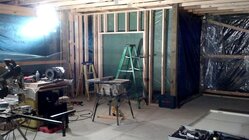
For farm use, my "dream" saws are other, smaller saws. I use them far more than the big table saw. When working on a peacock house, a deck, horse shelter, etc, and even when building the shop the portable saws go to the site. The pictures below show the shop going up around the PM in place.


The PM with the portable saws (and a few hand saws) cutting all the framing lumber.
View in the first pic is looking out double doorway space from what will be the little welding shop.
That door space also doubles as outfeed for ripping long boards.
The door space in the second pic is also for infeed for long rips.
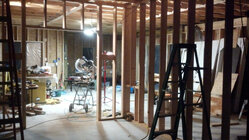
inside_2012-12-17_18-03-08_706.jpg shop_wall_construction_A.jpg
For panels (plywood, siding, inside and out) I always used a little inexpensive circular saw on an 8' guide track - made just for panels.

I now have two portable table saws. I carry a quality contractor portable saw to where I need it, say working on a deck. I sometimes use the smaller tablesaw (in the 2nd photo) on the fold-able stand. It's not good for precision crosscuts, ok for rips with moderate precision.

A Bosch Glide compound "sliding" miter saw, quite precise, is mounted on a Ridgid folding wheeled base with handles and can be moved easily, like a wheelbarrow. Can easily take it to work on a deck, on a farm building or set it up on a porch to work on trim in the house. No way I'm going to repeatedly walk 250' down the hill to the shop to make trim cuts. Accompanying any portable saw is an adjustable outfeed stand with a roller top for long stock.

A large horsepower saw is NOT good for any of this due to AC power requirements and the need to use 110v extension cords.

For woodturning, a good bandsaw is FAR more important than a table saw (unless segmented turning is on your list). I've had several. I now use an 18" Rikon. I often make use of the 18" capacity. This bandsaw will clear 12-1/4". Bandsaw makers got smarter later and made saws with more height. That would be nice, but I'd still want the 18" horiz clearance from the blade. A bandsaw with more power is nice. Sharp blade beats HP though.


So..., for a big table saw consider your space, needs/desires, and resources.
There are lots of good books with tool suggestions and shop layout for various endeavors.

Sorry if all this has been covered earlier in this thread.

JKJ

 
I did make one "modification" to my Saw Stop. It would only take a 4 inch hose, which for a 3 hp saw seems to be very minimal. I cut an opening in the back so I could put a flange on for the 5 inch hose. There is no real option for cleaning out the inside of the saw since the factory set up is pretty much aimed at enclosing the blade. No matter what you do, dust gets away inside the saw cabinet. Hopefully, it will be years before I have to vacuum out the inside cabinet. One thing I would do different about it.

robo hippy
 
Man, if he came by my shop the fines would bankrupt me
Yeah, a visit by a safety inspector could cost most home shop owners a good chunk of change. But, they have no authority over individual's shops unless employees are involved. In my state home shop owners can request a free safety inspection, no penalties, no requirement to correct dangerous situations, strictly informational for your safety.

Regarding having parts stacked or otherwise on the table of your saw is surprisingly considered a safety hazard, Sawstop or conventional type saw. You see it frequently among the segment turner's demos, a bunch of cutoffs piling up.

In my case years ago I was trimming wood pieces to length. Possibly due to vibration a small cutoff piece moved over into the running saw blade and was thrown back at me hitting me solidly in the soft flesh below the jaw bone. This was a relatively small, sharp cornered piece and it stuck deeply in. Blood gushing out. My wife insisted on going to the ER where they stitched it up.
 
Tripped a Sawstop twice?! Easy for me to say, but there was some serious operator error going on there. Twice.

I do not understand why machine tool users don't get themselves some training of some kind before using the machine. Even the owner's manual. All excuses, and no reasons.

For some folks, learning on a SawStop could result in a less safety-conscious approach. "The saw will save me from bad habits."
 
For some folks, learning on a SawStop could result in a less safety-conscious approach. "The saw will save me from bad habits."
True. It's not a far trip from familiarity to complacency.
 
For some folks, learning on a SawStop could result in a less safety-conscious approach. "The saw will save me from bad habits."
Watch a YouTube of the SawStop tripping, pretty sure that while it saves your finger you will probably need to change your pants. I think suggesting it would *in any way* be bad to learn on a SawStop is kind of like learning to drive in a car with seat belts and air bags is a bad thing.

I don’t suggest that my friend that tripped his SawStop isn’t careless and could use some training, but I’m glad he bought a SawStop.
 
Watch a YouTube of the SawStop tripping, pretty sure that while it saves your finger you will probably need to change your pants. I think suggesting it would *in any way* be bad to learn on a SawStop is kind of like learning to drive in a car with seat belts and air bags is a bad thing.

I don’t suggest that my friend that tripped his SawStop isn’t careless and could use some training, but I’m glad he bought a SawStop.
Your point is well-made and it got me to thinking about parallels to my work. I"m glad your friend bought a SawStop also, and I've pretty much decided that in my new shop I will have one. Maybe sooner but my current shop is only 9 x 22.

I'm not suggesting that a SawStop is a bad tool to learn on, but that people tend to become less concerned with personal safety when the consequences are - or seem to be - minor, or unlikely. I think that this was the point Kent was making and I agree that we humans can be pretty unconcerned about some concerning things.

One of the things that I find in evaluating hundreds of safety observations from my team is that people do take safety less seriously if the consequences seem removed or minimal. People working at heights become complacent about proper tie-off, for example, or the chefs that work for my firm "forget" to wear cutting gloves.
 
When I use my table saw I pay serious attention to everything I do. I am afraid with a sawstop I will start to get lax and that will lead me to the same on other tools without that feature.
 
I have a Sawstop 1.75 HP PCS. I’m still pretty careful using it as I don’t want to trip it and ruin the $100 brake cartridge and a $100 blade.

I’m very happy with the saw, it does everything I want it to.
 
I was fortunate to go to a school that had one of the best industrial arts' programs in the state and I took my first shop classes in the early mid-70s, basically from 7th grade through high school graduation. The first two days of class was always used for safety training and every accident, no matter how minor, meant a class stand down for the day to discuss what happened and how it could have been prevented.

Fifty years later I don't feel the need for a SawStop. Yes...the technology is great but at a price I cannot afford while I still remember and abide by all of the safety rules driven into us so long ago. But I recognize that many today didn't have the benefit of multiple years of cabinet making in school.

My point being...there's nothing wrong with using a SawStop especially if you didn't have years of formal training and safety classes to take. That said SawStop owners should not look down upon the rest of us who did go through all of the training and years of classwork.
 
I'm going to stick with my PM66 because I can't afford the space for anything bigger, but I lust after the saw a friend in Belgium has, Don't know the brand (might be Altendorf) but it's an enormous slider with motorized/DRO fence and blade height and tilt adjustment with incredible precision, ~45 cm blade, with a system that drops the blade below the table when your fingers get too close to the blade. I'm guessing it set him back something in the 30 to 50,000 euros range.
 
I asked myself “what will it cost you if you lose a finger(s)?” Answer was far more than the higher cost for the technology.

So what’s my dream table saw. It’s a Saw Stop and my new shop will have one. If another high end saw had the added safety feature, then it might become my dream saw. Who knows, I have about 9 months before I buy so there may be other choices that will enter the picture.

As a side note, a state trouper once told me he had never unbuckled a dead person from a seat belt. That stuck with me. I told my daughters when they were growing up the car won’t go unless the seatbelts are fastened. That very principle saved my daughter’s life when she was in an accident on the interstate and walked away from the wreck. The point is no matter how careful we are, things happen.
 
For those that have a Saw Stop, is 1.75hp enough or is 3hp needed?
I'd say depends on what you intend to be cutting - If you are using common 3/4 to 1" thick lumber, 1.75 HP outta do plenty (thinking segmented turnings and basic woodworks and stuff) but if you are going for heavier 2 inch, 3-inch lumber (bowls and the like) or long rips (cabinet shop) then 3 HP would be the better option
 
For those that have a Saw Stop, is 1.75hp enough or is 3hp needed?
For me, I have the 3 HP and wondered if I should have gotten the 5HP.
But after owning and using the heck out of it for almost ( I'm Guesing) 6+ years the 3 HP has done all I have asked of it.
If you can get 220V into your shop I highly recommend at least 3HP.
 
I have a lot of heavy kiln dried walnut (2", 3", & 4") and you just answered my question with a reason that makes sense. Thanks.

Also 220V will be available.
 
I worked in a tool store for over 13 years and sold many different table saws. All good saws but after Saw Stop came out that was about all the brand we sold. We had others but no one wanted them anymore. All I had to ask is what are your fingers worth..I also reminded contractors that if one of their employees got hurt that they were responsible. Another thing is when someone cut themselve they felt like they had to come and show me. I really didn’t want to see that.
 
1.75hp is not enough for thicker stock. 3 hp is fine for the thick stuff. 5 hp is overkill in most cases. 5 hp can also kick back a lot harder than anything else. More than 50 years ago I was doing production work cutting full sheets of 3/4" veneer plywood and did something wrong. The 5hp saw flipped the full sheet of plywood over my head and it took out a long string of lights up on a 12 foot ceiling. The boss was not happy.

Blade choice also makes a huge difference in saw performance. A 60 tooth fine crosscut blade will struggle to rip anything. A 24 tooth rip blade will make the same cut with ease. Thin kerf blades were invented just for the 1.5hp contractor style saws as they cut lots easier than full kerf blades. A riving knife or a splitter also helps with heavy ripping.
 
Last edited:
Cutting a lot of walnut and/or ash...1.75 is going to strain and if done regularly enough, may cause premature failure of the motor.
 
For me, I have the 3 HP and wondered if I should have gotten the 5HP.
But after owning and using the heck out of it for almost ( I'm Guesing) 6+ years the 3 HP has done all I have asked of it.
If you can get 220V into your shop I highly recommend at least 3HP.
Rest assured you don't need the 5 HP. I bought 5 HP in my ICS because I could. That turned out to be about the stupidest reason ever. I think cabinet or other pro shops that run their saw 4-5 hours (or more) a day get their money's worth with the larger motor, but for the rest of us it's waste of money.
 
For those that have a Saw Stop, is 1.75hp enough or is 3hp needed?
I'll throw this into the conversation. I have a sliding compound miter saw with a max capacity of 4 1/8" x 12". I routinely cross cut 16/4 x 12" boards (cross cut), then square the blanks (cross & rip cuts) with the SCM. I'm cutting hard maple, walnut, mahogany and butternut. It's a 120V machine and I doubt, that if truly measured, it would be more than 1 HP. 80 tooth blade. Go figure.
I do have a 3HP SawStop (estate sale purchase), but have never used a 1.75 HP machine for comparison. Still, the only disadvantage to 3 HP is the upfront cost of the machine and wiring.
What model of SS are you considering?
 
3hp. I saw one in a Woodcraft store last weekend when I was visiting family.

I went by a friend’s shop yesterday and he had a new Harvey saw. Nice saw but I’m will to spend the extra for the increased safety of the Saw Stop.
 
The 1.7 hp. saw "might" be enough. The 3 hp. will be plenty.

Wondering if anyone got their miter gage? I got one, and can't get it to "lock" into place. Accuracy seems to be very good, but that not being able to lock is a pain....

robo hippy
 
Saw Stop does make a miter gage. Most miter gages "lock" in place by a screw down handle. Saw Stop does have "increment" advances. The problem with the twist/screw down type of "lock" Is that the whole mechanism "advances" a tiny bit. While I could learn to "adapt" to that, I don't want to. As far as I am concerned, a cam lock system would be FAR better, similar to what is on the banjo of our lathes. Oh, it ain't cheap either!

View: https://www.youtube.com/watch?v=7BmQ45oln30&t=826s


robo hippy
 
… Most miter gages "lock" in place by a screw down handle…. a cam lock system would be FAR better, similar to what is on the banjo of our lathes.

I think I’d like the cam lock method. Makes me want to clear off the workbench in my little machine shop. Doesn’t seem impossible to design and make.

But I haven’t noticed the miter gauge on my bandsaw changing when I tighten the finger screw knob. Maybe because I added an extra washer below the knob. (But maybe I’m not understanding completely.)

JKJ
 
I have used the incra 3000se miter sled for years on my saw stop. If I need super accurate miters or precisely square cross cuts I grab my incra sled.
 
The problem with the twist/screw down type of "lock" Is that the whole mechanism "advances" a tiny bit. While I could learn to "adapt" to that, I don't want to. As far as I am concerned, a cam lock system would be FAR better, similar to what is on the banjo of our lathes. Oh, it ain't cheap either!

robo hippy

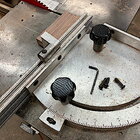
I designed and built a miter gauge for my Hammond Glider slider. My goal was to have the most accurate miter gauge possible. If you notice it has a vernier scale accurate to 1/10 of one degree. When first tested, it had the creep or as Reed calls it advance when I tightened the lock down knobs. To solve the problem I put thrust bearings under the lock down knobs which eliminated any tendency to creep when tightened. Thrust bearings might solve Reed's problem, I used cheap ones, a couple of bucks off eBay.

IMG_E7487.JPG

I have to brag a little on my gauge. Want a 11 segment ring or anything weird? Put in the degrees and the ring closes first time, every time and no batteries required.
 
Back
Top