• November 2025 Turning Challenge: Wall Hanging! (click here for details)
  • Congratulations to Craig Morton, People's Choice in the October 2025 Turning Challenge (click here for details)
  • Congratulations to Tracey Lee for "Huggins with Rope" being selected as Turning of the Week for November 10, 2025 (click here for details)
  • Welcome new registering member. Your username must be your real First and Last name (for example: John Doe). "Screen names" and "handles" are not allowed and your registration will be deleted if you don't use your real name. Also, do not use all caps nor all lower case.

Drilling holes into partially turned workpieces without shredding or tearout?

Joined
Jul 30, 2021
Messages
832
Likes
260
Location
Aurora, CO
I'm turning two-piece coffee scoops. Something I've wanted to do for a while. I want two-tone woods, one type for the handle, another for the scoop. I've therefor been putting little tenons on the handles and drilling little holes into the scoops. The tenons are fine, its the drilling that's a problem. I've tried strait drilling with the final bit (1/4" usually), and also tried starting with a smaller bit and progressing through a few up to the final size. So far, every attempt results in shredded wood around the edge of the hole. I think its partly because where I am having to drill, there is a bit of curvature. I thought about drilling before I turned, but, that makes it a lot harder to judge how deep I really need to drill, and then there are often issues still, as turning over a hole often doesn't leave the best edge either (at least, not with my current skill level, maybe there is a technique that can avoid the issue.) I've tried starting slow, which seems to pretty much guarantede that chunks of wood will be ripped out. Starting faster, its then hard to control where the drill contacts (and I have no jigs to help me drill into a piece still on the lathe...I've been drilling by hand.)

I do try to leave a bit of material that still needs to be turned off, so that once the hole is drilled, I can do that...but, these drill bits really shred, and even leaving a bit of wood on that still needs to be turned off, usually a chunk on the side with the highest curvature still gets ripped out and there is no repairing it.

Wondering if anyone has any tips for drilling into a piece still on the lathe, with some shape/curvature to it, without any chipping or shredding.

 
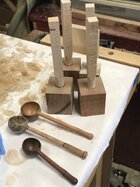
Here is a pic of how I do mine, drilled and epoxied while still square. I use epoxy to not have air gaps. I started making them in 2 pieces, whether matched or not, to save on wood. Can generally get 4 handles out of the spindle blank size for the scoop.

Turn a sphere at the large end and turn the handle, then put in a scoop chuck I made to hollow.

I’m going to make some with larger tenons and bandsaw in 1/2 to get 2 scoops per blank one of these days.

For drilling I use brad point bits, which are a bit like forstner bits, they have cutters on the OD for a clean cut.

1762804281948.jpeg
 
I am wondering if you do some hollowing first and then drill? If so, drill into the solid wood, then hollow. As with turning tools, bits need to be sharp.

robo hippy
 
I've only done a few of these but drilling into side grain with a brad point bit before hollowing may help. I got more tear out and the bit wanted to wander on end grain. Also aim for a press fit with a slightly mushroomed end of the tenon can help cover up small gaps.
 
I am wondering if you do some hollowing first and then drill? If so, drill into the solid wood, then hollow. As with turning tools, bits need to be sharp.

robo hippy

I've only done a few of these but drilling into side grain with a brad point bit before hollowing may help. I got more tear out and the bit wanted to wander on end grain. Also aim for a press fit with a slightly mushroomed end of the tenon can help cover up small gaps.


I've been hollowing first, so I know how deep NOT to drill. I don't want the wood of the handle appearing internally. So I do hollow first, then rough turn the outside. Then drill, its shallow but enough for the handle to hold well.
 
It might also be worth trying a 1/4" forstner bit for this application. A brad point bit is a good idea, but brad points generally work best into side grain and are less effective entering end grain. A forstner bit will be more forgiving depending on your intended grain orientation, and is certainly what I'd reach for first when trying to create a clean mortise hole for a project like this. It would be easy enough to test this on a piece of scrap/practice turning with any forstner bit (or brad point)!) you may have lying around, before purchasing one in the size you need.
 
Here is a pic of how I do mine, drilled and epoxied while still square. I use epoxy to not have air gaps. I started making them in 2 pieces, whether matched or not, to save on wood. Can generally get 4 handles out of the spindle blank size for the scoop.

Turn a sphere at the large end and turn the handle, then put in a scoop chuck I made to hollow.

I’m going to make some with larger tenons and bandsaw in 1/2 to get 2 scoops per blank one of these days.

For drilling I use brad point bits, which are a bit like forstner bits, they have cutters on the OD for a clean cut.

View attachment 81387

Does this approach require any manual carving? How are you able to turn the scoop fully round without hitting the handle with the tool?
 
It might also be worth trying a 1/4" forstner bit for this application. A brad point bit is a good idea, but brad points generally work best into side grain and are less effective entering end grain. A forstner bit will be more forgiving depending on your intended grain orientation, and is certainly what I'd reach for first when trying to create a clean mortise hole for a project like this. It would be easy enough to test this on a piece of scrap/practice turning with any forstner bit (or brad point)!) you may have lying around, before purchasing one in the size you need.

It would be side grain, really. I have both bradpoint and forstenrs, although I'm not sure I have a 1/4" of either... Most of my bradpoints are in millimeters, so I may have one that is close enough. I think my smallest forstner is 5/8".
 
I've been hollowing first, so I know how deep NOT to drill. I don't want the wood of the handle appearing internally. So I do hollow first, then rough turn the outside. Then drill, its shallow but enough for the handle to hold well.
If you don’t allow the handle tenon to go through the scoop wall, you really have very little strength at that thin of joint. I think the Shakers cut a slot in the tenon to make it a wedged mortise and tenon joint for more strength.
 
If you don’t allow the handle tenon to go through the scoop wall, you really have very little strength at that thin of joint. I think the Shakers cut a slot in the tenon to make it a wedged mortise and tenon joint for more strength.

Well, its a coffee grounds scoop. It shouldn't need a ton of strength. That said, I am putting the handle a little lower on the scoop, where the wall is thickest. The tenon is probably around 1/4" long on its own, so as long as it is around. Stylistically, I just don't want the tenon visible from the inside of the scoop...
 
Maybe the Star M F-Style bits will do a bit better for tear out. Chris Schwarz has recommended these for chairmaking purposes, in particular handling off 90 degree holes. He speaks a lot about the clean exit, but I would imagine it would have a clean entry as well. His biggest complaint is the usable lifetime, but in the context of a coffee scoop, it may not be an issue?

Here's one of many posts he's made about them: LostArtPress - Bits

I've purchased them from here before: TayTools StarM bit
 
Maybe the Star M F-Style bits will do a bit better for tear out. Chris Schwarz has recommended these for chairmaking purposes, in particular handling off 90 degree holes. He speaks a lot about the clean exit, but I would imagine it would have a clean entry as well. His biggest complaint is the usable lifetime, but in the context of a coffee scoop, it may not be an issue?

Here's one of many posts he's made about them: LostArtPress - Bits

I've purchased them from here before: TayTools StarM bit

Well, I remember now why I was just using a jobber bit. All the other types, poke a hole into the scoop...forstner, bradpoint. I suspect these StarM bits, which look really cool otherwise, would do the same thing. The jobber is able to get me just deep enough, without punching all the way through....

I have an idea here, though, that I'm going to try. I have some hole punch bits, for cutting out plugs. They normally cut a plug and a ring around the plug, so you can pop the plugs out with a small screwdriver or something. However, I THINK the rim of these bits, is the exact same size as whatever size plug you are cutting. So if I use these, just to get a starter circular cut going, then maybe...assuming I can center the actual 1/4" bit inside that circle...that might prevent the chipping that the jobber bit has thus far been causing...

Centering the jobber inside the cut ring, though...is not going to be fun...
 
I drill shallow 1/ 4” holes using a straight router bit. Doesn’t have a point like a brad point or forstner bit to go too far though.
I drill on the lathe. Might work if secured at the drill press. But without the center point it might be challenging to get started without drifting if drilling by hand.
 
I drill shallow 1/ 4” holes using a straight router bit. Doesn’t have a point like a brad point or forstner bit to go too far though.
I drill on the lathe. Might work if secured at the drill press. But without the center point it might be challenging to get started without drifting if drilling by hand.

There are metal "drill guides" that can be held securely or clamped to flat work. They keep the drill bit from drifting.
For either a drill bit or an end mill I think it might be reasonable to make a custom drill guide curved to fit the work (if I understand the problem correctly). I'd use a hard, fine-grained wood, perhaps lignum vitae which is self-lubricating. Using the wood lathe and with the help of someone with a milling machine could help to make the drill guide.

To avoid making the hole larger with use I might round over the peripheral cutting edges of an end mill (up the sides of the flutes) except close to the cutting edge at the tip.

I'm not sure I'd worry so much about drilling turning the outside first, drilling, then hollowing. It might be easy enough to measure carefully to avoid cutting into the hole (especially if the hole were a flat-bottomed end mill.

But I admit I've never made such a thing and know not of what I speak...

JKJ
 
Last edited:
While the Star M bits do an excellent job on the entry and exit side they won't work for this application because the center spur is too long and will go through the scoop. I use them frequently building chairs and stools.

A plunge router would do an excellent job with a standard router bit. Just don't know how you would get it in place to do the deed.
 
Back
Top