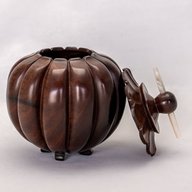
• January 2026 Turning Challenge: Turned and Bent! (click here for details)
  • Congratulations to Phil Hamel, People's Choice in the December 2025 Turning Challenge (click here for details)
  • Congratulations to David Wyke for "Maple Platter #567" being selected as Turning of the Week for January 5, 2026 (click here for details)
  • Welcome new registering member. Your username must be your real First and Last name (for example: John Doe). "Screen names" and "handles" are not allowed and your registration will be deleted if you don't use your real name. Also, do not use all caps nor all lower case.

Dual wheel steadies

Joined
Oct 1, 2008
Messages
1,418
Likes
1,952
Location
Sydney, AUS
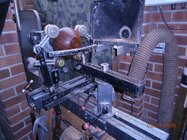
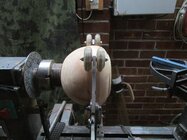
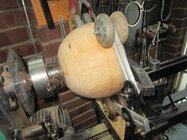
Dual Wheels, lately I have been turning some very soft wood, Huron Pine and now cedar and found the dual wheel set up does the job much better on these very soft blanks. I find the additional support an improvement with more contact points around the soft body of the vessel. In this case, I can bridge the major dia reasonably well, which is ideal.

Its of my own simple design, flat bar, angle and a bunch of skate wheels, bed mounted with a couple Allen cap screws and readily slides to where ever its needed. I have had to add a cross locking bar as the long uprights were prone to movement at times.
I prefer skate wheels as they have better dual bearings than roller skates, oh and very cost-effective :)
 

Attachments

  • P1030043.JPG
    P1030043.JPG
    452.9 KB · Views: 66
  • P1030047.JPG
    P1030047.JPG
    574.6 KB · Views: 66
Last edited:
First thought that came to mind was some thing I have seen for turning larger platters, one wheel on the front/inside of the platter and the other one on the outside/back of the platter. That is an interesting concept.

robo hippy
 
took some more images

I reckon if wanted, you could vary the width between wheels to accommodate flatter curves. It wouldnt take much. A common shaft and slide the wheel along as needed
 

Attachments

  • IMG_5037.JPG
    IMG_5037.JPG
    329.6 KB · Views: 23
  • IMG_4937.JPG
    IMG_4937.JPG
    399.7 KB · Views: 23
Last edited:
It looks like that would only work with the space between the wheels centered on the largest diameter and a equal arc on both sides of the major diameter.
The solution I came up with is to true up the wheels which also removes the mold flash.
The method I use is to make a wood fixture to mount the wheel via the outer race bores and use a very sharp tool to peel away the flash with the result being a very smooth true round wheel that will not dent the softest wood and can be used on any curve. Note the driven end on the headstock could be held in a 4 jaw scroll chuck but I prefer the collet chuck for accuracy when remounting.

IMG_0083.jpgIMG_0082.jpgIMG_0081.jpg
 
very interesting, with a few questions (I'm obviously a novice, so sorry if these are obvious to some):

1. You distinguish between "skate" and "roller-skate" wheels. The wheels look like in-line skate wheels. Is that the difference? I usually refer to my inlines as roller skates.

2. In your 2 pics, are we looking at the top of a to be hollowed form? The pics appear to be a bottom of a bowl, which I never thought to use the steadies for. I thought the steadies support the outer edge while cutting the inside.

3. Again, sorry for the simplicity, and this may be answered by the above, but would this setup be considered a spindle steady? The bowl steadies I've looked at only support one side.

Very impressive engineering!

Thanks,
 
Back
Top