• The forum upgrades have been completed. These were moderate security fixes from our software vendor and it looks like everything is working well. If you see any problems please post in the Forum Technical Support forum or email us at forum_moderator (at) aawforum.org. Thank you
  • March 2026 Turning Challenge: Olla! (click here for details)
  • Congratulations to David Wyke, People's Choice in the February 2026 Turning Challenge (click here for details)
  • Congratulations to Tim Connell for "Black Locust Basket Illusion Series #4" being selected as Turning of the Week for March 16, 2026 (click here for details)
  • Welcome new registering member. Your username must be your real First and Last name (for example: John Doe). "Screen names" and "handles" are not allowed and your registration will be deleted if you don't use your real name. Also, do not use all caps nor all lower case.

Faceplate? Screw?

Joined
Sep 26, 2025
Messages
59
Likes
21
Location
Fort Lauderdale, FL
Hello everyone,

I know this is a beginner’s question—that’s exactly why I’m asking!

When do you choose to use the screw
versus a faceplate?

I’ll be cutting a split log into a round blank on the bandsaw and then turning it into a bowl. I have several pieces to practice on, so I’d really appreciate some guidance on when it’s best to use each method.

Thanks in advance for your advice and suggestions!
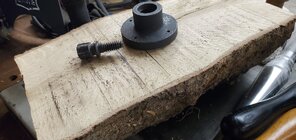
WhatsApp Image 2026-03-19 at 8.31.08 PM.jpeg
 
Both work very well on small bowls. Just remember to use a live center in the tailstock while getting the blank trued up. I'd suggest using both and see what works best for you because it's one of those 6 of one, half dozen of the other kind of things.
 
With the advent of decent screw chuck designs, and chucks in general etc I no longer use the faceplate method. If I have to go that way I will screw a block to the blank and use the chuck to hold the block.
 
You should try them both and see what you prefer. Everybody has their different ways of doing things that work best for them. After you've done a few, you'll probably develop your own preference. I can't remember the last time I've used a faceplate or screw for turning a bowl. Their big disadvantage is that you lock yourself into a rotational axis based on measurements (or just eyeballs) with no balance. Your lathe might run true, or shake and dance, but you won't know until you've committed to your arbitrary axis. If it's the latter, either you slow way down, or you start over.

I start between centers, so I have a large spur center that fits in my chuck, or an Elio drive. Either one will allow me to balance the log/blank before I lock in my axis. If there's some defect I want to remove, or grain/feature I want to highlight, I can alter the axis almost instantly, and keep going. I shape the outside and cut a tenon to fit one of my chucks. (I have 3 chucks, each with different size jaws) Then I flip it and mount it in a chuck and hollow the inside. I usually go back between centers to remove the tenon and shape the bottom. I never really have the full access that a vacuum chuck or Cole jaws give, but I get by without. I sort of view them as inefficient extra steps.
 
For roughing bowls, either will work, but the woodworm screw is much simpler, as there is only a single hole to bore. I use woodworm screws when I'm roughing blanks which are asymmetrical, like on an emerging bowl. But even then, I'll use tailstock support.

I use faceplates for hollowing, where I want a lot more holding power. I don't use faceplates for bowls often, due to the many holes/screws to deal with, and chucks with a tenon work nearly as well.
 
Depends on the wood and what I'm going to do. Noticed a crack running from the faceplate. Might come into play with a screw.
 
Hello everyone,

I know this is a beginner’s question—that’s exactly why I’m asking!

When do you choose to use the screw
versus a faceplate?

I’ll be cutting a split log into a round blank on the bandsaw and then turning it into a bowl. I have several pieces to practice on, so I’d really appreciate some guidance on when it’s best to use each method.

Thanks in advance for your advice and suggestions!
View attachment 86328
Depends on the wood and what I'm going to do. Noticed a crack running from the faceplate. Might come into play with a screw.
When I use a woodworm screw, I first begin with the tailstock in place and make a tenon the size for one of my chucks. This way, there will always be a way to finish the bowl just in case the threads pull out of the woodworm screw. Finish turning the outside of the bowl, and finish it with beeswax or a mixture of beeswax and walnut oil. This way it won't dry too fast as you turn the inside of it. For an instructional video, look up Richard Raffan on YouTube. You may also choose to core out the inside to do two or more bowls from one blank. It's a way to keep the amount of shavings you make down. Play with it and see if you like these discussed methods. Stay Sharp, wear protection, and keep Turning! 😎☕
 
Back
Top