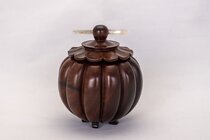
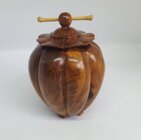
• December 2025 Turning Challenge: Single Tree! (click here for details)
  • Congratulations to Bob Henrickson, People's Choice in the November 2025 Turning Challenge (click here for details)
  • Congratulations to John Dillon for "Chinquapin Oak" being selected as Turning of the Week for December 22, 2025 (click here for details)
  • Welcome new registering member. Your username must be your real First and Last name (for example: John Doe). "Screen names" and "handles" are not allowed and your registration will be deleted if you don't use your real name. Also, do not use all caps nor all lower case.

Favorite Forms for Boxes

Joined
Jun 20, 2025
Messages
38
Likes
31
Location
Utah
Lately I’ve enjoyed turning boxes as a break from doing bowls. I’m curious what people’s favorite box forms are. I’ve searched a lot on line and in prior threads but was hoping others would share pictures of some of their favorites.

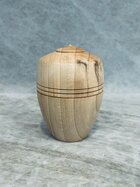
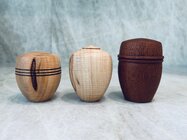
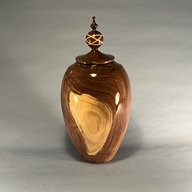
Here are a couple of mine that I turned this week as well as a couple turned a few months ago. The first 5 have suction fit lids, the last one with a knob is loose-fitting. All finished with yorkshire grit.

Mine are fairly simple, reflecting my skill level, but I’m just starting to play around with beads/grooves to hide the joint.

IMG_1612.jpeg Maple, 3 1/2 x 2”

IMG_0923.jpeg Maple 2 1/2 x 2”, maple 3 x 2”, African mahogany (I think) 4 x 2”

IMG_0927.jpeg Pecan 3 1/2 x 4”

IMG_1638.jpeg Cottonwood with black walnut, 5 x 3 1/2”


Thanks, Tom
 
The features that I have not done for at least 30 years is the suction fit lid and the lid and the body from the same piece of wood such that the grain is continuous through the lid and the body. The suction fit lid is subject to fit problems when the humidity level changes, especially without the pith in the middle, where the two halves can go oval. The continuous grain match rarely matches all the way around the the box.
In the 1990's I started experimenting with the pith included and found that it is possible and also presents the wood grain in a totally different way. The wood can still distort with seasonal changes and cause fit problems.
Red Oak body & segmented loose fit red oak lid with celtic cross knob, 6" diameter X 8" high.24019Box.jpg
Butternut or white walnut body segmented butternut loose fit lid with black walnut finial.
24022Box1.jpg
 
No photos to show at the moment, but shapes found in nature are what pleased me the most vs. variations of geometric cylinders. Think apples, and acorns, and bell peppers (sort of...).
 
I’m curious what people’s favorite box forms are.

Yikes, I have too many "favorite" box forms. I guess if there are many, maybe the concept of favorite goes sideways.

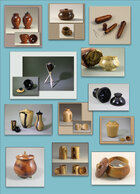
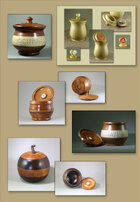
I once made a composite of photos of some of my favorite boxes. Well, I included a couple that are a bit less favorite but still I like them better than some I've made! (Rather than throw those away I gave some to kids - they aren't very picky.)

1766979751780.jpeg

The three from black&white Ebony have threaded lids. One on bot right is a music box. Top center is a walnut box, a copy of the late Lisi Oland's favorite box, one her husband Knud Oland made so many decades ago (I photographed, measured and traced to try to get the shape right.) Knud's didn't have a lid - I don't know if the lid on mine is a plus or minus.

The one on tripod stand I call a pod box - I know of no box rules that say a box has to be able to sit on a flat surface. . I love the shapes of the Cocobolo boxes at top left and the African Blackwood at middle right. The insides of these are nearly egg-shaped.

The tiny boxes at upper right are sometimes made as needle cases or to carry pills. I've made dozens of different shapes but my favorite is the one with a bit of flare on the lid.

I'm not sure what to call the one from Albizia and brass on the lower left. I guess it's a lidded box since it has a lid but the lid is kind of unconventionally set down in a tapered section below the top rim. First time I tried that shape and I like the way it feels in my hand.

The two from American Ebony (Persimmon) at bottom middle were sort of an experiment. I like the shape, even the one with a rounded top. I did catch some grief from some who said that lid shape would make it hard to open. But it doesn't. I don't do boxes with the "woodturner's suction fit", IMO good primarily to impress other woodturners. My least favorite of these is the one with a greenish-blue cabochon - I dislike the wood, the shape with straight sides, and the color combination. Don't much like the one next to it, either. Live and learn.


If embarking on a box-making spree, consider making some large Beads of Courage boxes. Many clubs encourage these, made for children who are seriously ill, many with cancer. They get a special colored bead for each medical procedure, thread them on long strings. A BOC box gives them a place to store some of their strings of beads to pull out to tell their story. What's to like about these is more the reason for them. The size needs to be large enough to hold plenty of bead strings. The lid loose lid and won't stick with seasonal changes. A gentleman in our club keeps a cabinet at the local Children's Hospital stocked with as many boxes as he can get - a new patient can pick their favorite from the cabinet. Nothing else matters! However, I do like the shapes of those I made with the basswood layer so I could add chip carving. My least favorite shape is the one in the middle.

All of these are best made, I think, with a wide enough base so it doesn't tip over easily. The one at top right has a possibly undesirable feature of a thick lid with a tenon - but that's the only good way I could think of to fit a music box built into the lid. Made from a large, dry y.poplar blank.

1766981164487.jpeg

JKJ
 
Yikes, I have too many "favorite" box forms. I guess if there are many, maybe the concept of favorite goes sideways.

I once made a composite of photos of some of my favorite boxes. Well, I included a couple that are a bit less favorite but still I like them better than some I've made! (Rather than throw those away I gave some to kids - they aren't very picky.)

View attachment 83390

The three from black&white Ebony have threaded lids. One on bot right is a music box. Top center is a walnut box, a copy of the late Lisi Oland's favorite box, one her husband Knud Oland made so many decades ago (I photographed, measured and traced to try to get the shape right.) Knud's didn't have a lid - I don't know if the lid on mine is a plus or minus.

The one on tripod stand I call a pod box - I know of no box rules that say a box has to be able to sit on a flat surface. . I love the shapes of the Cocobolo boxes at top left and the African Blackwood at middle right. The insides of these are nearly egg-shaped.

The tiny boxes at upper right are sometimes made as needle cases or to carry pills. I've made dozens of different shapes but my favorite is the one with a bit of flare on the lid.

I'm not sure what to call the one from Albizia and brass on the lower left. I guess it's a lidded box since it has a lid but the lid is kind of unconventionally set down in a tapered section below the top rim. First time I tried that shape and I like the way it feels in my hand.

The two from American Ebony (Persimmon) at bottom middle were sort of an experiment. I like the shape, even the one with a rounded top. I did catch some grief from some who said that lid shape would make it hard to open. But it doesn't. I don't do boxes with the "woodturner's suction fit", IMO good primarily to impress other woodturners. My least favorite of these is the one with a greenish-blue cabochon - I dislike the wood, the shape with straight sides, and the color combination. Don't much like the one next to it, either. Live and learn.


If embarking on a box-making spree, consider making some large Beads of Courage boxes. Many clubs encourage these, made for children who are seriously ill, many with cancer. They get a special colored bead for each medical procedure, thread them on long strings. A BOC box gives them a place to store some of their strings of beads to pull out to tell their story. What's to like about these is more the reason for them. The size needs to be large enough to hold plenty of bead strings. The lid loose lid and won't stick with seasonal changes. A gentleman in our club keeps a cabinet at the local Children's Hospital stocked with as many boxes as he can get - a new patient can pick their favorite from the cabinet. Nothing else matters! However, I do like the shapes of those I made with the basswood layer so I could add chip carving. My least favorite shape is the one in the middle.

All of these are best made, I think, with a wide enough base so it doesn't tip over easily. The one at top right has a possibly undesirable feature of a thick lid with a tenon - but that's the only good way I could think of to fit a music box built into the lid. Made from a large, dry y.poplar blank.

View attachment 83391

JKJ
Fine collection John K
 
My efforts are much less and a bit more ornate
 

Attachments

  • BMA05798-Edit.jpg
    BMA05798-Edit.jpg
    131.3 KB · Views: 9
  • 120893288_1658717940956509_8532433867413396712_n.jpg
    120893288_1658717940956509_8532433867413396712_n.jpg
    174 KB · Views: 9
  • IMG_1246.JPG
    IMG_1246.JPG
    55 KB · Views: 9
Here are a few of my favorite boxes that i have made more recently. I am always changing the form and just really never 100% happy with the form. I think my favorite here is actually the square box and the the box in the second pic, The pistion fit tooth pic holders are fun and I do demo's on making them Screenshot 2025-11-21 090926.jpg585410734_10231393977852982_7944806417646410151_n.jpgScreenshot 2025-12-29 054554.jpgtoothpickholders.jpg.
 
Yikes, I have too many "favorite" box forms. I guess if there are many, maybe the concept of favorite goes sideways.

I once made a composite of photos of some of my favorite boxes. Well, I included a couple that are a bit less favorite but still I like them better than some I've made! (Rather than throw those away I gave some to kids - they aren't very picky.)

View attachment 83390

The three from black&white Ebony have threaded lids. One on bot right is a music box. Top center is a walnut box, a copy of the late Lisi Oland's favorite box, one her husband Knud Oland made so many decades ago (I photographed, measured and traced to try to get the shape right.) Knud's didn't have a lid - I don't know if the lid on mine is a plus or minus.

The one on tripod stand I call a pod box - I know of no box rules that say a box has to be able to sit on a flat surface. . I love the shapes of the Cocobolo boxes at top left and the African Blackwood at middle right. The insides of these are nearly egg-shaped.

The tiny boxes at upper right are sometimes made as needle cases or to carry pills. I've made dozens of different shapes but my favorite is the one with a bit of flare on the lid.

I'm not sure what to call the one from Albizia and brass on the lower left. I guess it's a lidded box since it has a lid but the lid is kind of unconventionally set down in a tapered section below the top rim. First time I tried that shape and I like the way it feels in my hand.

The two from American Ebony (Persimmon) at bottom middle were sort of an experiment. I like the shape, even the one with a rounded top. I did catch some grief from some who said that lid shape would make it hard to open. But it doesn't. I don't do boxes with the "woodturner's suction fit", IMO good primarily to impress other woodturners. My least favorite of these is the one with a greenish-blue cabochon - I dislike the wood, the shape with straight sides, and the color combination. Don't much like the one next to it, either. Live and learn.


If embarking on a box-making spree, consider making some large Beads of Courage boxes. Many clubs encourage these, made for children who are seriously ill, many with cancer. They get a special colored bead for each medical procedure, thread them on long strings. A BOC box gives them a place to store some of their strings of beads to pull out to tell their story. What's to like about these is more the reason for them. The size needs to be large enough to hold plenty of bead strings. The lid loose lid and won't stick with seasonal changes. A gentleman in our club keeps a cabinet at the local Children's Hospital stocked with as many boxes as he can get - a new patient can pick their favorite from the cabinet. Nothing else matters! However, I do like the shapes of those I made with the basswood layer so I could add chip carving. My least favorite shape is the one in the middle.

All of these are best made, I think, with a wide enough base so it doesn't tip over easily. The one at top right has a possibly undesirable feature of a thick lid with a tenon - but that's the only good way I could think of to fit a music box built into the lid. Made from a large, dry y.poplar blank.

View attachment 83391

JKJ
John , Beautiful work and i love the sheen of your flawless looking finishes, may i ask what your finish is and your process
 
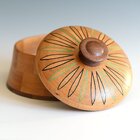
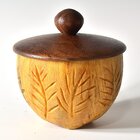
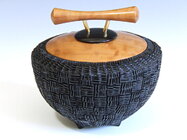
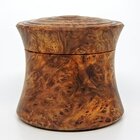
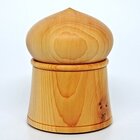
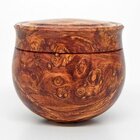
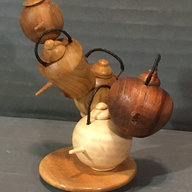
My favorite forms are mostly three to four "signature styles" I have developed and changed from different styles that I have seen in books, online, etc... Here are a few examples....

First one is the Tower Box
Second one is the Raffan Style Box
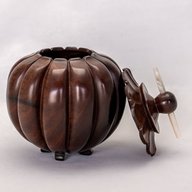
Third one is the Round Bottom Box
Fourth one is the Sun Hat Box

Brown Malle Burl Tower Box.jpgEnglish Yew Raffan Style Box.jpgHonduras Rosewood Burl Round Bottom Box.jpgOlivewood Sun Hat Box.jpg
 
1. In your same spot a few years ago, I acquired 3 books on shapes.
Woodturning Projects by Mark Baker has high quality photos of a number of different shapes for various projects, about 8 of them boxes. He also includes some instruction on making the different pieces.
Woodturning, a Source Book of Shapes by John Hunnex is all photos of various projects and maybe a dozen are boxes.
Shapes for Woodturners by David Weldon is the most unique of the bunch as it is a compilation of hundreds of shapes, as outlines on grid 'paper'. He includes variations on a particular shape with the wide spot moving up and down. It's a little hard for me to visualize the end result from these outlines, and the shapes could be applied to any project you might imagine, but by comparing one outline to another, eventually I could see what appealed to me and make use of the outline. Then it's just a matter of transferring the outline, using the grid, to the size piece you are working on.

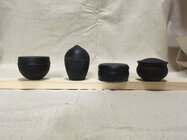
2. As always, Richard Raffan comes to the rescue. He has examples of box shapes in his books which can help develop your repertoire of designs, and one unexpectedly great idea. Make solid box shapes out of wood you don't care about and paint them black. In doing so, you ignore the pretty wood and just see the form. Some will be near misses and you can go back and improve the shape until you've got something pleasing. Some will be complete misses and you can toss them out. The final results become your permanent collection of 3-D patterns and you can go back 3 years down the road and replicate one of the designs when you need to. Here are my box patterns:

BoxShapes.jpgBoxShapes2.jpg
Missing from this collection is my most common box shape, which I can do in my sleep, though when I haven't made one for a while it takes a couple of attempts to get the proportions just right. (I really ought to make a model for that one, now I think about it) When I shared this photo previously, it was obvious that the grain and colors affected viewers' appreciation--something removed when they're painted black.
IMG_2024.jpg
Richard, if you're still tuning in, THANK YOU for teaching me woodturning.
 
Last edited:
I did try going fancy with my boxes, and just didn't like them. I generally go with a straight sided cylinder and a slightly rounded top. KISS!

robo hippy
 
John , Beautiful work and i love the sheen of your flawless looking finishes, may i ask what your finish is and your process

Thank you Bob. Boxes are good clean fun.

I turn as cleanly as I can, maybe use a NRS if needed.
Sand by hand.
If needed, say inside where sanding might be difficult for some pieces, I often use small curved hand scrapers before sanding.
Sometimes I can start with 600 grit paper, but usually start sanding with 400 grit or drop to 320 if needed). I generally sand to 600 grit (by hand), sometimes to 800 or even 1000 depending. Then use 0000 steel wool.

After sanding and the steel wool, on some hard exotics I use no finish, as with the B&W Ebony threaded boxes, I just buff the wood and maybe apply micro-crystalline (Renaissance) wax.

If I want a glossy surface, on exotic wood like the B&W Ebony shown and sometimes Cocobolo. If I lose my mind and go for a glossy surface on small things I generally rub on shellac-based Myland's friction polish with a small piece of soft cotton cloth (usually old tee shirts cut into small strips). I apply and buff/polish by hand. I think I did that for the curved Cocoblolo and African Blackwood boxes shown.

For domestic hardwoods like cherry, walnut, dogwood, etc I usually use multiple coats of "danish" oil - generous application, wipe off after 1/2 hour or so, dry over night. I usually repeat this 6 to 10 times over that many days. (Not for getting in a hurry!) If I deem necessary, I might wet sand one or more applications with the oil and 0000 steel wool, or if a spot doesn't feel "right" I might wet sand with 400 grit

I don't see that I showed this lidded box, made from Eastern Red Cedar:
1767027209092.jpeg
It has a finish I rarely use - multiple coats of spray lacquer, each rubbed down with 4000 steel wool, then finished up with Renaissance wax. In the full photo one spot looks like it has a hard gloss but it's not, that's an artifact of a light and photo contrast I didn't notice until later. Might see in the closeup taken at a different angle that spot doesn't look so glossy.

In general, I prefer a soft sheen for most pieces. (I know glossy sells but I don't make things to sell.)
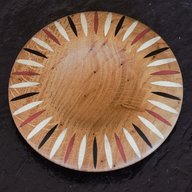
When I first started turning I made this type of soft surface and mostly stuck with it.

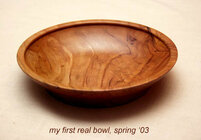
For years I thought this bowl from ERC was my first real bowl but I later found a photo where I'd bestowed that honor on a cherry bowl, given to a neighbor. For some odd reason my memory is not exactly reliable!

1767028158117.jpeg 1767028238126.jpeg

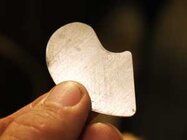
I do know for sure the cedar bowl is where I came up with the idea of using curved cabinet scrapers to smooth the surface. I was having trouble with heat checking from sanding heat so I cut off the end of what is sometimes called a gooseneck card scraper to smooth the inside. Been using it and a bunch of later variations ever since! (I also learned to sand without generating heat - turn FAST, sand S_l_o_w!)

1767028831926.jpeg

JKJ
 
Very nice, thanks for sharing Bill, lots of these finishes are already my go to as well and the more years that pass the more i use them, although i am trying to cut back on lacquer use because of people in the house sensitive to the smell , i do like the idea of the small scraper for inside and will have to give that a go. I'm learning to like danish oil more and more if i can be patient with applying. Are you making your own danish oil or purchasing? since i cant use lacquer much anymore i have been trying to up my game in other areas and considering making my own for a more true danish oil as who know what we are actually buying
 
Thank you Bob. Boxes are good clean fun.

I turn as cleanly as I can, maybe use a NRS if needed.
Sand by hand.
If needed, say inside where sanding might be difficult for some pieces, I often use small curved hand scrapers before sanding.
Sometimes I can start with 600 grit paper, but usually start sanding with 400 grit or drop to 320 if needed). I generally sand to 600 grit (by hand), sometimes to 800 or even 1000 depending. Then use 0000 steel wool.

After sanding and the steel wool, on some hard exotics I use no finish, as with the B&W Ebony threaded boxes, I just buff the wood and maybe apply micro-crystalline (Renaissance) wax.

If I want a glossy surface, on exotic wood like the B&W Ebony shown and sometimes Cocobolo. If I lose my mind and go for a glossy surface on small things I generally rub on shellac-based Myland's friction polish with a small piece of soft cotton cloth (usually old tee shirts cut into small strips). I apply and buff/polish by hand. I think I did that for the curved Cocoblolo and African Blackwood boxes shown.

For domestic hardwoods like cherry, walnut, dogwood, etc I usually use multiple coats of "danish" oil - generous application, wipe off after 1/2 hour or so, dry over night. I usually repeat this 6 to 10 times over that many days. (Not for getting in a hurry!) If I deem necessary, I might wet sand one or more applications with the oil and 0000 steel wool, or if a spot doesn't feel "right" I might wet sand with 400 grit

I don't see that I showed this lidded box, made from Eastern Red Cedar:
View attachment 83413
It has a finish I rarely use - multiple coats of spray lacquer, each rubbed down with 4000 steel wool, then finished up with Renaissance wax. In the full photo one spot looks like it has a hard gloss but it's not, that's an artifact of a light and photo contrast I didn't notice until later. Might see in the closeup taken at a different angle that spot doesn't look so glossy.

In general, I prefer a soft sheen for most pieces. (I know glossy sells but I don't make things to sell.)
When I first started turning I made this type of soft surface and mostly stuck with it.

For years I thought this bowl from ERC was my first real bowl but I later found a photo where I'd bestowed that honor on a cherry bowl, given to a neighbor. For some odd reason my memory is not exactly reliable!

View attachment 83414 View attachment 83415

I do know for sure the cedar bowl is where I came up with the idea of using curved cabinet scrapers to smooth the surface. I was having trouble with heat checking from sanding heat so I cut off the end of what is sometimes called a gooseneck card scraper to smooth the inside. Been using it and a bunch of later variations ever since! (I also learned to sand without generating heat - turn FAST, sand S_l_o_w!)

View attachment 83416

JKJ

Yeah not so fond of the plastic look myself. I like to use satin Polyurethane, let it harden over a few days then lightly buff where the hands normally go which gives it a patina of a well used piece. Lol as well I have a selection of scrapers out of 2-3mm HSS that allows it to be shaped quite readily.
 
Back
Top