• The forum upgrades have been completed. These were moderate security fixes from our software vendor and it looks like everything is working well. If you see any problems please post in the Forum Technical Support forum or email us at forum_moderator (at) aawforum.org. Thank you
  • Congratulations to Bernie Hyrtzak, People's Choice in the January 2026 Turning Challenge (click here for details)
  • Congratulations to Matt Carvalho for "Red Mallee Folded Form" being selected as Turning of the Week for February 9, 2026 (click here for details)
  • AAW Symposium demonstrators announced - If the 2026 AAW International Woodturning Symposium is not on your calendar, now is the time to register. And there are discounts available if you sign up early, by Feb. 28. Early Bird pricing gives you the best rate for our 40th Anniversary Symposium in Raleigh, North Carolina, June 4–7, 2026. (There are discounts for AAW chapter members too) For more information vist the discussion thread here or the AAW registration page
  • Welcome new registering member. Your username must be your real First and Last name (for example: John Doe). "Screen names" and "handles" are not allowed and your registration will be deleted if you don't use your real name. Also, do not use all caps nor all lower case.

Filling lots of small checking

Joined
Sep 7, 2024
Messages
9
Likes
7
Location
Seattle, WA
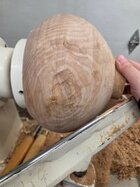
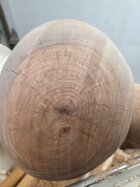
I do mostly found wood, and like it that way. After about four years of this, I'm really tired of filling all these tiny checks, one by one.
I know I can't be the first to deal with this, so what's your favorite solution? And I'm not putting it in the burn pile until I have to.
 

Attachments

  • 20260211_165143.jpg
    20260211_165143.jpg
    466.5 KB · Views: 35
  • 20260211_165216.jpg
    20260211_165216.jpg
    449.5 KB · Views: 35
Depends on type of finish. For oil, poly, etc, create plenty of sanding dust, apply the finish, keep sanding to push the dust into the cracks, then wipe off. May take 3-4 coats with this method to get it smooth.
 
I routinely use CA to fill small cracks and leave them as a feature, or turn them away. I find if I try to hide them it lloks exactly that, OK it may take a couple of goes to fill them.
 
Another technique that works is to put some Titebond in the crack and then sand—the dust mixes with the glue and it hides it fairly well.
 
I used to use the Titebond method that Alan mentioned, but I always felt the color looked off once it dried. Now I prefer to fill the cracks with dust (personally, I think 220 or 240 produces the best granularity) and run a thin bead of thin CA over the crack. The dust will condense when saturated by the CA, so it takes 2-3 passes to completely fill the crack and achieve a flush surface.

Now, given the number of splits you’re dealing with, any method of filling is going to be very time-intensive. If you’re trying to prevent or avoid splits, you’d do well to a) exclude the pith from your pieces, b) more carefully control the drying process, and/or c) source woods that have a lower T/R shrinkage ratio.
 
If you use CA to help fill the cracks besure and put a sanding sealer on first. If you don't, the CA will stain the wood and leave a notifiable stain.

I have recently tried a new method. I have taken Minwax Woodfill and mixed some black leather dye and used that to fill some cracks. Yes, the filler is noticeable but it does add to the characteristic of the turning. Even with this method as a precaution, I put the sanding sealer on first.
 
My favorite solution is to split it down and smoke a pork loin with it. I detest cracked wood, but that is never a popular stance with hobbyist turners. Most will spend lots of time to fill cracks, and that draws a person’s eye first. I prefer them to look at the proportions and design of my turnings. My other artist friends don’t sell cracked ceramic, glass pieces, or cracked paintings. Go ahead everyone, give me hell
 
My favorite solution is to split it down and smoke a pork loin with it. I detest cracked wood, but that is never a popular stance with hobbyist turners. Most will spend lots of time to fill cracks, and that draws a person’s eye first. I prefer them to look at the proportions and design of my turnings. My other artist friends don’t sell cracked ceramic, glass pieces, or cracked paintings. Go ahead everyone, give me hell
I’m with you. I just turned through cracks like that making a ~9” blank into a ~4” bowl by the time I got through all of the cracks. I do have a few bowls from years ago that I filled some cracks on…every time I look at them I’m disappointed
 
"Life's too short to turn crappy wood" - John Jordan

Seriously, if the wood is full of checks before turning I use it for heating the shop. If checks show up after turning and the piece is worth saving for its form I accept them and look to improve my drying methods. You can't hide them or make them go away. Where I live the wood grows on trees.
 
If you use CA to help fill the cracks besure and put a sanding sealer on first. If you don't, the CA will stain the wood and leave a notifiable stain.

I’ve used a method from John Lucas to use CA to fill something like a bit of tearout and avoid staining - put a bit if thin CA on a piece of sandpaper and sand across the spot. The sandpaper picks up sawdust, mixes with CA, and stuffs it into the void. There is not enough liquid CA to stain the surface. The fix is usually invisible since the sawdust comes from the wood near the defect. I’ve done this on places where a small chip popped out of the wood. I haven’t tried it on end-grain checking/cracks shown around the pith. I would be afraid the cracks would keep changing with further wood movement.
 
Back
Top