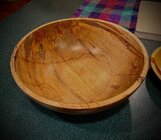
I have turned my first large bowl which is Maple and approximately 15 x 6.5 inches. It has been sanded and finished with Yorkshire grit. No final finish yet. I would like to use it as a salad bowl and was looking for finishing suggestions. I prefer a finish that is not a high gloss. I would also like a food safe but durable finish that will stand up to use and cleaning. Appreciate any advice

-
Congratulations to Bernie Hyrtzak, People's Choice in the January 2026 Turning Challenge (click here for details) -
Congratulations to David Croxton for "Geri's Basket Illusion" being selected as Turning of the Week for February 2, 2026 (click here for details) -
AAW Symposium demonstrators announced - If the 2026 AAW International Woodturning Symposium is not on your calendar, now is the time to register. And there are discounts available if you sign up early, by Feb. 28. Early Bird pricing gives you the best rate for our 40th Anniversary Symposium in Raleigh, North Carolina, June 4–7, 2026. (There are discounts for AAW chapter members too) For more information vist the discussion thread here or the AAW registration page
-
Welcome new registering member. Your username must be your real First and Last name (for example: John Doe). "Screen names" and "handles" are not allowed and your registration will be deleted if you don't use your real name. Also, do not use all caps nor all lower case.
You are using an out of date browser. It may not display this or other websites correctly.
You should upgrade or use an alternative browser.
You should upgrade or use an alternative browser.
Finish for a Salad Bowl
- Thread starter Chuck Augenbraun
- Start date

I think you’ve already made your choice with Yorkshire grit as it contains wax that will make adding another finish difficult.
For future reference I’d recommend Bob Flexner’s book of finishes. A wealth of knowledge, well organized and very readable.
By the way, pretty bowl
For future reference I’d recommend Bob Flexner’s book of finishes. A wealth of knowledge, well organized and very readable.
By the way, pretty bowl
I have been using Sutherland Welles polymerized tung oil. I use the Food Grade D-Limone orange thinner. Have had good luck with it, you can vary the shine by how you mix it with the thinner you use. I put four to five coats on and let it cure for a few days between coats and burnish with a 1500 grit scotch brute pad between coats. I have made some bowls with this finish for some neighbors and they actually use them for salad bowls, they put salad in them with dressing on it and wash them with soap and water when done. That was two years ago and they said they are holding up fine.
Last edited:

I vote for Osmo Top Oil Clear Matte finish. So many options from which to choose that'll work well. Very nice work, especially for a first large bowl.

john lucas
AAW Forum Expert
Read the latest article in American Woodturner on food safe finishes

Some great suggestions here! Question for Vincent- Which colour of the Scotch Brite pads is 1500 grit? Thanks1500 grit scotch brute pad between coats.
Seri Robinson has an article on finishes in this month’s AAW magazine, American Woodturner.
I think you’ve already made your choice with Yorkshire grit as it contains wax that will make adding another finish difficult.
For future reference I’d recommend Bob Flexner’s book of finishes. A wealth of knowledge, well organized and very readable.
By the way, pretty bowl
That's interesting. I was under the impression that additional finishes could be added on top of the friction polishI think you’ve already made your choice with Yorkshire grit as it contains wax that will make adding another finish difficult.
For future reference I’d recommend Bob Flexner’s book of finishes. A wealth of knowledge, well organized and very readable.
By the way, pretty bowl
Thanks for the feedback
Chuck
Thanks, VincentI have been using Sutherland Welles polymerized tung oil. I use the Food Grade D-Limone orange thinner. Have had good luck with it, you can vary the shine by how you mix it with the thinner you use. I put four to five coats on and let it cure for a few days between coats and burnish with a 1500 grit scotch brute pad between coats. I have made some bowls with this finish for some neighbors and they actually use them for salad bowls, they put salad in them with dressing on it and wash them with soap and water when done. That was two years ago and they said they are holding up fine.
I am interested in this approach and I can find the Sutherland Welles product online but found several variants of the Orange Thinner. Could you share the product you use and where it can be purchased. This is very helpful
Chuck
I will check it outSeri Robinson has an article on finishes in this month’s AAW magazine, American Woodturner.
thanks
Chuck
I have been a walnut oil user for years, mostly from the Doctor's Woodshop.
robo hippy
robo hippy
Actually I’ve never tried. Let us know, but I suspect wax would get in the way of good adherence.That's interesting. I was under the impression that additional finishes could be added on top of the friction polish
Thanks for the feedback
Chuck
Usually just use walrus oil cutting board oil, not super durable but it wont poison anyone and it tastes a bit like walrus……..


I use walnut oil. It will need several days in the light, preferably sunlight, to cure. My experiments indicate that the grocery store walnut oil cures about the same as the Doctor's oil.I have turned my first large bowl which is Maple and approximately 15 x 6.5 inches. It has been sanded and finished with Yorkshire grit. No final finish yet. I would like to use it as a salad bowl and was looking for finishing suggestions. I prefer a finish that is not a high gloss. I would also like a food safe but durable finish that will stand up to use and cleaning. Appreciate any advice
While I don't use walnut oil much anymore, it has the great advantage of being readily available, such that the ultimate owner of the bowl can refresh the finish as needed.
But I now mostly use Sutherland Welles Polymerized Tung Oil (recommended above by Vincent) and Sutherland Welles Wiping Varnish (which adds a touch of resin to the tung oil). These finishes are so easy to apply (wipe-on / wipe-off) and are very versatile: satin to gloss, depending on your blends and application methods.
I note that these finishes accord with Seri Robinson's recommendations in her AAW article (a drying oil or Danish oil [drying oil + varnish]) for salad bowls that will have the dressing mixed in the bowl. (I think it is best to cover the possibility that the ultimate owner might mix the salad dressing in the bowl.) Sensibly, I think, Dr. Robinson is in the "once it is cured it is food safe" school, given that she specifically recommends that these finishes include driers so that they cure properly, and specifically warns against "raw" oil finishes because they take ages to fully cure. The above-mentioned Sutherland Welles tung oil finishes have some safe-when-cured solvent, but SW also has their "botanical" line with a citrus-based solvent for those who want safe-even-before-cured.
Chuck, re: the wax and oil you have put on by using the abrasive paste, give the bowl several good rub-downs with DNA or isopropyl alcohol; this is not a complete fix, but it will remove some of the oil and wax and should improve the penetration of the oil finishes.
But I now mostly use Sutherland Welles Polymerized Tung Oil (recommended above by Vincent) and Sutherland Welles Wiping Varnish (which adds a touch of resin to the tung oil). These finishes are so easy to apply (wipe-on / wipe-off) and are very versatile: satin to gloss, depending on your blends and application methods.
I note that these finishes accord with Seri Robinson's recommendations in her AAW article (a drying oil or Danish oil [drying oil + varnish]) for salad bowls that will have the dressing mixed in the bowl. (I think it is best to cover the possibility that the ultimate owner might mix the salad dressing in the bowl.) Sensibly, I think, Dr. Robinson is in the "once it is cured it is food safe" school, given that she specifically recommends that these finishes include driers so that they cure properly, and specifically warns against "raw" oil finishes because they take ages to fully cure. The above-mentioned Sutherland Welles tung oil finishes have some safe-when-cured solvent, but SW also has their "botanical" line with a citrus-based solvent for those who want safe-even-before-cured.
Chuck, re: the wax and oil you have put on by using the abrasive paste, give the bowl several good rub-downs with DNA or isopropyl alcohol; this is not a complete fix, but it will remove some of the oil and wax and should improve the penetration of the oil finishes.
I've bought two different brands on Amazon. Main thing is to be sure it's listed as food safe or food contact. Sutherland Welles sells a version of it but it's more expensive than Amazon. I will have to look at my jug for the brand tomorrow. I bought a gallon jug this time. Another note I've tried other brands of tung oil that were advertised as polymerized but they didn't cure as fast as Sutherland.Thanks, Vincent
I am interested in this approach and I can find the Sutherland Welles product online but found several variants of the Orange Thinner. Could you share the product you use and where it can be purchased. This is very helpful
Chuck
Will, I buy my scotch brite pads at the local auto body supply store. 3M brand medium gray color. They make a white pad that's finer yet, don't know the grit equivalent of it but it doesn't do much but dull a shiny finish it seems to be good for knocking dust nibs off. @John K Jordan posted the grit equivalent of the scotchbrite pads in another thread. Maybe he will repost it here when he sees this.Some great suggestions here! Question for Vincent- Which colour of the Scotch Brite pads is 1500 grit? Thanks

In my hands, the gray scotchbrite pads are equivalent to about 600 grit sandpaper.
At one time 3M assigned a grit number to their pads, and the light gray pad (officially #7448) was given 600-800. And it is perfect between coats of SW tung oil or, for that matter, just about any oil finish, in part because its abrasive is silicon carbide. The Mirlon pads (by Mirka) are also good, and they have 1500 and 2500 grit pads that are great for a final polishing or knocking-back the finish.In my hands, the gray scotchbrite pads are equivalent to about 600 grit sandpaper.
Last edited:
If you can't get the Sutherland Welles citrus solvent (they brand theirs "Di-Citrisol"), make sure that you get a true citrus solvent, not just a citrus cleaner / degreaser. The citrus solvent will seem expensive and is usually sold in smallish quantities (e.g. quarts) by a specialty supplier, whereas the cleaner / degreasers are less expensive and sold in larger quantities (gallons etc.) by big box stores. The cleaner is fine as a cleaner / degreaser, but is not what you want for thinning finishes.Thanks, Vincent
I am interested in this approach and I can find the Sutherland Welles product online but found several variants of the Orange Thinner. Could you share the product you use and where it can be purchased. This is very helpful
Chuck
You can also just thin the SW tung oil with a good paint thinner, that is what SW does for the normal tung oil line. It is the "botanical" line that uses the citrus solvent as its thinner.