• December 2025 Turning Challenge: Single Tree! (click here for details)
  • Congratulations to Bob Henrickson, People's Choice in the November 2025 Turning Challenge (click here for details)
  • Congratulations to Steven Gordon for "Dropped Ice Cream Cone" being selected as Turning of the Week for December 8, 2025 (click here for details)
  • Welcome new registering member. Your username must be your real First and Last name (for example: John Doe). "Screen names" and "handles" are not allowed and your registration will be deleted if you don't use your real name. Also, do not use all caps nor all lower case.

Finishing question

Joined
Feb 25, 2025
Messages
488
Likes
600
Location
Jackson, MS
I was working on a piece today and used Tung oil and beeswax. I wasn’t completely satisfied with the finish. My question is can I go back and use some Yorkshire grit and repeat the Tung oil and beeswax or is there something better to get an improve the finish on a base of Tung oil and beeswax?
 
Webb, one coat of any oil will really only accentuate the grain colors, it won't do anything to create a sheen. And beeswax is a quite dull wax, it does not provide a polished look like carnuba wax can, or at least not as much. But any wax really needs a film finish below it to help bring the surface to life. Wax over oil or bare wood is very subtle, hardly noticeable.

To resolve your issues, you'd need a solvent to completely remove the wax, then probably some sanding to make sure the wax is completely removed as not to mess with a surface film finish. The oil is in the wood, it will need time, up to a couple weeks at room temp, to completely cure. Then you can effectively start over.

I don't know what Yorkshire grit is, or what it claims to do. In 30 years of turning, whatever it is, I've never needed it... I prefer to keep things simple and not listen to the "advice" of product marketing.

If you want the look of a polished sheen surface, you'll need a varnish/shellac/lacquer product to give a film finish on top the wood, or several coats of tung oil, enough that it no longer absorbs and instead *very* thin coats will start to cure into a film on the surface of the wood. And a ton of time to oil it like that. Some version of wiping varnish may be your friend, store bought or homemade. Homemade varnish talk galore is found on the board.

As an aside, I cannot recommend enough Bob Flexner's "Understanding Wood Finishing". This book is about the science and process of finishing, and studying it will help you understand the roll of penetrating oils, surface films, and waxes (which "finish the finish", as it were), and how to achieve success with wood finishing. This is a highly respected book on this board, and in the general woodworking world. Have fun with it! Finishing is not something to lose sleep over or allow a bunch of confusion in your mind.

Oils penetrate. Resins form a surface film. Waxes fill in micro scratches on a film finish making them look and feel smoother. That is the base-level understanding of all wood finishing.

 
Last edited:
I'd think the project and intended purpose and the species and its porosity/density might make some difference. I'm not sure how long tung oil needs to cure, and I'm definitely no finishing expert, but I wonder about a coat or 2 of Osmo over it, then buff.

Just read it again... Is the Yorkshire Grit to try to remove some kind of defect, or as a surface prep?
 
Webb we did not talk about Tung Oil so here is the scoop. The first two coats should be thinned 50/50 with mineral spirits or turpentine (I use terp).
apply liberally and wipe off excess after 30 minutes. Then it can be applied daily (if dry to touch) till you get the desired finish. You can use full strength after the first two days but I have found that the thinned applications work better and cure faster. This can take 7 to 12 applucations and possibly go to 3 or 4 weeks. If not happy with the time to cure you can buff off the sticky but that is only a last resort BTDT.
 
Finishing is an art unto itself... I second Steve's comment above.
Bob Flexner's UNDERSTANDING WOOD FINISHING is amazing!
It cuts right through all of the marketing and flat-out misinformation flying around there.

Things I have found in my woodworking and woodturning:

- I hate "mixology". Mixing up different products (other than thinning something out)
is a waste of money and can lead to inconsistent results. I would suggest finding one
product that will work on your projects (both material type and final end-use) and stick with it.
Learn to use it successfully. Learn different ways to apply that finish and your results will
be rewarding. I use a gloss polyurethane to hand-rub into a well cut and sanded surface
to get a super satin plain wood look in addition to using the exact same product for a
super smooth shiny deep gloss.

- The type of wood you use in your project can dramatically affect the finish you put on top.
Rosewoods, Cocobolo, Bacote, and other oily woods can wreak havoc on the ability of an oil
based finish to cure. Having to turn away a finish that refuses to cure and re-sand a project
is no fun. (I get caught by this more often than I would like to admit as my fav finish for most
things is a wipe-on oil poly. It's a redo of the surface or set it aside for six months to fully cure.)

- The intended use of your project is very important too. A decorative holiday tree ornament does
not need a bulletproof finish. It only gets handled a couple times a year. (Caution! Go with a
bullet proof finish if there are little, tiny hands with sticky candy cane goo involved!)
Any time food is involved, a "food safe finish" is a must. Do your own homework on this one.

- Wax is not a good quality long lasting finish to protect wood. (My opinion... yours may vary.)
However, if you think of it as a finish for the finish... your life will be filled with unicorns and rainbows.
Putting paste wax on a tabletop is a prime example. Spill the Kool-Aid and the wax will protect the
finish from that bright red food dye while you run and get towels. It also gives a nice feel to a project
in the hand.

OK. Anyway. Enough of that.
But please go out and buy yourself and your favorite woodturning buddy a copy of
Bob Flexner's book UNDERSTANDING WOOD FINISHING. There is a third updated edition
out there now. The cost of that book is nothing compared to the price of a can of
finish these days and will save you hours of aggravation.
(I have no stakes in the sale of Bob's book. It is just a fantastic resource.)
 
I'd think the project and intended purpose and the species and its porosity/density might make some difference. I'm not sure how long tung oil needs to cure, and I'm definitely no finishing expert, but I wonder about a coat or 2 of Osmo over it, then buff.

Just read it again... Is the Yorkshire Grit to try to remove some kind of defect, or as a surface prep?
I noticed some sanding marks and thinking the grit would be a good way to remove since the wood now has oil and wax on it.
 
Webb, I took a quick peak at the Yorkshire Grit product. A wax with a fine abrasive mixed in, somewhere around 1000 grit equivalent, maybe. It's intended purpose is also to finely polish a cured film finish as it's buffed across the surface. It won't do anything for sanding scratches on the wood. Careful sandpaper work before finishing is the answer there. Most USA domestic hardwoods should give good sanding results progressing up to the 320-400 grit range. Super hard and oily exotic woods like Curt mentioned require more deliberate sanding care, and generally a couple higher grit levels. It all starts with clean and careful toolwork, though. A great surface from the tools pays back in the sanding process, then finishing. Lighting your piece from the side will help you see scratch patterns while cutting and sanding on the lathe. A quick wipe of mineral spirits between grits will help clean the surface and highlight pesky scratches. Most times, my final sanding step is aggressively burnishing the surface of the wood with a handful of clean wood shavings off that lump of wood. No bark, no thick heavy shavings, just the nice fluffy stuff from mid-process cuts. Paper grocery store bag works well for final burnishing, too. Some say it's like 2000 grit sandpaper...

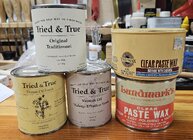
For full disclosure, linseed oil products have been my finish of choice for a long time. Specifically Tried and True. 3 versions- Original is an oil and beeswax blend. Danish is straight linseed oil. Varnish is linseed oil with some pine resin to create a very light film surface. If I choose to use a wax, I have two different (pretty much the same stuff) carnuba wax furniture waxes that I apply and buff off while spinning on the lathe. If you like the light scent of turpentine, the Lundmark brand uses it for the solvent. Trewax is very low, mild odor, I can't identify the solvent by nose. The two cans of wax in my pic are 80% full, and each over 20 years old. Both provide very good results, when I want to use wax in my finishing of the finish.

Flexner's book... Flexner's book...

1000016865.jpg
 
Last edited:
I noticed some sanding marks and thinking the grit would be a good way to remove since the wood now has oil and wax on it.

I've never used Yorkshire grit and know nothing it; can't contribute to answering your question.

But if you haven't tried this, a suggestion for future pieces: After sanding I like to apply a small amount of naphtha to the wood with a small piece of paper towel. I keep some in a small plastic squeeze bottle in a shelf over the lathe. Naphtha evaporates quickly and leaves no residue. Some people use mineral spirits for this (takes longer to evaporate) or even denatured alcohol (can raise the grain).

The helpful thing is as naphtha dries, the surface dries first and a remaining sanding scratch will hold the liquid and be more visible for a few seconds. Sometimes I'll apply it several times while rotating and examining the piece under good glancing light. This has saved me time trying to fix things later.

As a bonus, until it evaporates the naphtha better shows what the color, figure, and chatoyance of the wood will look like with a penetrating finish like "danish" oil, instant gratification for my shallow personality.

The lighting is important to me when looking for scratches. I use small diameter light sources that can be easily positioned. I think the worst lighting for critical examination is broad, diffuse lighting such as a high ceiling full of fixtures. I sometimes switch off overhead lights for a bit.

JKJ
 
Back
Top