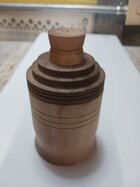
Outside was good; inside walls were a bit rough. Need to work on the interior including the bump at the bottom.
For boxes that have straight walls inside I like to use a box scraper to make them straight after hollowing. Box scrapers often have the long sharp working edge (down the side near the end) ground at a small angle to the axis of the tool and handle which seems easier to handle. Note that the very end is ground at an angle so it's 90-deg to the side cutting edge.

I've ground one to have a negative rake edge for easier smoothing. I burnish burrs on all scrapers and negative rake scrapers. These are usually used held flat on the rest, the working edge just above center.
For boxes with either straight or curved insides I usually clean up the inside walls with a spindle gouge or Hunter tool used as a shear scraper. For getting the bottom flat, a square end can help. A bump at the bottom can often be removed with the end square or very gently curved - scraped by hand with the lathe off.
What kind of wood is the darker lid? Are both the lid and body made with dry end-grain blanks? A few species are just plain difficult to smooth so I avoid them.
Maybe it's just the light but from the photo the flat "steps" on the top look like they might be a bit rough. Were they cut from the side with a parting tool? That can leave rough surfaces. With some practice the long point of the skew can make quite smooth "facing" cuts. In general, for me, a surface with some curve to it seems to be easier to turn cleanly and to sand smooth. But I keep a variety of negative rake scrapers to smooth flat surfaces on both end grain and face grain.
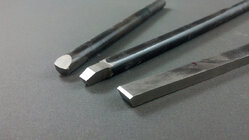
A couple of these are helpful when smoothing small flat areas. I ground one from a spare Thompson 3/8" detail gouge. I almost always grind a different profile on the other end - use these without handles. I almost always stick with Thompson steel.
JKJ