• The forum upgrades have been completed. These were moderate security fixes from our software vendor and it looks like everything is working well. If you see any problems please post in the Forum Technical Support forum or email us at forum_moderator (at) aawforum.org. Thank you
  • February 2026 Turning Challenge: Cookie Jar! (click here for details)
  • Congratulations to Matt Carvalho for "Red Mallee Folded Form" being selected as Turning of the Week for February 9, 2026 (click here for details)
  • AAW Symposium demonstrators announced - If the 2026 AAW International Woodturning Symposium is not on your calendar, now is the time to register. And there are discounts available if you sign up early, by Feb. 28. Early Bird pricing gives you the best rate for our 40th Anniversary Symposium in Raleigh, North Carolina, June 4–7, 2026. (There are discounts for AAW chapter members too) For more information vist the discussion thread here or the AAW registration page
  • Welcome new registering member. Your username must be your real First and Last name (for example: John Doe). "Screen names" and "handles" are not allowed and your registration will be deleted if you don't use your real name. Also, do not use all caps nor all lower case.

Flexible epoxy

Joined
Feb 6, 2010
Messages
3,492
Likes
2,582
Location
Brandon, MS
Website
threeringswoodshop.square.site
Filling some holes in offering plates I am working on . I find System Three T-88 and West Systems G/Flex. Are there any dynamics that would make one better than the other? So far the largest hole in pecan is about 3/4 inch.

 
Wood movement is still a problem with epoxy, but it depends on how you use it. To fill holes or even fairly large gaps, not a problem. Putting a rim on a 12" platter and it will have a problem eventually. When filling voids of say 1 or 2 inches there simply isn't enough wood movement in most woods to cause a problem. When you start getting up to the 10" and bigger range then you get into 1/8" seasonally on some woods but that of course depends on where it's stored and how much humidity changes in the area stored over the year. When I do decorative rings out of epoxy or Inlace I try to undercut the slot so the epoxy is kind of captured. In my tests what usually happens is one side comes loose and then over several years that loose area gets larger and larger. I had a 12" platter that I left an epoxy ring on the outer boarder. I cut a rabbit and then cut a slot in the inner side of the rabbit. Filled with epoxy and then turned away all the wood to leave the epoxy proud on both sides. It still filled the horizontal slot so I had a mechanical groove for the epoxy to bind to as well as the outer surface. It took about 3 years for it to show a gap. The gap would git bigger every year working it's way around until I could pull the ring completely off.
 
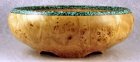
I've used polyester resin instead of epoxy with pretty good results. This 12" bowl has a crushed stone filled poly resin ring, and it looks the same today as it did when this picture was made, over 10 years ago. On the other hand, I'm living in a dry high altitude area with average humidity in my home running 20-25%.Vess_28b.jpg
 
Back
Top