• December 2025 Turning Challenge: Single Tree! (click here for details)
  • Congratulations to Bob Henrickson, People's Choice in the November 2025 Turning Challenge (click here for details)
  • Congratulations to Guillaume Fontaine for "Old Tea Pot" being selected as Turning of the Week for December 15, 2025 (click here for details)
  • Welcome new registering member. Your username must be your real First and Last name (for example: John Doe). "Screen names" and "handles" are not allowed and your registration will be deleted if you don't use your real name. Also, do not use all caps nor all lower case.

Gouge from a bolt

Same here. I have 5 new turning tools in need of wood handles. Started last night. One is complete, one in process, and three other handle blanks are waiting for their turn (get it?!) on the lathe.

A roughing gouge from a bolt. Huh. it would need a big bolt. Grade 2-8 bolts are generally plain carbon steel, grade 8 being stronger for shear forces. I bet it would develop a nice sharp edge, but not long-lived used for turning. For manual carving purposes, it may make a decent cutter.

Happy Holidays!

 
I remember some one, Del Stubbs maybe, who made his first gouge out of galvanized pipe. Just about any metal can hold an edge, but how long depends on the metal. I have heard of many making scrapers and skews from planer blades. The nice thing about high speed steel is that you can't get it hot enough to lose the temper, even on high speed grinders. Other metals, well, kind of iffy....

robo hippy
 
Same here. I have 5 new turning tools in need of wood handles. Started last night. One is complete, one in process, and three other handle blanks are waiting for their turn (get it?!) on the lathe.

A roughing gouge from a bolt. Huh. it would need a big bolt. Grade 2-8 bolts are generally plain carbon steel, grade 8 being stronger for shear forces. I bet it would develop a nice sharp edge, but not long-lived used for turning. For manual carving purposes, it may make a decent cutter.

Happy Holidays!
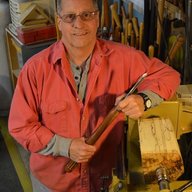
He made it out of a 6" bolt. I don't know what hardness but he heat-treated it. It was a roughing gouge and the handle was about a foot long.
 
This is a roughing gouge I made in a blacksmithing class a few years ago. It was forged from a piece of automobile coil spring which is a high carbon steel. It was flattened on a power hammer, then using a fuller, forged the tang. To make the flute we placed it in a half round groove on a swage block with a steel bar on the top side to forge the shape. It was heat treated in a toaster oven.
 

Attachments

  • 20251225_121849.jpg
    20251225_121849.jpg
    490 KB · Views: 23
I had a carbon steel roughing gouge i bought at the flea mkt. It didnt hold an edge worth s darn. I heat treated it just to see if it wasn't hardened properly. Still didnt hold an edge. I use an m2 steel roughing gouge that I've had for 20 years. Holds a decent edge. I just ground it to 30 degrees per the discussion with Mike Darlow. I think it does hold an edge longer but that's a difficult thing to quantify. Ive had it sharpened at 49 degrees fir many years.
 
Easy to do, but wont hold an edge for long. Bolts are from high tensile steel and will take some heat treatment to improve hardness but the edge wont hold. But if you are stuck and the wood is soft it will get you out of trouble
 
Last edited:
I remember some one, Del Stubbs maybe, who made his first gouge out of galvanized pipe.
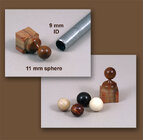
I once discovered I could turn spheres with a length of steel pipe. Small pipe was great for tiny, perfect spheres. A sharpened edge was uncontrollable - what worked best was a ground beveled edge with a narrow flat on the end (straight across, made with a diamond hone) which worked more like a scraper. This actually worked extremely well!

Method: Turn an "approximate" sphere or even start with a cylinder. Cut a bit of clearance on the headstock side. Using the tool rest, of course, hold the pipe against the side and simply swing left and right. Could make different diameter spheres with the same piece of pipe.

Pink Flamewood, Ebony, Holly, Cocobolo, and Maple.
1766715772953.jpeg
The date on this photo is Feb 2008 so it's been a while.

Funny story: when I posted this photo on another forum way back then a kind and thoughtful gentleman made and sent me a tool for these. He had machined interchangeable tips in two sizes, each threaded to fasten to a steel shaft, made a handle and everything. (They were beautiful and well made but too sharp to work as made.) The thing was he thought he was sending them to the "other" John Jordan, the late great JJ! When I told him who I was and would send it on to JJ he said, oops, oh, you just keep it! Still have it. (Can't count the number of times we two Johns confused people by having the same name. How rude of us! That's one reason I always use "JKJ")

I had a carbon steel roughing gouge i bought at the flea mkt. It didnt hold an edge worth s darn. I heat treated it just to see if it wasn't hardened properly. Still didnt hold an edge.
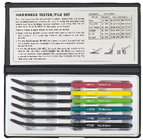
I keep a box of old tools, given to me or bought cheap - I test each one with a triangular file for hardness (if hardened, the file will just skid and not cut). Doesn't tell if it's HSS or hardened tool steel though.

Besides finding that some tools were not hardened at all, I found that some tools were only hardened for an inch or two on the working end. Maybe to save money? Sharpen enough and those tools won't hold an edge! The end could be hardened again if one guessed the steel type correctly for temperature and quenching parameters. Moral of the story - test old and used tools for hardness!

I recently discovered calibrated hardness testing files, got a set to try. Interesting. I've used them to test unknown tools visitors brought for sharpening help.
1766716208251.png

JKJ
 
Back
Top