I'm looking for an inexpensive 8" low-speed bench grinder for touching up lathe tools. I already have a standard speed grinder I'd use for large removal and reshaping tools. The HF Bauer variable speed grinder goes down to 2000 rpm while fixed speed low-speed grinders are spec'd at 1750rpm. I intend to put CBN wheels on it but is 2K slow enough for CBN wheels? Note that I do not do a lot of turning so I won't be putting a lot of hours on a sharpening system so I don't want to spend big $$ for a high-end grinder. TIA!

-
April 2026 Turning Challenge: Salad Bowl! (click here for details) -
Congratulations to David Bartell, People's Choice in the March 2026 Turning Challenge (click here for details) -
Congratulations to Ted Pelfrey for "Cherry Blossoms on Cherry" being selected as Turning of the Week for April 27, 2026 (click here for details) -
Welcome new registering member. Your username must be your real First and Last name (for example: John Doe). "Screen names" and "handles" are not allowed and your registration will be deleted if you don't use your real name. Also, do not use all caps nor all lower case.
You are using an out of date browser. It may not display this or other websites correctly.
You should upgrade or use an alternative browser.
You should upgrade or use an alternative browser.
Grinder suggestions for novice/occasional turner
- Thread starter Dan Moran
- Start date

Mark Hepburn
Artist & Chef
Dan, I bought the Rikon 80-805 nearly ten years ago and It's still going strong. 1750RPM. I have CBN wheels on mine. Here's a link to the item:
That Rikon Mark linked would be a good choice. Not quite as cheap as the Bauer, but a very good value (IMHO).
2000 RPM is close enough. There is nothing magic about 1750 RPM. High speed bench grinders were avoided to minimize potential heat build up in the tool. That was extremely important with old, plain carbon steel tools that will lose their tempered hardness at relatively low temperatures. HSS tool steels in use today have to get red hot before the hardness properties are affected. Turning modern tool steels blue by being over aggressive on the wheel does nothing to the hardness. Doing that to very old tools is a problem. All that said, the Rikon looks like a decent price point grinder. It looks like it probably comes from the same factory as the HF grinders..

I have used the HF grinders, but not for turning. They are well balanced and have good power. I think it will serve you well.
I'm looking for an inexpensive 8" low-speed bench grinder for touching up lathe tools. I already have a standard speed grinder I'd use for large removal and reshaping tools. The HF Bauer variable speed grinder goes down to 2000 rpm while fixed speed low-speed grinders are spec'd at 1750rpm. I intend to put CBN wheels on it but is 2K slow enough for CBN wheels? Note that I do not do a lot of turning so I won't be putting a lot of hours on a sharpening system so I don't want to spend big $$ for a high-end grinder. TIA!
Hello Dan.
Like many things in woodturning, a lot may depend on what you want to or end up turning. Hard, dry wood? Bowls from green wood? Many people are happy sharpening on coarser wheels than I prefer but I think we mostly turn different things. I often turn smaller, detailed things from dry wood, fine-grained, often quite hard species.
My preference is the 1750rpm is for CBN. Most turners I know use them. In fact, I would often like a slower speed. I use one wheel on a very low speed Tormek - my favorite for some tools.
That said, as Dwayne mentioned, 2000 rpm should be fine. A higher speed might be a problem with increased heat for hardened non-HSS tools, but it's almost impossible to overheat a HSS tool
BTW, after using various grits of CBN I settled on 60 and 600 for my lathe tool bench grinder - I use the 60 when shaping custom tools and the 600 to sharpen skews, parting tool, bowl gouges, etc., and the custom tools. I put a finer grit CBN wheel on the Tormek for my spindle gouges.
If shopping for CBN wheels at some point, there are various widths and styles. I prefer the wider wheels (1.5"), square edges instead of radiused, and with 1" of grit down the flat sides of the wheel. This lets me grind and sharpen various custom tools. I think the radiused edged CBN wheels have only limited use to most turners, plus they take away from the useful width of the wheel. (The extra width is especially nice when grinding skews.) Be aware of the arbor size when buying CBN - all my 8" grinders use 5/8" diameter. And while the wheel guards are important for standard grinding wheels you can (or may even have to) take them off for CBN.
Also, it's advisable to get a set of spherical washers for each wheel - they can compensate for irregularities in the mounting which can keep the wheels from running true.
Many people, including me, use the Oneway Wolverine jig for lathe tools, combined with the Oneway Varigrind for gouges. I like the Wolverine Mini platform instead of the standard large for most tools.
I like to mount the grinder and the Wolverine bases to a square of 3/4" plywood so the grinder and platform can be moved on my sharpening bench if needed. I've also carried them to events to show sharpening techniques.
I did use conventional grinding wheels for a long time - used fairly fine grit compared to most, the blue Norton 3X. I did find the Oneway grinding wheel balancers mounted on the wheels helped me get a better edge on the tools. But going to CBN was a big improvement.
A 1/2 hp grinder is enough for aluminum CBN wheels. Some of the heavier steel CBN wheels were a bit slow to start with 1/2hp but I don't think that will hurt the grinder motor.
JKJ

I have the HF low speed grinder with CBN wheels. It works great. I've had it for several years.

I have a Bucktool grinder. It's a good grinder, but if I had to do it over again I would get the Rikon.
I had one of the no name grinders from Woodcraft years ago as my first grinder. It was okay, but not good. I bought a Baldor, but they are over $1000 now. When Rikon replaced the no name grinder at Woodcraft, I looked at them and remembering how long it took the WC grinder to come up to speed with the standard matrix wheels, I opted for the 1 hp model. They do spin for a long time after you turn them off. Many do use the 1/2 hp Rikon grinder, but I just wanted some thing more heavy duty. The Baldor are the best, if you can afford them.
As for speeds, with the high speed steel we use, we can't get the tools hot enough for them to lose their temper like you can with high carbon tools, which are mostly hand plane irons and bench chisels. The CBN wheels are spin and bubble balanced, so it doesn't really make any difference what speed they are running, they will spin true with no wobble, unless there is some thing wrong with your grinder.
robo hippy
As for speeds, with the high speed steel we use, we can't get the tools hot enough for them to lose their temper like you can with high carbon tools, which are mostly hand plane irons and bench chisels. The CBN wheels are spin and bubble balanced, so it doesn't really make any difference what speed they are running, they will spin true with no wobble, unless there is some thing wrong with your grinder.
robo hippy

Have a Bucktool ... would buy another and/or would look at a Rikon as well ...

Have a BuckTool 8" Low Speed 3/4 hp with 2 Wood Turners Wonders CBN wheels (180-and 350 grit)
Spins up to speed in a couple seconds
CBNs run true with spherical washers
Nice LED gooseneck light
Quiet
Plenty of power - 3/4 HP
Three yrs running ... no issues
Affordable ~ $189 ... here's a link
Slow to stop spinning - Yes .. as most are
Do I wish I bought their variable speed version - No
Do I need a Baldor - No
Do I wish I had a Baldor - No ... would rather spend the extra cash elsewhere
Just my $0.02
Spins up to speed in a couple seconds
CBNs run true with spherical washers
Nice LED gooseneck light
Quiet
Plenty of power - 3/4 HP
Three yrs running ... no issues
Affordable ~ $189 ... here's a link
Slow to stop spinning - Yes .. as most are
Do I wish I bought their variable speed version - No
Do I need a Baldor - No
Do I wish I had a Baldor - No ... would rather spend the extra cash elsewhere
Just my $0.02


I’ve had one of these for ~10 yrs, did replace the start cap once, no other issues. I tend to think a single speed 1750 is a bit more reliable vs a var speed (something in the adj circuit will fail).
I run Al ox wheels, but cbn will wirk on this one same as grinders with the same power rating. A bigger motor gets one thing and one thing only - faster spin-up. Up to you whether it matters. I’ve used grinders with cbn of the same power and it wasn’t a problem. Recommend the spherical washers for mounting the wheels.
I run Al ox wheels, but cbn will wirk on this one same as grinders with the same power rating. A bigger motor gets one thing and one thing only - faster spin-up. Up to you whether it matters. I’ve used grinders with cbn of the same power and it wasn’t a problem. Recommend the spherical washers for mounting the wheels.
Mark Hepburn
Artist & Chef
I’ve had one of these for ~10 yrs, did replace the start cap once, no other issues. I tend to think a single speed 1750 is a bit more reliable vs a var speed (something in the adj circuit will fail).
I run Al ox wheels, but cbn will wirk on this one same as grinders with the same power rating. A bigger motor gets one thing and one thing only - faster spin-up. Up to you whether it matters. I’ve used grinders with cbn of the same power and it wasn’t a problem. Recommend the spherical washers for mounting the wheels.
Haven't owned the WEN grinder but have had a couple of other tools by them (benchtop drill press, spindle sander) and no issues. They make a pretty good product IMHO.
I just set up this same grinder along with the Peachtree sharpening setup from Amazon. Everything seems to be good quality and went together easy enough. Unfortunately I’m just getting started myself so can’t vouch for long term performance. Or short term for that matter.I’ve had one of these for ~10 yrs, did replace the start cap once, no other issues. I tend to think a single speed 1750 is a bit more reliable vs a var speed (something in the adj circuit will fail).
I run Al ox wheels, but cbn will wirk on this one same as grinders with the same power rating. A bigger motor gets one thing and one thing only - faster spin-up. Up to you whether it matters. I’ve used grinders with cbn of the same power and it wasn’t a problem. Recommend the spherical washers for mounting the wheels.

I agree. I started on the Wen 14" lathe. It's the same lathe HF sells as a Bauer. It's a good starter lathe for $600. I have their dust collector, benchtop drill press, benchtop sander, and some small power tools. The switch failed on the dust collector and they had me a new one in a couple of days.Haven't owned the WEN grinder but have had a couple of other tools by them (benchtop drill press, spindle sander) and no issues. They make a pretty good product IMHO.
Another vote for the woodcraft no-name low speed grinder. I used Norton 3X wheels at first, as the supplied white aluminum oxide wheels were very soft. I got a lot of vibration even when the wheels were new, so I bought the Oneway wheel balancers, which worked great. I used a diamond dressing stone on them for years, and a vari-grind jig for my gouges. After using both blue wheels down to less than 6" diameter (they started at 8"), I stepped up to CBN wheels, a 180 and a 120 grit. I now own a Oneway wolverine, but I used a homemade version for years with wooden slides. I'd love to buy a Baldor or similar heavy duty grinder, as with 2 CBN wheels the woodcraft 1/2HP one is just not powerful enough. It takes several seconds to come up to speed, and is easily bogged down when reshaping tools. I hone both my gouges and scrapers (and the skew of course).
Another vote for the woodcraft no-name low speed grinder. I used Norton 3X wheels at first...
...with 2 CBN wheels the woodcraft 1/2HP one is just not powerful enough. It takes several seconds to come up to speed, and is easily bogged down when reshaping tools. I hone both my gouges and scrapers (and the skew of course).
I use a No-Name Woodcraft grinder, I think for over 20 years now, also started with the Oneway balancers on the blue Norton wheels. I now have aluminum CBN wheels on both sides.
But two things: mine comes up to speed very quickly, and I've never had it bog down. It does take a couple of minutes to coast to stop when turned off (if I don't use my custom unpatented stopping stick invention.
 )
)Maybe mine is a different version.
EDIT: I just checked. My grinder is 3/4hp. S/N 0310.
Last edited:
Mine is 1/2hp; I know it's at least 15 years old. It works fine for sharpening, but I can get a little impatient reshaping tools. I just bought a couple new scrapers and gouges to replace ones that were too short to sharpen anymore. I have a oneway mini-rest on the way from craft supplies that hopefully will allow me to get at least another 3/4-1" out of them. I have an 8" piece of 5/8" 10V that needs to be turned into a point tool. My grinder also takes a few minutes to stop spinning after turning it off.I use a No-Name Woodcraft grinder, I think for over 20 years now, also started with the Oneway balancers on the blue Norton wheels. I now have aluminum CBN wheels on both sides.
But two things: mine comes up to speed very quickly, and I've never had it bog down. It does take a couple of minutes to coast to stop when turned off (if I don't use my custom unpatented stopping stick invention.
Maybe mine is a different version.
EDIT: I just checked. My grinder is 3/4hp. S/N 0310.
Mine is 1/2hp; I know it's at least 15 years old. It works fine for sharpening, but I can get a little impatient reshaping tools. I just bought a couple new scrapers and gouges to replace ones that were too short to sharpen anymore. I have a oneway mini-rest on the way from craft supplies that hopefully will allow me to get at least another 3/4-1" out of them. I have an 8" piece of 5/8" 10V that needs to be turned into a point tool. My grinder also takes a few minutes to stop spinning after turning it off.
If a tool is too short for the grinder platform but still has enough steel to be useful you can place or tape a piece of plywood or something on the platform, thick enough so the handle/ferrule will clear the rest and a bit narrower than the depth of the platform.
I make several types of point tools including a spear point. Some are for specific uses, for example one to cut the exact groove profile to make string-driven spindles for spinning wheels.
Lots of people use round rod and grind three facets to meet at a point, good for several things. However, sometimes I just want to use the point to make a little groove. About 10 years ago I started making point tools this way (sorry if you've already seen it):
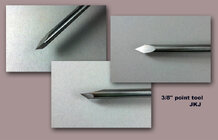
I call this my Wicked Point Tool.
I make them from both 3/8" and 1/4" round rod (from Doug Thompson).
Compared to the 3-facet point tool, this can be ground to cut a narrower and cleaner v-groove.
These don't get heavy use so I've never had to resharpen one. (For most v-grooves I just use the long point of a skew.)
JKJ
Last edited:
After a lot of research I also got the Rikon 80-805. I’m still setting it up, but the specs and reviews convince me that I won’t be disappointed. It was disappointing that Rikon doesn’t offer it with CBN wheels, but the stock ones are certainly easier on a newbie budget.Dan, I bought the Rikon 80-805 nearly ten years ago and It's still going strong. 1750RPM. I have CBN wheels on mine. Here's a link to the item:

Good for you. If you keep them dressed and account for them slowly getting smaller, those wheels will serve you very well for quite a while. Just about everybody here started with similar friable wheels.After a lot of research I also got the Rikon 80-805. I’m still setting it up, but the specs and reviews convince me that I won’t be disappointed. It was disappointing that Rikon doesn’t offer it with CBN wheels, but the stock ones are certainly easier on a newbie budget.

I bought the Rikon low speed grinder at Woodcraft. I was in Harbor Freight recently and noticed a variable speed grinder with light. Didn't bother to check the website for reviews.
I have had the WEN slow speed grinder for almost a year now. Swapped the stones for CBN wheels, and it has not given me one hiccup so far. I realize it may not last 20yrs, but got me up and started and has ran strong and continues to do soI'm looking for an inexpensive 8" low-speed bench grinder for touching up lathe tools. I already have a standard speed grinder I'd use for large removal and reshaping tools. The HF Bauer variable speed grinder goes down to 2000 rpm while fixed speed low-speed grinders are spec'd at 1750rpm. I intend to put CBN wheels on it but is 2K slow enough for CBN wheels? Note that I do not do a lot of turning so I won't be putting a lot of hours on a sharpening system so I don't want to spend big $$ for a high-end grinder. TIA!
My Ricon 1hp is my main but I have 2 lathes in different rooms in my studio. Had a home depot gift card so I bought a 1/2 hp Wen
https://wenproducts.com/products/we...nOJKbN02Qr4myCDeNWO-ioONXxGGeAtY_7OMPeUTbtxiM
I don't use it all the time but it gets the job done when I use the smaller lathe. Think it was just over $100.
https://wenproducts.com/products/we...nOJKbN02Qr4myCDeNWO-ioONXxGGeAtY_7OMPeUTbtxiM
I don't use it all the time but it gets the job done when I use the smaller lathe. Think it was just over $100.
Yea man. I fully intend to upgrade, and will, but to jump in and get started I have no problem recommending it to people. Especially if you’re on a budget. It’s been good to me so far………so far lolMy Ricon 1hp is my main but I have 2 lathes in different rooms in my studio. Had a home depot gift card so I bought a 1/2 hp Wen
https://wenproducts.com/products/we...nOJKbN02Qr4myCDeNWO-ioONXxGGeAtY_7OMPeUTbtxiM
I don't use it all the time but it gets the job done when I use the smaller lathe. Think it was just over $100.