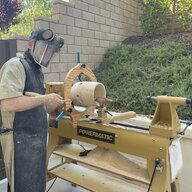
I heard about basket illusion turning for the first time last summer, and I was blown away. I wanted to try it, but I didn’t want to spend $200+ on an indexing system. So my engineer brain got busy on an alternative.
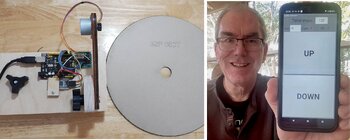
In my electronic junk box I had an arduino (tiny hobbyist microcontroller) and a stepper motor. I figured I could make those turn the lathe in small increments. On my laser, I cut a big gear that meshed with the little gear on the motor. The middle of the big gear has a 1” hole that fits my lathe spindle. I put the arduino, a bluetooth interface and a stepper driver on a board that clamps onto my lathe bed. The motor is on a swing arm that lets me mesh the gears nicely, and can accommodate different lathe swings.
I wrote a companion app on my Android phone that talks to the arduino over bluetooth. The app lets you set the total number of steps, and has big geezer-friendly buttons to step up and down. It also displays the current step and angle, and lets me go directly to any step.
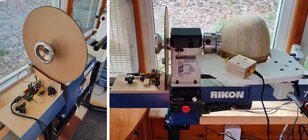
In the picture below, the controller board is clamped to a bed extension on the outboard side of my headstock. The big gear is held to the spindle by the headstock hand wheel, and the motor swing arm is adjusted to mesh the gears. On the inboard side a segmented urn, with the bead rings already turned, is mounted in a bowl chuck. I made a pvc platform held by the banjo that conforms to the shape of the urn. A pyrography tool clamped in a wood block slides on the platform. The height of the platform adjusts in the banjo to put the tip of the pyrography tool exactly on the lathe axis. You can see I’ve already burned some of the axial lines. When I got all the way around, the pyrography tip lined up exactly with the first line. The indexer worked great, and having the number of steps programmable means no extra wheels are needed for different projects. It cost me nothing since I had all the parts, but buying them on Amazon would only cost around $25 (except of course for the big gear, which I had to cut on a laser).
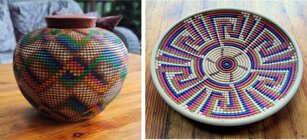
Here’s the finished urn and a platter. They’re pretty, but SO. MUCH. WORK. I had to enlist my daughters to help with the coloring (India ink pens).
I brought both of these to a Christmas craft fair. I didn’t really want to sell them, I just wanted to show them off. So I priced them higher than I thought anyone would want to pay. They sold anyway. Oh well, now I have the setup so I can make more
In my electronic junk box I had an arduino (tiny hobbyist microcontroller) and a stepper motor. I figured I could make those turn the lathe in small increments. On my laser, I cut a big gear that meshed with the little gear on the motor. The middle of the big gear has a 1” hole that fits my lathe spindle. I put the arduino, a bluetooth interface and a stepper driver on a board that clamps onto my lathe bed. The motor is on a swing arm that lets me mesh the gears nicely, and can accommodate different lathe swings.
I wrote a companion app on my Android phone that talks to the arduino over bluetooth. The app lets you set the total number of steps, and has big geezer-friendly buttons to step up and down. It also displays the current step and angle, and lets me go directly to any step.
In the picture below, the controller board is clamped to a bed extension on the outboard side of my headstock. The big gear is held to the spindle by the headstock hand wheel, and the motor swing arm is adjusted to mesh the gears. On the inboard side a segmented urn, with the bead rings already turned, is mounted in a bowl chuck. I made a pvc platform held by the banjo that conforms to the shape of the urn. A pyrography tool clamped in a wood block slides on the platform. The height of the platform adjusts in the banjo to put the tip of the pyrography tool exactly on the lathe axis. You can see I’ve already burned some of the axial lines. When I got all the way around, the pyrography tip lined up exactly with the first line. The indexer worked great, and having the number of steps programmable means no extra wheels are needed for different projects. It cost me nothing since I had all the parts, but buying them on Amazon would only cost around $25 (except of course for the big gear, which I had to cut on a laser).
Here’s the finished urn and a platter. They’re pretty, but SO. MUCH. WORK. I had to enlist my daughters to help with the coloring (India ink pens).
I brought both of these to a Christmas craft fair. I didn’t really want to sell them, I just wanted to show them off. So I priced them higher than I thought anyone would want to pay. They sold anyway. Oh well, now I have the setup so I can make more