Follow along with the video below to see how to install our site as a web app on your home screen.
Note: This feature may not be available in some browsers.
The forum upgrades have been completed. These were moderate security fixes from our software vendor and it looks like everything is working well. If you see any problems please post in the Forum Technical Support forum or email us at forum_moderator (at) aawforum.org. Thank you
Congratulations to Chris Lawrence for "Dragon's Grip" being selected as Turning of the Week for March 30, 2026
(click here for details)
Welcome new registering member. Your username must be your real First and Last name (for example: John Doe). "Screen names" and "handles" are not allowed and your registration will be deleted if you don't use your real name. Also, do not use all caps nor all lower case.
The recent AAW journal had a picture of a Christams ornament with a lower stem that is turned yet curved in several directions. Does anyone know this technique?
The recent AAW journal had a picture of a Christams ornament with a lower stem that is turned yet curved in several directions. Does anyone know this technique?
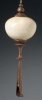
What you refer to as the lower stem is commonly called an "icicle" on a turned ornament. The icicle on the ornament you're asking about was hand carved after it was turned. That is to say it wasn't turned into the corkscrew shape but rather carved that way from a thicker turning.
The "icicle" design, which involves a wood carving process, is actually not as complicated as it might appear. A good woodcarving knife, a few small files and perhaps a mini-rasp is really all you need to make it happen. You could probably do the work without the knife, but I think starting with the knife and finishing with the file(s) reduces the time necessary to complete the task. It's a great project for a rainy day.
David This is a little more complicated icicle because I hollowed the end but it is done the same way. I turned the bottom part into a sort of trumpet bell shape. I used several different drill bits to roughly hollow the bell and then used a 1/4" gouge to finish hollowing. When I was done I took it offf the lathe and carved away what I didn't want.
This site uses cookies to help personalise content, tailor your experience and to keep you logged in if you register.
By continuing to use this site, you are consenting to our use of cookies.