
The same principle can work with a skew, a long bevel angle can lift grain but the steeper angle can deal better as it doesn’t lift the fibres so much.
It’s an interesting subject
Thanks. My experience is similar.
I tend to grind most of my skews with longish bevel, about 20-21° on each face for about 40° included angle, some a bit more, some a bit less. (I sharpen most tools including skews with a 600 grit CBN wheel.)
I do have one skew I ground with about 30° on each face for about a 60° included angle. I find that one is far easier for a beginner to control and thus advance quicker so that's one one I hand them. It has a "Raffan" curve on the edge. (I learned most of my turning from Raffan and Darlow's books along with books by Kieth Rowley and others.)
I tried that skew on the second piece of the problem wood I described earlier and it does work better.
Another wood species has given me a different sort of interesting "problem." When turning thin spindles 1/2" and smaller from Osage Orange, SOME but not all specimens have given me long splinter chipout when using a skew with a smaller included angle, not the short, wide thin flakes I got with the so-called Bloodwood. The Osage fibers were sometimes 1/2" long and very thin, like needles. Switching to a different skew or tool fixed things. Which has been the case for most turning problems!
I might try an even larger angle such as the 35° on the plane you mentioned just to see how it behaves.
Good clean fun!
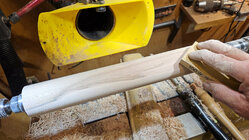
I just now finished another skew project - a 2-1/8" diameter cylinder made of Dogwood from our farm. It's a rolling pin, the style with no handles preferred by our family, requested by a son. For those who haven't tried, I find a "perfect" cylinder is a bit more challenging to make than something with free-hand curves. Sanding sticks and hand scrapers to the rescue. Turned mostly with 1-3/8" curved edge and 1-1/4" straight edge Thompson skews with 20° bevels on each face. Hard, heavy, and strong wood - zero tearout. Just trim the ends, oil, and wrap for Christmas.
JKJ